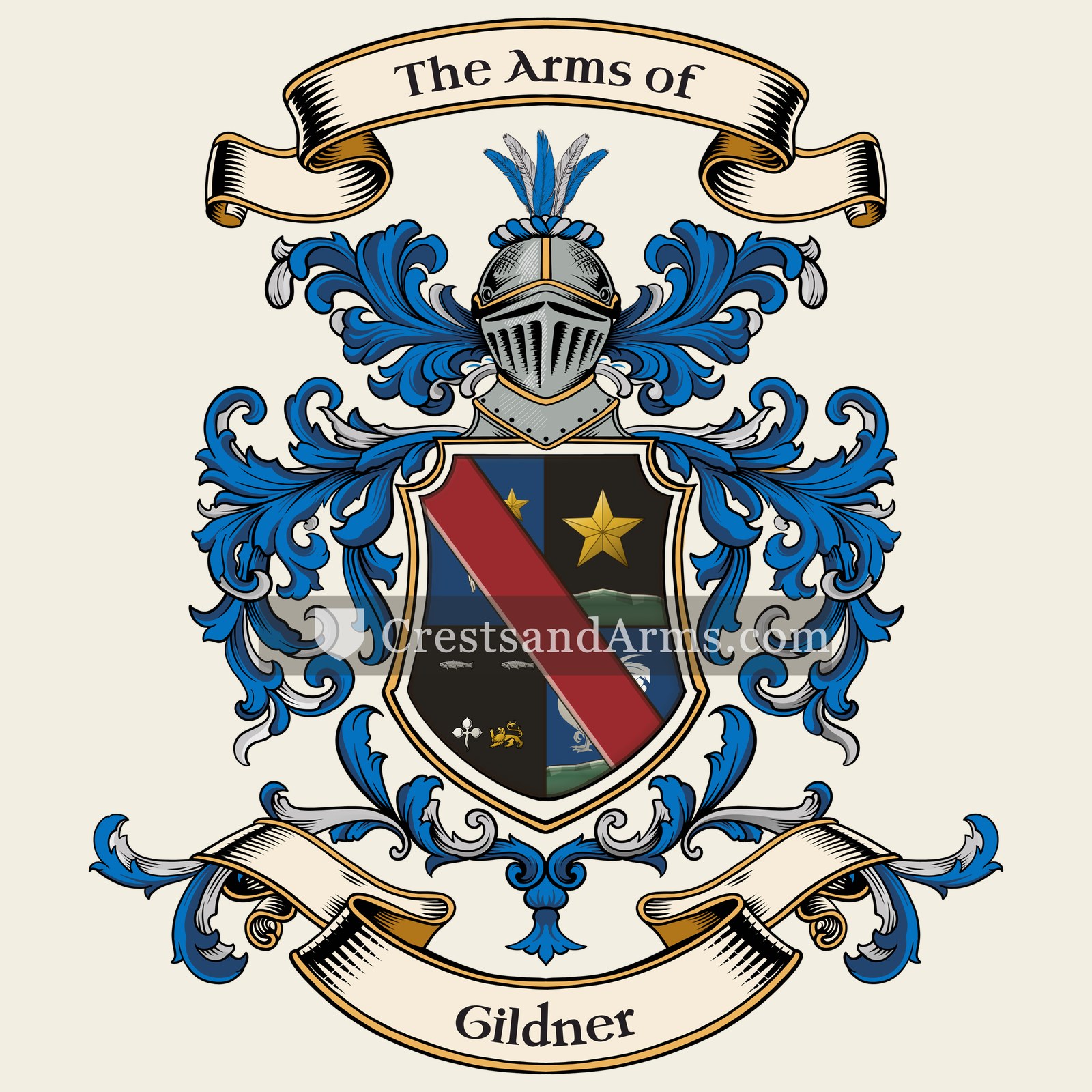
A record of documented arms, meaning and origin, researched for the Gildner family of Germany.
Reg. 5284 · German, G–I
Coat of Arms & Family Crest Details
Symbols on this shield
cross symbolChristian faith and service
mountThe ground held, and steadfastness upon it
bendDefence, and the scarf of a commander
cherubDivine protection over the innocent
mulletThe third son, and a divine quality from above
fishA true and generous mind, and Christian faith
trefoilPerpetuity, and the Trinity
lionCourage, strength and royalty
cockCourage, vigilance and readiness for battle
Colours
Blue (Azure)Means: Loyalty and truth
Black (Sable)Means: Constancy
Red (Gules)Means: Military strength
Green (Vert)Means: Hope
Gold (Or)Means: Generosity
Silver (Argent)Means: Peace and sincerity
Historical info
Source
J. B. Rietstap, Armorial Général, Gouda: G. B. van Goor Zonen, 1884–87
Blazon (the actual original written record)
“Ec.: au 1 d'azur à un chérubin au nat., surm. d'une croisette d'or entre deux étoiles du même; au 2 de sa. à un tertre de trois coupeaux de sin., mouv. de la p. et surm. d'une étoile d'or; au 3 parti: a. de gu. à deux bars adossés d'arg., acc. en chef d'un trèfle du même; b. d'azur au lion d'or; au 4 d'or à un coq au nat., posé sur un tertre de sin. Sur le tout d'arg. à la bande de gu. Cq. cour. C.: un lion d'or, assis de front; entre deux prob., de gu. et d'arg. L.: à dextre d'or et d'azur, à sen. d'arg. et de gu.”
HesseHesse, c. 1765
Digital archive packCoat of arms PNG, gold border print PDF, vector SVG and the certificate of authenticity. Sent to your email in minutes.
Map of Germany showing where the Gildner arms are recorded
The Gildner arms were recorded in Hesse, c. 1765.
Hesse was central German country, divided among a large number of small landowners and prosperous towns. So many separate households held ground there that the region produced an unusual number of coats of arms.
This is where the arms were entered in the register. Families often moved to other parts of the country, so the same name can turn up in more than one region.
The body that granted and recorded arms in Germany in this period.
Francis I, Holy Roman Emperor
Sovereign of the period
Francis I, Holy Roman Emperor
1745–1765
Reigning in Germany when the Gildner arms are first recorded.
How Arms Worked in Germany
In the Holy Roman Empire, coats of arms were often granted to individuals by the Emperor or his representatives. These arms were then passed down through the generations to all legitimate descendants of the original holder. Younger branches of a family usually kept the same shield design without needing to change it, as the arms belonged to the entire lineage.
Granting authority
The Holy Roman Emperor held the sole power to grant new coats of arms throughout his vast imperial territories.
How they got arms
Families typically obtained their coats of arms through a formal imperial grant or by proving their noble status to the authorities.
Where arms were recorded
These grants were officially recorded in the Imperial Chancery registers, which began keeping formal records of such honors during the Middle Ages.
The family's standing
Recorded among the armigerous families of Hesse.
Origin & History of the Gildner Family in Germany
The family name Gildner is deeply rooted in the historical region of Hesse, Germany, where records confirm the presence of family members by the year 1765. The name is generally categorized as a locational or occupational surname, likely derived from Middle High German terms related to gold or the payment of taxes. During the eighteenth century, families in this part of Germany were often tied to the land through agriculture or specialized trades within small village communities. Life in Hesse at this time was defined by the complex social structures of the Holy Roman Empire, where local identity was closely linked to one's parish and village of origin. As the family grew, members likely moved between neighboring towns to find work, helping to spread the name across the Hessian landscape during a period of significant social and economic transition.
Related Branches & Arms
Root word
Gelt
A Middle High German term referring to money, payment, or tribute.
This name
GildnerAn occupational surname for a tax collector or someone responsible for handling payments.
Documented Sources
J. B. Rietstap, Armorial Général, Gouda: G. B. van Goor Zonen, 1884–87
Hessisches Landesarchiv, Kirchenbücher der evangelischen Kirchengemeinden in Hessen, 1765
Bahlow, Hans, Deutsches Namenlexikon: Familien- und Vornamen nach Ursprung und Sinn erklärt, 1972
Gottschald, Max, Deutsche Namenkunde: Unsere Familiennamen nach ihrer Entstehung und Bedeutung, 1971
Digital archive packCoat of arms PNG, gold border print PDF, vector SVG and the certificate of authenticity. Sent to your email in minutes.


 cross symbolChristian faith and service
 mountThe ground held, and steadfastness upon it
 bendDefence, and the scarf of a commander
 cherubDivine protection over the innocent
 mulletThe third son, and a divine quality from above
 fishA true and generous mind, and Christian faith
 trefoilPerpetuity, and the Trinity
 lionCourage, strength and royalty
 cockCourage, vigilance and readiness for battle
 cross symbolChristian faith and service
 mountThe ground held, and steadfastness upon it
 bendDefence, and the scarf of a commander
 cherubDivine protection over the innocent
 mulletThe third son, and a divine quality from above
 fishA true and generous mind, and Christian faith
 trefoilPerpetuity, and the Trinity
 lionCourage, strength and royalty
 cockCourage, vigilance and readiness for battle