Map of Wales showing where the Giles arms are recorded
The Giles arms were recorded in Glamorgan, c. 1683.
Glamorgan was the richest part of Wales, with good coastal farmland and Norman castles along it. The families who held those castles kept their land for centuries, and long holding brought recorded arms.
This is where the arms were entered in the register. Families often moved to other parts of the country, so the same name can turn up in more than one region.
The body that granted and recorded arms in Wales in this period.
Charles II of England
Sovereign of the period
Charles II of England
1660–1685
Reigning in Wales when the Giles arms are first recorded.
How Arms Worked in Wales
English heraldry allowed arms to be shared by all legitimate descendants of the original owner. These symbols were treated as personal property that moved through the generations to all children. While the eldest son kept the original design, other family members could use the same shield without needing to change it or register their own unique versions.
Granting authority
The College of Arms in London has regulated the use of coats of arms throughout England and Wales since 1484.
How they got arms
Families typically obtained their coats of arms through a formal grant from the Crown or by proving their ancient right to them.
Where arms were recorded
All official coats of arms are recorded in the registers kept at the College of Arms, which date back to the fifteenth century.
The family's standing
Recorded among the armigerous families of Glamorgan.
Origin & History of the Giles Family in Wales
The surname Giles has deep roots in the Welsh landscape, particularly within the historic county of Glamorgan. By the late seventeenth century, families bearing this name were well-established in the region, appearing in local records as early as 1683. The name itself is derived from the Greek word *aigidion*, which means a young goat or a shield made of goatskin. Over many centuries, this name evolved through various languages, eventually becoming a popular given name in medieval Europe before it transitioned into a hereditary surname. In the context of Glamorgan, families named Giles were often part of the rural community, living in parishes where they contributed to the local economy and social structure. These early settlers were likely influenced by the shifting cultural tides of Wales, where they maintained their identity while living alongside families with traditional Welsh patronymic names. By settling in this coastal area, the Giles family became part of the long and complex history of the Welsh people, leaving behind a legacy that can still be traced through parish registers and land documents from the era.
Coat of Arms & Family Crest Details
Symbols on this shield
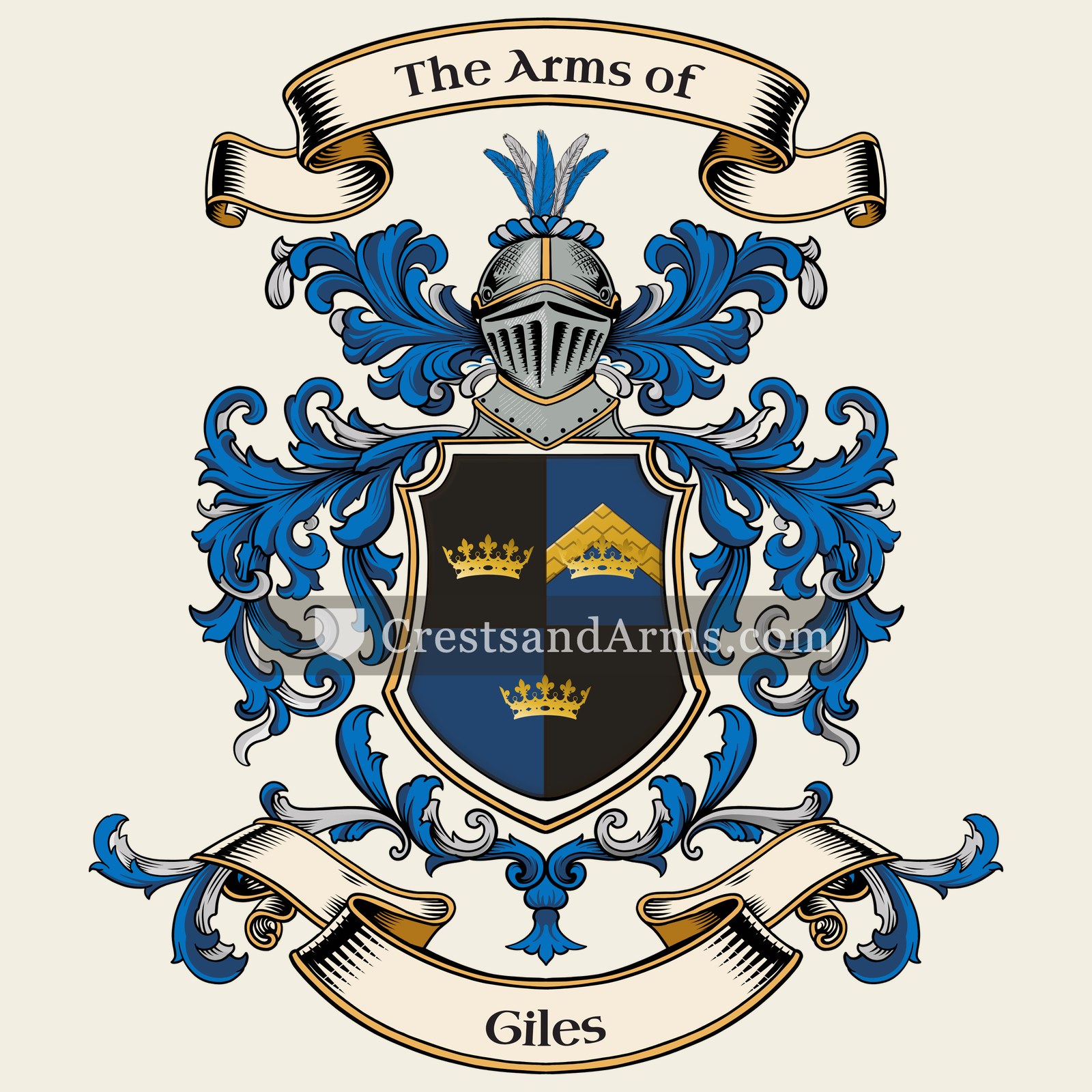
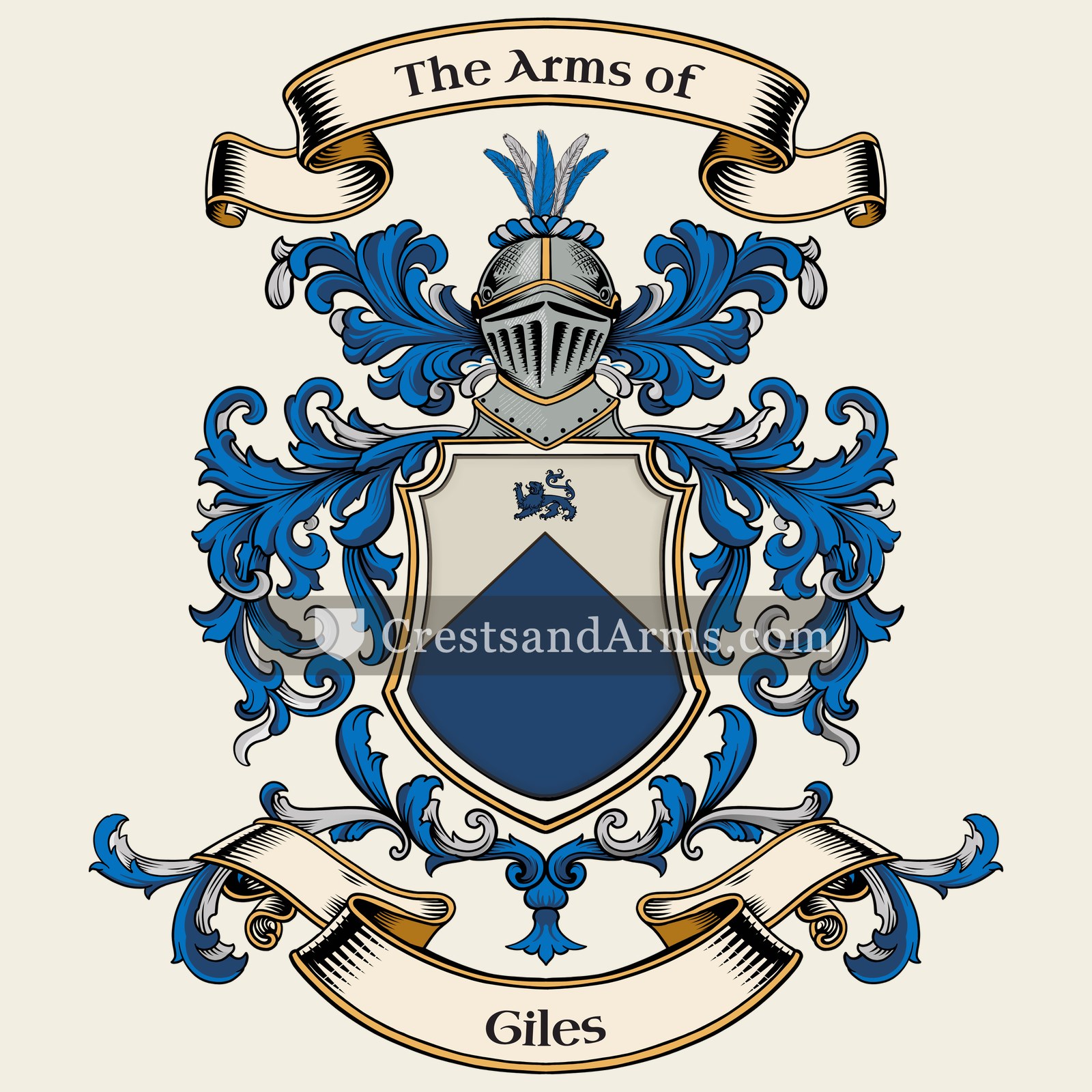
lionCourage, strength and royalty
Colours
Silver (Argent)Means: Peace and sincerity
Blue (Azure)Means: Loyalty and truth
Historical info
Source
Sir Bernard Burke, The General Armory of England, Scotland, Ireland and Wales, London: Harrison & Sons, 1884
Blazon (the actual original written record)
“Per chev. ar. and az. a lion ramp. counterchanged collared or”
DevonBowden · Devon, c. 1620
Digital archive packCoat of arms PNG, gold border print PDF, vector SVG and the certificate of authenticity. Sent to your email in minutes.
Map of England showing where the Giles arms are recorded
The Giles arms were recorded in Devon, c. 1620.
Devon was a county of small manors and seafaring families. Its gentry were spread thickly across the countryside, and money made at sea often bought an estate, which in turn brought a coat of arms.
This is where the arms were entered in the register. Families often moved to other parts of the country, so the same name can turn up in more than one region.
The body that granted and recorded arms in England in this period.
James VI and I
Sovereign of the period
James VI and I
1603–1625
Reigning in Wales when the Giles arms are first recorded.
How Arms Worked in England
English heraldry allowed arms to be shared by all legitimate descendants of the original owner. These symbols were treated as personal property that moved through the generations to all children. While the eldest son kept the original design, other family members could use the same shield without needing to change it or register their own unique versions.
Granting authority
The College of Arms in London has regulated the use of coats of arms throughout England and Wales since 1484.
How they got arms
Families typically obtained their coats of arms through a formal grant from the Crown or by proving their ancient right to them.
Where arms were recorded
All official coats of arms are recorded in the registers kept at the College of Arms, which date back to the fifteenth century.
The family's standing
Recorded among the armigerous families of Devon.
Origin & History of the Giles Family in England
The surname Giles finds its roots in the ancient Greek name Aegidius, which eventually evolved into the French form Gille. Following the Norman Conquest of 1066, this name became popular across England as a given name before transitioning into a hereditary surname. By the time the family was firmly established in Devon during the early seventeenth century, the name had been in use for generations among both rural farmers and local tradespeople. Families bearing this name often lived in the southwestern counties, where they contributed to the growth of local parishes and the development of regional agriculture. The presence of the Giles family in Devon by 1620 reflects a period of stability for many English families who were deeply connected to the land and their local communities during the reign of King James I.
Coat of Arms & Family Crest Details
Symbols on this shield
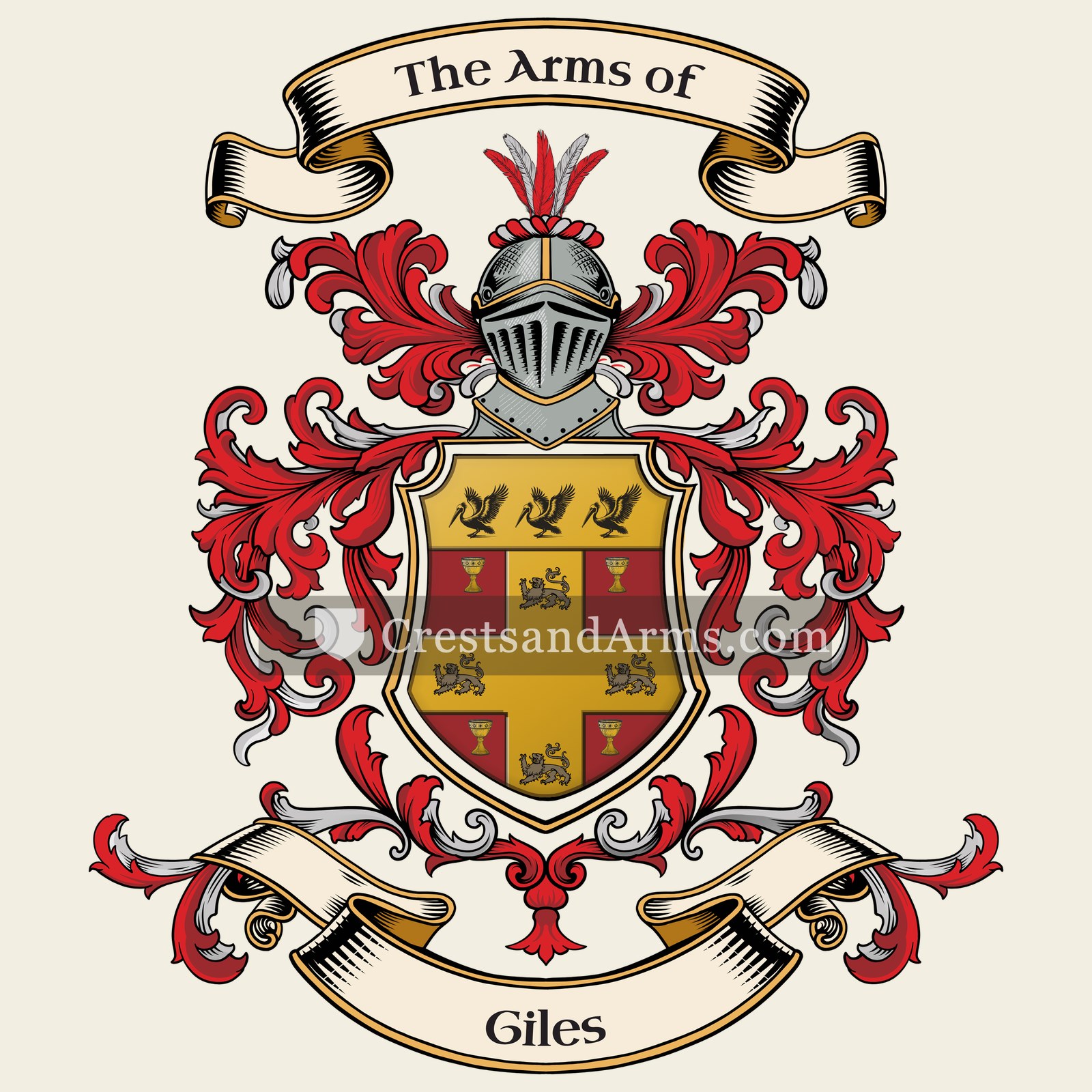
cross symbolChristian faith and service
chiefAuthority, wisdom and dominion
cupFaith, office, and a trust discharged
lionCourage, strength and royalty
pelicanSelf-sacrifice and devotion to one's children
Colours
Red (Gules)Means: Military strength
Gold (Or)Means: Generosity
Black (Sable)Means: Constancy
Historical info
Source
Sir Bernard Burke, The General Armory of England, Scotland, Ireland and Wales, London: Harrison & Sons, 1884
Blazon (the actual original written record)
“Gu. on a cross betw. four chalices or, as many lions' heads full-faced ppr. on a chief of the second three pelicans sa”
PeeblesKailzie · Peebles, c. 1850
Digital archive packCoat of arms PNG, gold border print PDF, vector SVG and the certificate of authenticity. Sent to your email in minutes.
Map of Scotland showing where the Giles arms are recorded
The Giles arms were recorded in Peebles, c. 1850.
Peeblesshire was upland sheep country in the Scottish borders. Wool made steady money, families bought and held small estates, and holding an estate is what brought arms.
This is where the arms were entered in the register. Families often moved to other parts of the country, so the same name can turn up in more than one region.
The body that granted and recorded arms in Scotland in this period.
Victoria
Sovereign of the period
Victoria
1837–1901
Reigning in Wales when the Giles arms are first recorded.
How Arms Worked in Scotland
Scottish heraldry is unique because it treats a coat of arms as a piece of personal property protected by law. Only one person can own a specific design at any given time. When a family grows, the head keeps the original shield while other relatives must apply for their own distinct version with slight changes to prove their specific identity.
Granting authority
The Court of the Lord Lyon acts as the official body that regulates and controls all heraldic matters throughout Scotland.
How they got arms
Individuals obtain a legal right to their arms through a formal petition process that confirms their identity and family connection.
Where arms were recorded
All valid coats of arms are officially entered into the Public Register of All Arms and Bearings starting from 1672.
The family's standing
Recorded among the armigerous families of Peebles.
Origin & History of the Giles Family in Scotland
The surname Giles traces its roots back to the Greek name Aegidius, which eventually evolved into the French form Gille and later became common in Britain. By the time the name became established in the Scottish Borders, it was often associated with families living in the rolling landscapes of Peeblesshire. Records show that by the middle of the nineteenth century, members of the Giles family were well-integrated into the local community of Peebles. During this era, Peebles was a bustling market town known for its textile industry and its position along the River Tweed. Families like the Giles were part of the social fabric that supported the town’s growth during the Industrial Revolution. They lived through a time of significant change as the region transitioned from traditional rural life to a more modern economy. Their presence in the 1850 census data confirms that the family had firmly planted its roots in the Scottish Lowlands, contributing to the local workforce and the everyday life of the town.
Giles Meaning & Related Branches
Root word
Aigidios
Derived from the Greek word for a goatskin shield or aegis.
This name
GilesA name signifying a young goat or a protector shielded by divine grace.
also spelled
Gylis
Gyles
Gyls
Gille
Gylle
Related arms
Gylessame arms
Gillevariant spelling
Gyllevariant spelling
Gylles, or Gylesvariant spelling
Documented Sources
Sir Bernard Burke, The General Armory of England, Scotland, Ireland and Wales, London: Harrison & Sons, 1884
Morgan, Prys, A Study of Welsh Family History, 1988
Reaney, Percy Hide, A Dictionary of British Surnames, 1991
Glamorgan Archives, Parish Registers of the Diocese of Llandaff, 1683
Digital archive packCoat of arms PNG, gold border print PDF, vector SVG and the certificate of authenticity. Sent to your email in minutes.


 chevronProtection, and faithful service completed
 crownSovereignty, authority and just reward
 chevronProtection, and faithful service completed
 crownSovereignty, authority and just reward


 lionCourage, strength and royalty

 cross symbolChristian faith and service
 chiefAuthority, wisdom and dominion
 cupFaith, office, and a trust discharged
 pelicanSelf-sacrifice and devotion to one's children