Map of France showing where the Gillet arms are recorded
The Gillet arms were recorded in Lorraine, c. 1577.
Lorraine sat on the border between France and the German lands, and border country bred soldiers. Families here held small estates and served in arms, and a fighting man was exactly the sort who carried a shield of his own.
This is where the arms were entered in the register. Families often moved to other parts of the country, so the same name can turn up in more than one region.
The body that granted and recorded arms in France in this period.
Henry III of France
Sovereign of the period
Henry III of France
1574–1589
Reigning in France when the Gillet arms are first recorded.
How Arms Worked in France
In France, a coat of arms was a mark of honor that passed down through the male line to all legitimate descendants. Families often used the same shield without changes to show their shared heritage. If a branch wanted to stand out, they could add a small mark to their shield to show their specific place in the family tree.
Granting authority
The Juge d'armes de France acted as the official authority that regulated and verified coats of arms across the country.
How they got arms
Families typically inherited their arms from ancestors, though they could also receive them through royal grants or by proving their noble status.
Where arms were recorded
Coats of arms were officially recorded in the Armorial Général de France, which began its main collection in the year 1696.
The family's standing
Recorded among the armigerous families of Lorraine.
Origin & History of the Gillet Family in France
The surname Gillet finds its roots in the medieval French practice of creating nicknames from personal names. It originated as a diminutive form of the name Gilles, which was a popular choice in France during the Middle Ages. By the time the family was firmly established in the Lorraine region in 1577, the name had already evolved from a simple nickname into a stable hereditary surname used to identify specific family lineages. During this period, Lorraine was a region defined by its unique position between the French Kingdom and the Holy Roman Empire. Families like the Gillets lived through a time of significant social change as the region transitioned toward stronger centralized control. Because the name was tied to the common name Gilles, it spread naturally across various social classes throughout the French provinces. The presence of the family in Lorraine by the late sixteenth century suggests they were part of the established local population that helped shape the agricultural and civic life of the region during the Renaissance.
Coat of Arms & Family Crest Details
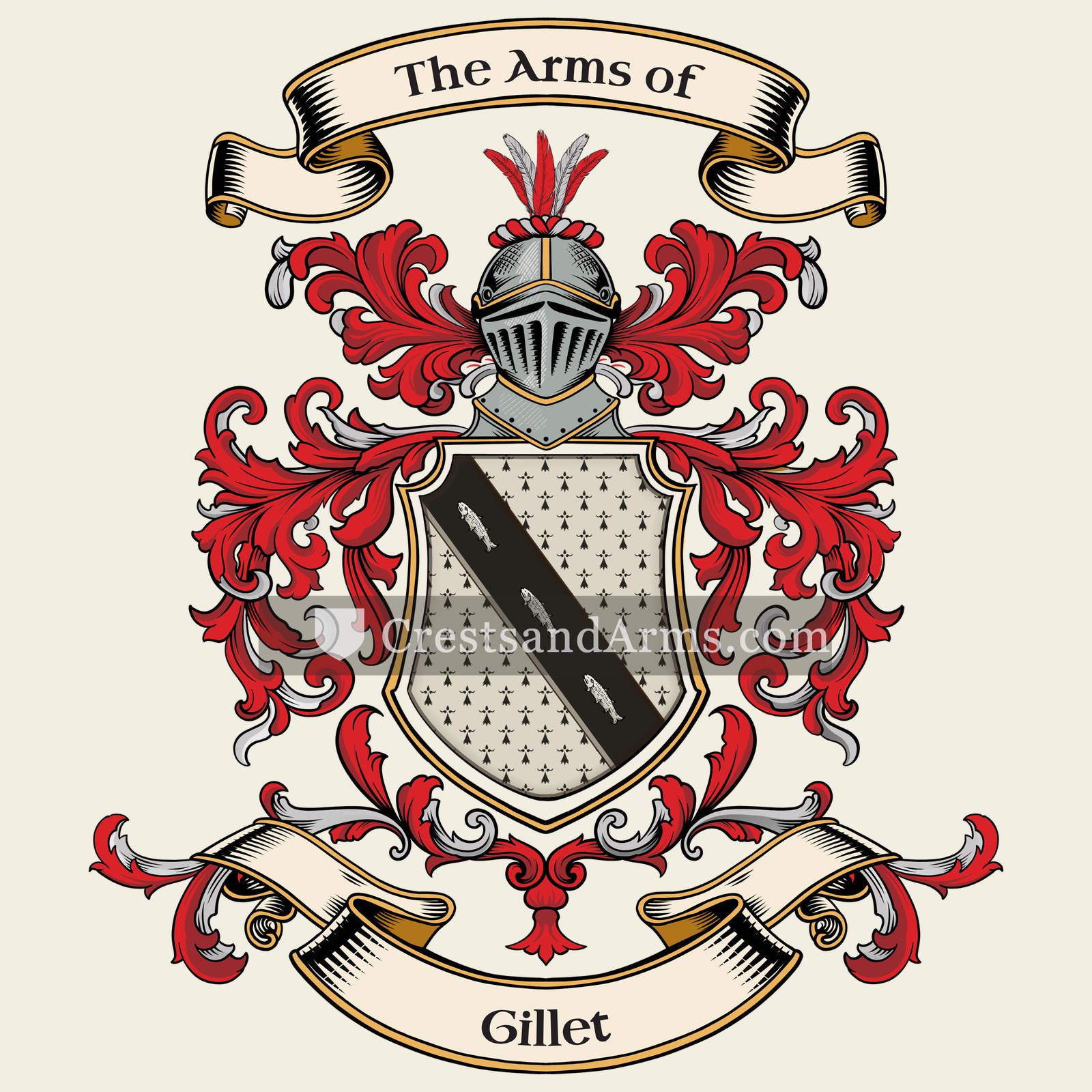
Symbols on this shield
bendDefence, and the scarf of a commander
fishA true and generous mind, and Christian faith
Colours
ErmineMeans: Dignity
Black (Sable)Means: Constancy
Silver (Argent)Means: Peace and sincerity
Historical info
Source
Sir Bernard Burke, The General Armory of England, Scotland, Ireland and Wales, London: Harrison & Sons, 1884
Blazon (the actual original written record)
“Erm. on a bend engr. sa. three lucles' heads erased ar. collared with a bar gemel gu”
SuffolkIpswich · Suffolk, c. 1620
Digital archive packCoat of arms PNG, gold border print PDF, vector SVG and the certificate of authenticity. Sent to your email in minutes.
Map of England showing where the Gillet arms are recorded
The Gillet arms were recorded in Suffolk, c. 1620.
Suffolk was wool country, and its cloth towns were among the wealthiest in England. Clothier families bought manors with their profits, and holding a manor was the ordinary route to a coat of arms.
This is where the arms were entered in the register. Families often moved to other parts of the country, so the same name can turn up in more than one region.
The body that granted and recorded arms in England in this period.
James VI and I
Sovereign of the period
James VI and I
1603–1625
Reigning in France when the Gillet arms are first recorded.
How Arms Worked in England
English heraldry allowed arms to be shared by all legitimate descendants of the original owner. These symbols were treated as personal property that moved through the generations to all children. While the eldest son kept the original design, other family members could use the same shield without needing to change it or register their own unique versions.
Granting authority
The College of Arms in London has regulated the use of coats of arms throughout England and Wales since 1484.
How they got arms
Families typically obtained their coats of arms through a formal grant from the Crown or by proving their ancient right to them.
Where arms were recorded
All official coats of arms are recorded in the registers kept at the College of Arms, which date back to the fifteenth century.
The family's standing
Recorded among the armigerous families of Suffolk.
Origin & History of the Gillet Family in England
The surname Gillet is a diminutive form of the name Giles, which traces its roots back to the Greek word for a young goat or a shield bearer. In medieval England, names often evolved from nicknames or shortened versions of popular saints' names, and Gillet became a common way to identify a person as the son or follower of Giles. By the time the family was established in Suffolk in 1620, the name had already been in use across various English counties for several centuries. Families in this region during the early seventeenth century were often involved in agriculture, trade, or the burgeoning textile industry that defined the Suffolk economy. As the family settled into their lives in East Anglia, they became part of a long tradition of English families who helped shape the local community through their work and daily interactions. This period was a time of significant social change, and the presence of the Gillet name in historical records from 1620 highlights their deep connection to the rural landscape of eastern England.
Gillet Meaning & Related Branches
Root word
Gilles
Derived from the Greek name Aegidius meaning young goat or shield bearer.
This name
GilletA diminutive form indicating a descendant or follower of someone named Giles.
also spelled
Gille
Jilay
Gilet
Gyllet
Gyllett
Related arms
Commendairesame arms
Documented Sources
J. B. Rietstap, Armorial Général, Gouda: G. B. van Goor Zonen, 1884–87
Dauzat, Albert. Dictionnaire étymologique des noms et prénoms de France. 1951
Morlet, Marie-Thérèse. Dictionnaire étymologique des noms de famille. 1991
Digital archive packCoat of arms PNG, gold border print PDF, vector SVG and the certificate of authenticity. Sent to your email in minutes.


 bendDefence, and the scarf of a commander
 eagleNobility, strength and a keen mind
 bendDefence, and the scarf of a commander
 eagleNobility, strength and a keen mind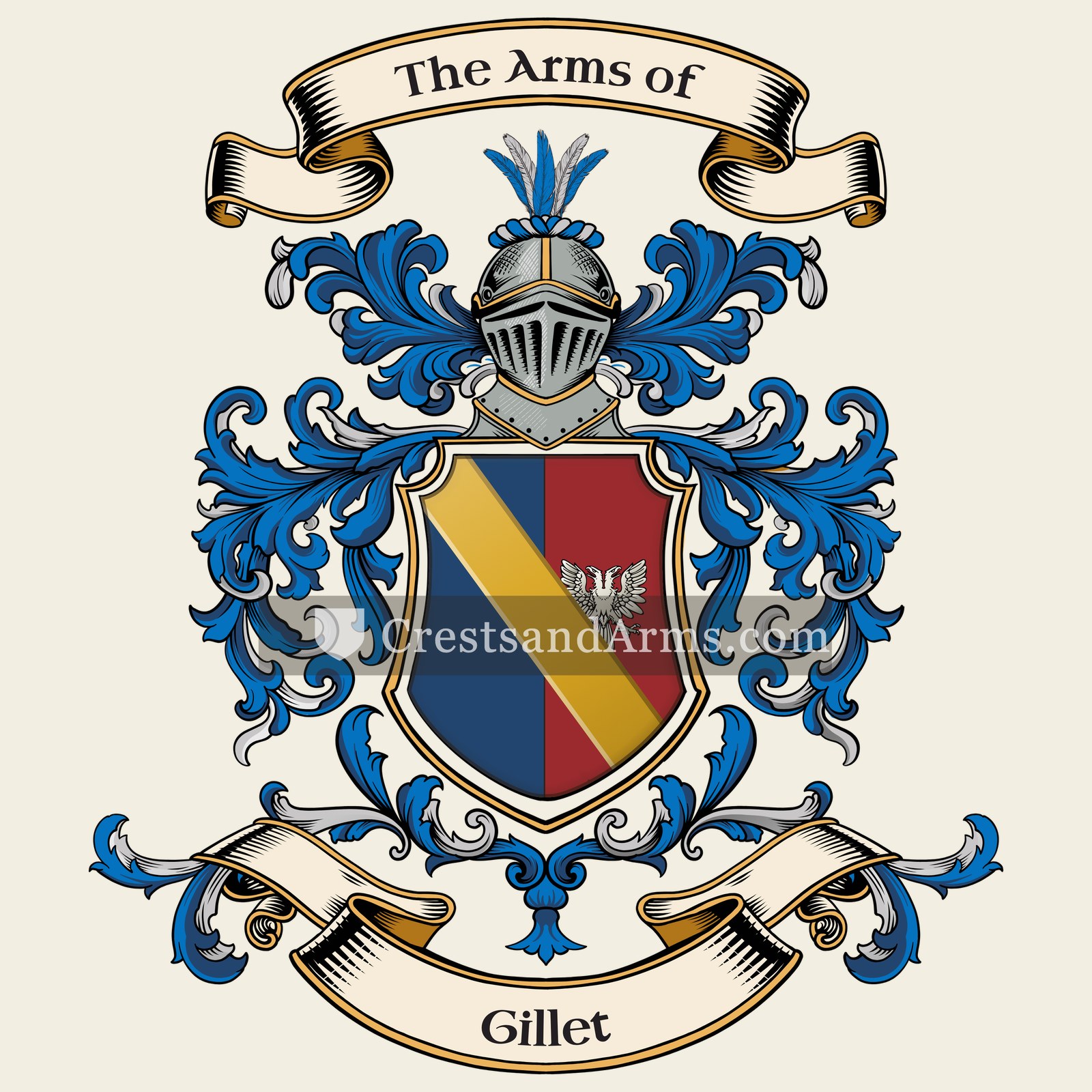


 fishA true and generous mind, and Christian faith