Map of Scotland showing where the Gillin arms are recorded
The Gillin arms were recorded in Linlithgow, c. 1676.
Linlithgow, now West Lothian, held a royal palace between Edinburgh and Stirling. Families with court business settled nearby, and closeness to the court brought recorded arms.
This is where the arms were entered in the register. Families often moved to other parts of the country, so the same name can turn up in more than one region.
The body that granted and recorded arms in Scotland in this period.
Charles II of England
Sovereign of the period
Charles II of England
1660–1685
Reigning in Scotland when the Gillin arms are first recorded.
How Arms Worked in Scotland
Scottish heraldry is unique because it treats a coat of arms as a piece of personal property protected by law. Only one person can own a specific design at any given time. When a family grows, the head keeps the original shield while other relatives must apply for their own distinct version with slight changes to prove their specific identity.
Granting authority
The Court of the Lord Lyon acts as the official body that regulates and controls all heraldic matters throughout Scotland.
How they got arms
Individuals obtain a legal right to their arms through a formal petition process that confirms their identity and family connection.
Where arms were recorded
All valid coats of arms are officially entered into the Public Register of All Arms and Bearings starting from 1672.
The family's standing
Recorded among the armigerous families of Linlithgow.
Origin & History of the Gillin Family in Scotland
The family name Gillin has deep roots in the historic Scottish town of Linlithgow, where records confirm members of the family were living as early as 1676. During the seventeenth century, Linlithgow served as a vital royal burgh and a center for trade, meaning that families living there were often involved in local commerce, crafts, or the administration of the town. The name likely evolved as a localized variation of older Gaelic or Northern English surnames, reflecting the movement of people across the borders and regions of Scotland. By establishing themselves in a town known for its royal palace and significant political history, the early Gillin family became part of a community that was central to the development of the Scottish Lowlands. These early settlers helped shape the local landscape, leaving behind a legacy that connects the family to the foundational history of the region.
Related Branches & Arms
Root word
Gille Fhinn
Servant of the fair or white one.
This name
GillinDerived from Gaelic, signifying a devotee or follower of a fair-haired individual or saint.
also spelled
Gyllon
Gyllone
Documented Sources
Sir Bernard Burke, The General Armory of England, Scotland, Ireland and Wales, London: Harrison & Sons, 1884
National Records of Scotland, Linlithgow Burgh Records, B48/1/1
National Records of Scotland, Register of Testaments, CC21/5/1
Digital archive packCoat of arms PNG, gold border print PDF, vector SVG and the certificate of authenticity. Sent to your email in minutes.


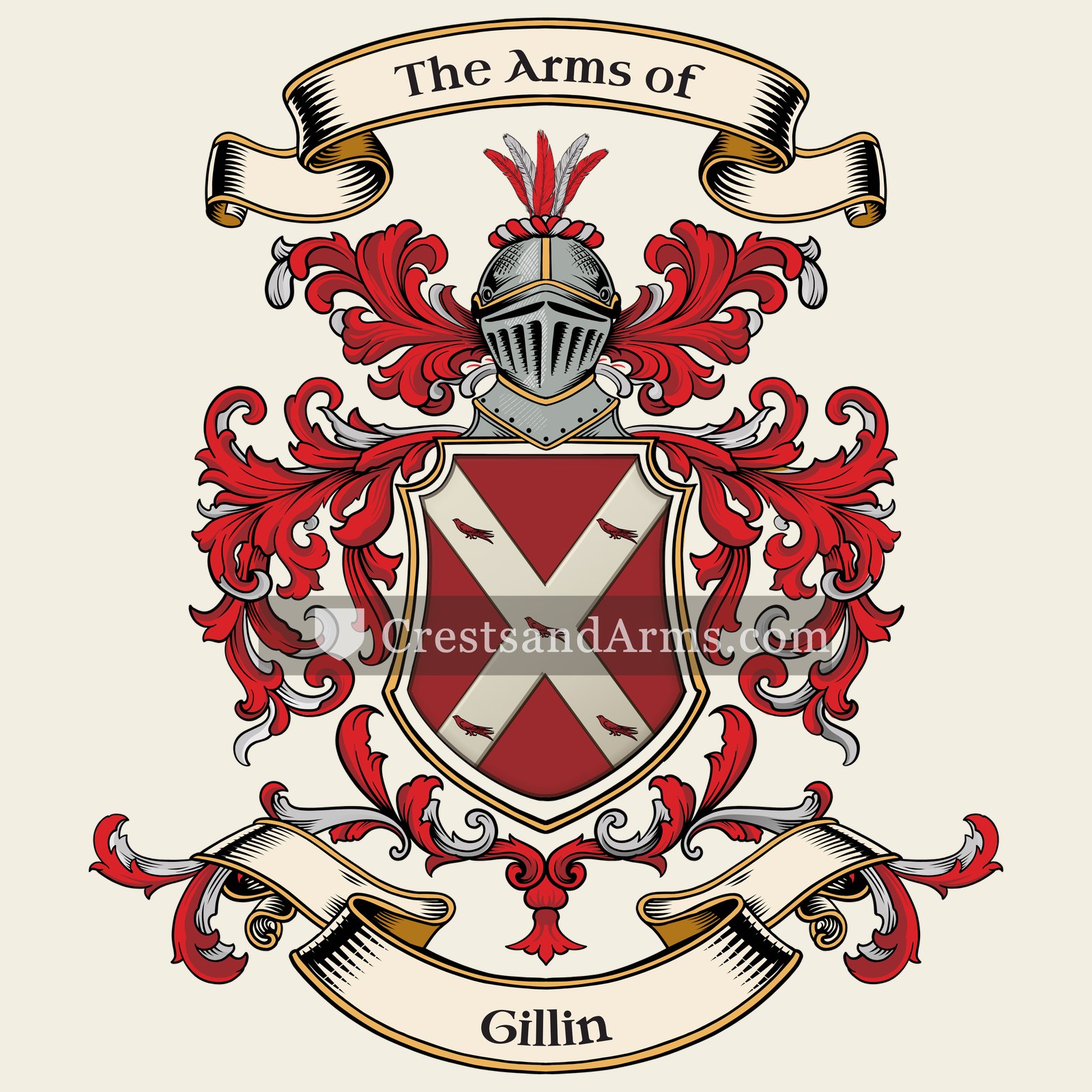
 saltireResolution, and St Andrew's cross
 martletA younger son, who must win his own land
 saltireResolution, and St Andrew's cross
 martletA younger son, who must win his own land