Map of England showing where the Gillman arms are recorded
The Gillman arms were recorded in Hereford, c. 1620.
Herefordshire lay on the Welsh border, where land was held in return for military service. Families there were expected to arm and to fight, and a fighting household needed a shield it could be known by.
This is where the arms were entered in the register. Families often moved to other parts of the country, so the same name can turn up in more than one region.
The body that granted and recorded arms in England in this period.
James VI and I
Sovereign of the period
James VI and I
1603–1625
Reigning in England when the Gillman arms are first recorded.
How Arms Worked in England
English heraldry allowed arms to be shared by all legitimate descendants of the original owner. These symbols were treated as personal property that moved through the generations to all children. While the eldest son kept the original design, other family members could use the same shield without needing to change it or register their own unique versions.
Granting authority
The College of Arms in London has regulated the use of coats of arms throughout England and Wales since 1484.
How they got arms
Families typically obtained their coats of arms through a formal grant from the Crown or by proving their ancient right to them.
Where arms were recorded
All official coats of arms are recorded in the registers kept at the College of Arms, which date back to the fifteenth century.
The family's standing
Recorded among the armigerous families of Hereford.
Origin & History of the Gillman Family in England
The surname Gillman is rooted in the linguistic traditions of medieval England, where it functioned as a descriptive name for a servant or a follower of a man named Gill. This name was likely a shortened form of William or Giles, reflecting the common practice of using nicknames to identify people within small, tight-knit village communities. By the early 17th century, the family had established a clear presence in the county of Hereford. Records from 1620 confirm that members of the Gillman family were active participants in the local life of this region, which was then a bustling center of agriculture and trade along the border of Wales. These early ancestors were likely yeomen or tradespeople who helped shape the rural economy of the West Midlands. Their presence in Hereford during this era suggests that the family had successfully integrated into the social fabric of the English countryside, moving from simple occupational origins to becoming recognized members of their local parish communities.
Coat of Arms & Family Crest Details
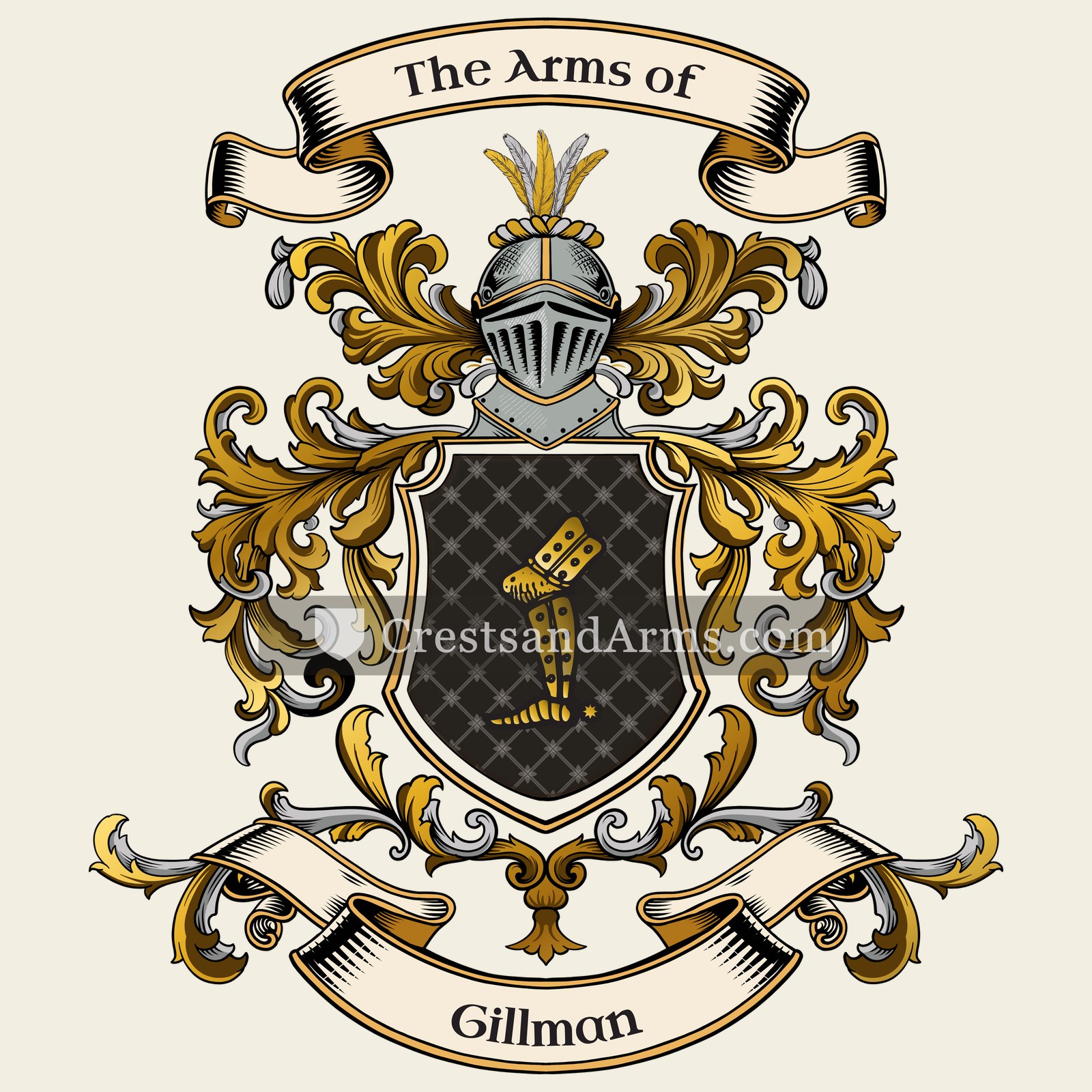
Symbols on this shield
legStrength and swiftness
Colours
Black (Sable)Means: Constancy
Gold (Or)Means: Generosity
Historical info
Source
Sir Bernard Burke, The General Armory of England, Scotland, Ireland and Wales, London: Harrison & Sons, 1884
Blazon (the actual original written record)
“Sa. a dexter leg couped above the knee or”
CorkCurriheen · Cork, c. 1799
Digital archive packCoat of arms PNG, gold border print PDF, vector SVG and the certificate of authenticity. Sent to your email in minutes.
Map of Ireland showing where the Gillman arms are recorded
The Gillman arms were recorded in Cork, c. 1799.
Cork was the largest county in Ireland, with a great harbour and a wide farming hinterland. Both English settlers and older Irish families held land there, and holding land is what brought a family into the records.
This is where the arms were entered in the register. Families often moved to other parts of the country, so the same name can turn up in more than one region.
The body that granted and recorded arms in Ireland in this period.
George III of Great Britain
Sovereign of the period
George III of Great Britain
1760–1801
Reigning in England when the Gillman arms are first recorded.
How Arms Worked in Ireland
The Ulster King of Arms granted coats of arms to individuals who proved their social standing and good character. These symbols were typically inherited by all legitimate descendants of the original holder. If a family branch wanted a unique look, they could apply for a specific change to their design through the office to ensure their identity remained distinct.
Granting authority
The Ulster King of Arms acted as the official body that regulated and issued all coats of arms throughout Ireland.
How they got arms
Families obtained their arms through formal grants issued by the office after proving their eligibility and paying the required fees.
Where arms were recorded
All official grants were recorded in the registers held by the Ulster King of Arms starting from the year 1552.
The family's standing
Recorded among the armigerous families of Cork.
Origin & History of the Gillman Family in Ireland
The Gillman family name has a long and established history in County Cork, where members of the family were documented as prominent landowners and residents by the late eighteenth century. While the name likely originated from earlier roots in England, the Irish branch became deeply integrated into the social and economic life of the Munster region by 1799. During this era, families like the Gillmans often held positions of local influence, managing estates and participating in the administrative affairs of their communities. Their presence in Cork during this time reflects a period of significant transition for many families who settled in Ireland to pursue agricultural and professional opportunities. Over the following decades, the family continued to expand their footprint across the county, leaving behind a legacy tied to the development of local land and commerce.
Gillman Meaning & Related Branches
Root word
Gille
Old Norse term for a servant or a devotee of a saint.
This name
GillmanA person who served a man named Gill or a devotee of a saint.
also spelled
Gyllman
Documented Sources
Sir Bernard Burke, The General Armory of England, Scotland, Ireland and Wales, London: Harrison & Sons, 1884
Bardsley, Charles Wareing, A Dictionary of English and Welsh Surnames, 1901
Reaney, P.H., A Dictionary of British Surnames, 1958
Herefordshire Archives and Records Centre, Parish Registers of Herefordshire, 1620
Digital archive packCoat of arms PNG, gold border print PDF, vector SVG and the certificate of authenticity. Sent to your email in minutes.


 horseReadiness to serve king and country
 handFaith, sincerity and justice
 horseReadiness to serve king and country
 handFaith, sincerity and justice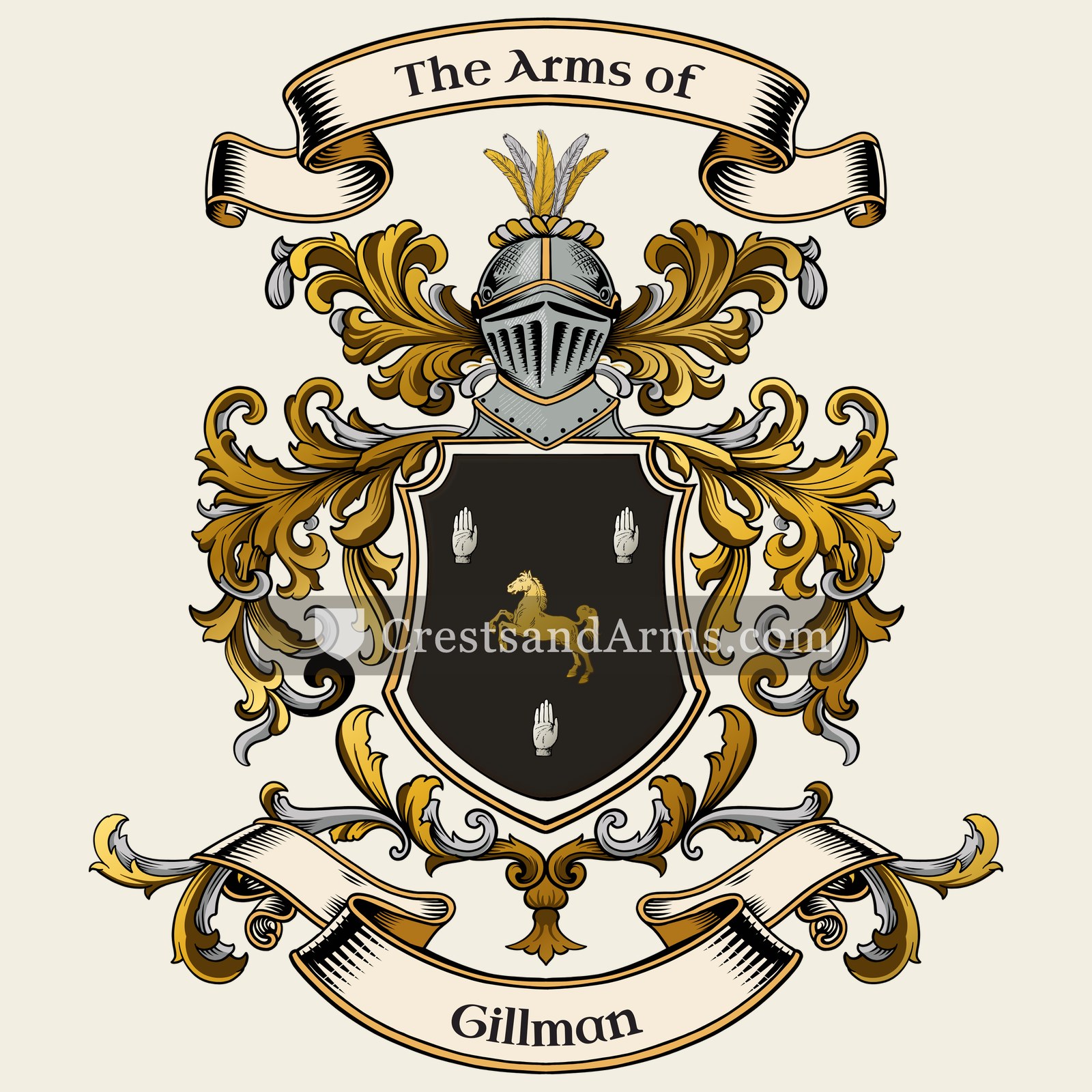


 legStrength and swiftness