Map of England showing where the Gillow arms are recorded
The Gillow arms were recorded in Lancaster, c. 1620.
Lancashire was divided among a great many small landed families, more than most northern counties. Estates were passed down whole rather than split up, so the same names hold the same ground for centuries in the records.
This is where the arms were entered in the register. Families often moved to other parts of the country, so the same name can turn up in more than one region.
The body that granted and recorded arms in England in this period.
James VI and I
Sovereign of the period
James VI and I
1603–1625
Reigning in England when the Gillow arms are first recorded.
How Arms Worked in England
English heraldry allowed arms to be shared by all legitimate descendants of the original owner. These symbols were treated as personal property that moved through the generations to all children. While the eldest son kept the original design, other family members could use the same shield without needing to change it or register their own unique versions.
Granting authority
The College of Arms in London has regulated the use of coats of arms throughout England and Wales since 1484.
How they got arms
Families typically obtained their coats of arms through a formal grant from the Crown or by proving their ancient right to them.
Where arms were recorded
All official coats of arms are recorded in the registers kept at the College of Arms, which date back to the fifteenth century.
The family's standing
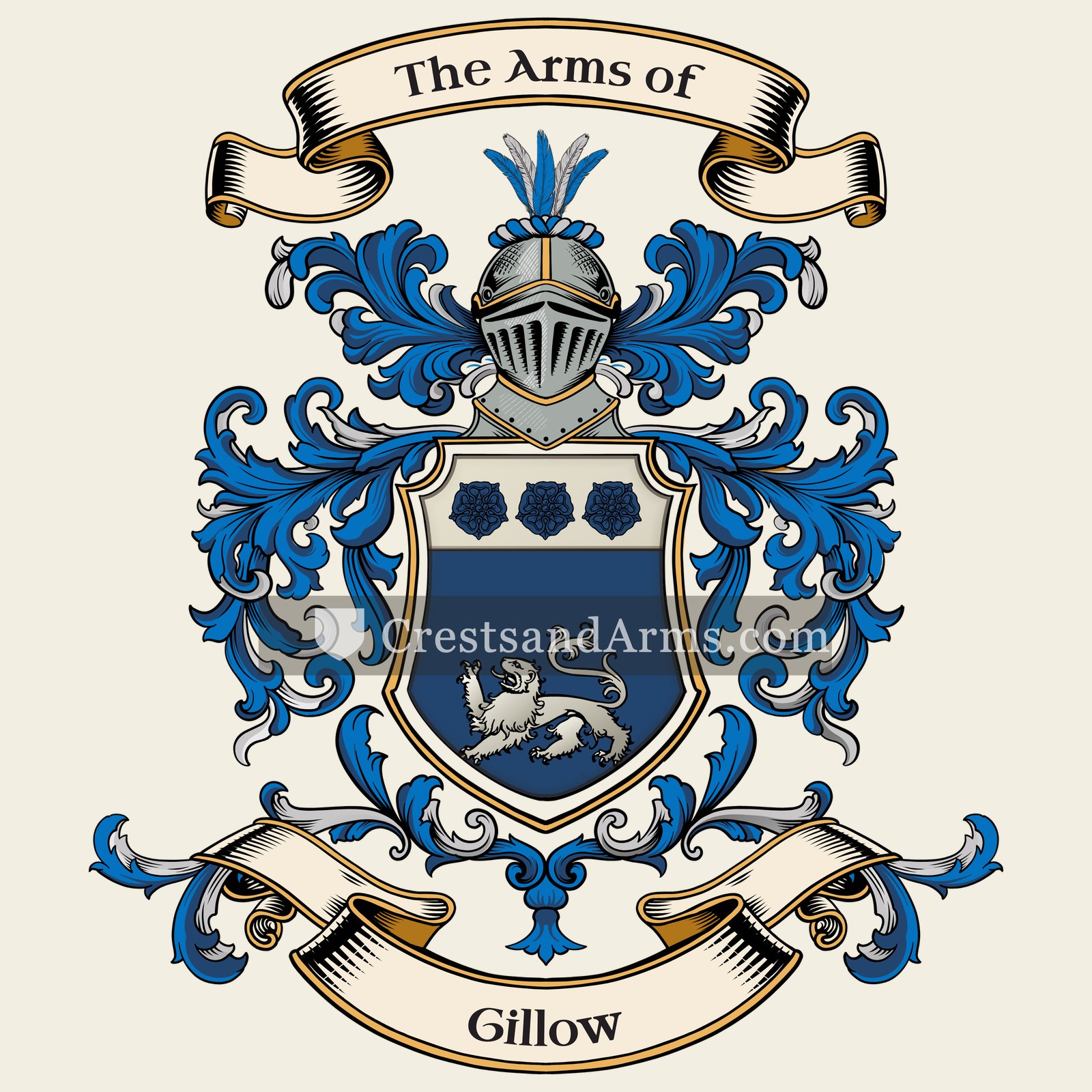
Recorded among the armigerous families of Lancaster.
Origin & History of the Gillow Family in England
The Gillow family name is deeply rooted in the historical landscape of Lancashire, England, where members were firmly established by the early seventeenth century. The name is considered a locative surname, which means it likely originated from a specific place or geographical feature near the town of Lancaster. During the 1600s, the family began to build a reputation that would eventually see them become prominent figures in the region. While they are often remembered for their later contributions to furniture making and architecture, their early history was defined by their presence in the North West of England during a time of significant social and religious change. By maintaining a consistent presence in Lancaster from at least 1620, the family secured a lasting legacy that helped shape the local community for generations to come.
Gillow Meaning & Related Branches
Root word
Gille
A diminutive form of the Old Norse name Gisl meaning hostage.
This name
GillowA locative surname derived from a place in Lancashire meaning a ravine or narrow valley.
also spelled
Gyllow
Gyllowe
Documented Sources
Sir Bernard Burke, The General Armory of England, Scotland, Ireland and Wales, London: Harrison & Sons, 1884
Gillow, Joseph. A Literary and Biographical History, or Bibliographical Dictionary of the English Catholics, from the Breach with Rome, in 1534, to the Present Time. 1885


 chiefAuthority, wisdom and dominion
 lionCourage, strength and royalty
 roseThe seventh son, and beauty with grace
 chiefAuthority, wisdom and dominion
 lionCourage, strength and royalty
 roseThe seventh son, and beauty with grace