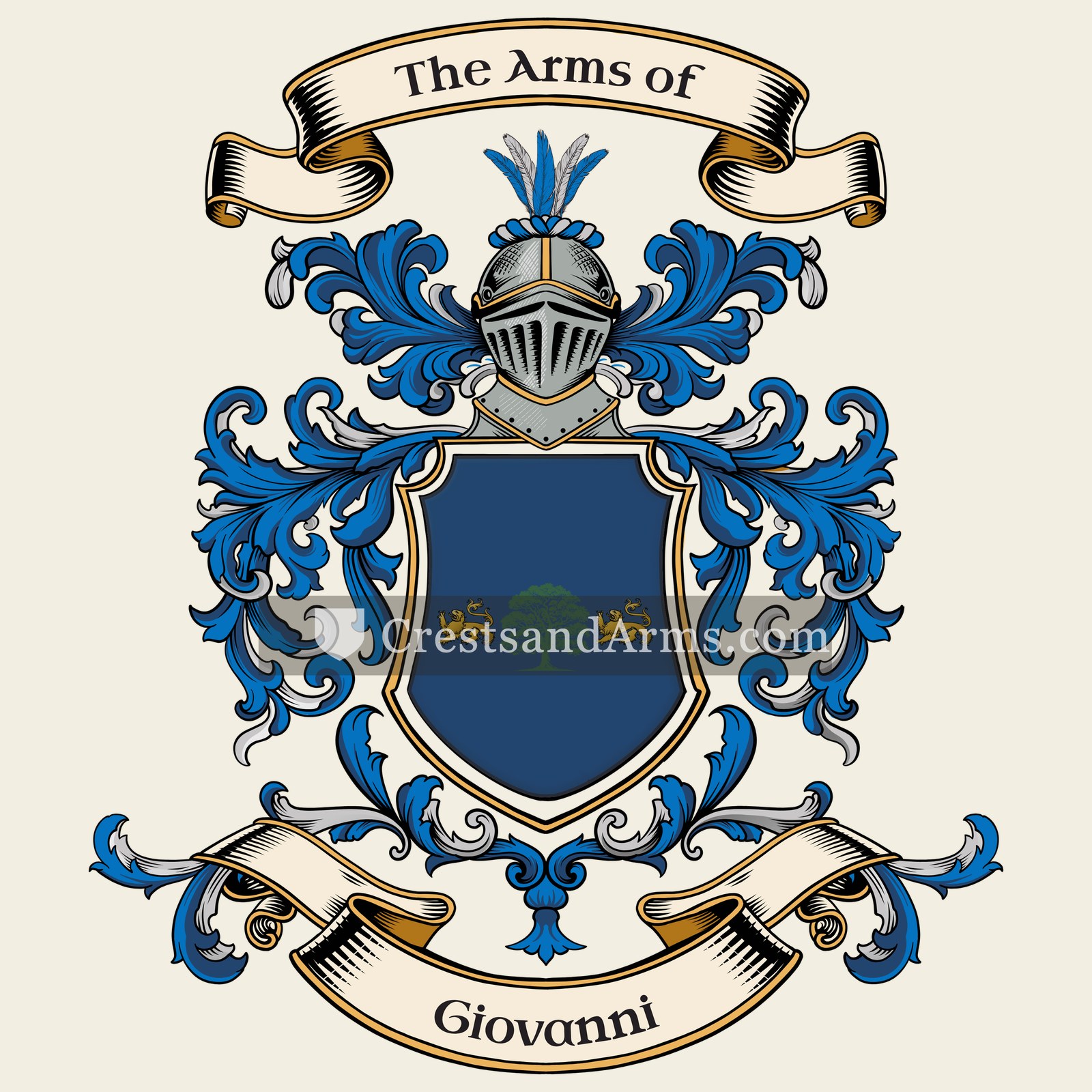
A record of documented arms, meaning and origin, researched for the Giovanni family of Italy.
Reg. 9699 · Italian, G–I
Coat of Arms & Family Crest Details
Symbols on this shield
treeLife, endurance and deep roots
lionCourage, strength and royalty
Colours
Blue (Azure)Means: Loyalty and truth
Green (Vert)Means: Hope
Gold (Or)Means: Generosity
Historical info
Source
J. B. Rietstap, Armorial Général, Gouda: G. B. van Goor Zonen, 1884–87
Blazon (the actual original written record)
“D'azur à un chène de sin., accosté de deux lions affr. d'or, ramp. contre le fût. Cq. cour. C.: une aigle de sa. L.: à dextre d'arg. et de gu., à sen. d'or et d'azur.”
SicilySicily, c. 1775
Digital archive packCoat of arms PNG, gold border print PDF, vector SVG and the certificate of authenticity. Sent to your email in minutes.
Map of Italy showing where the Giovanni arms are recorded
The Giovanni arms were recorded in Sicily, c. 1775.
Sicily was ruled in turn by Normans, Germans, French and Spanish, and each left landed families behind. The island kept formal lists of its noble houses, which is why so many Sicilian names carry recorded arms.
This is where the arms were entered in the register. Families often moved to other parts of the country, so the same name can turn up in more than one region.
The body that granted and recorded arms in Italy in this period.
Alvise Giovanni Mocenigo
Sovereign of the period
Alvise Giovanni Mocenigo
1763–1778
Reigning in Italy when the Giovanni arms are first recorded.
How Arms Worked in Italy
In the Italian states, coats of arms were often used by noble families to show their status and history. These symbols were passed down through the generations to all legitimate male descendants. Younger branches of a family usually kept the original design but sometimes added small changes to distinguish their specific line from the main branch.
Granting authority
Various local rulers and city governments controlled the use of coats of arms across the different Italian states.
How they got arms
Families often assumed their own arms or received them as official grants from local lords, popes, or city councils.
Where arms were recorded
Arms were recorded in local city archives or private family books rather than in one single national register.
The family's standing
Recorded among the armigerous families of Sicily.
Origin & History of the Giovanni Family in Italy
The name Giovanni is a classic Italian given name that evolved into a surname, rooted in the Hebrew name Yochanan, which means God is gracious. By the time the family was documented in Sicily in 1775, the name had already been popular across the Italian peninsula for centuries due to its strong religious ties to Saint John the Baptist. Families who adopted this name often did so to honor their faith or to distinguish themselves in their local communities. In the context of 18th-century Sicily, the Giovanni family likely lived in a society shaped by agricultural traditions and local parish life. Records from this era suggest that families were deeply connected to their specific towns, where the name served as a marker of identity passed down through generations of laborers, artisans, or landowners. As the family established their roots on the island, they became part of the long history of Sicilian social development, reflecting the blend of cultural influences that defined the region during that period.
Giovanni Meaning & Related Branches
Root word
Yochanan
Hebrew for God is gracious
This name
GiovanniAn Italian given name and surname signifying divine grace and favor.
also spelled
Giovanni
Jovanni Sentelles
Documented Sources
J. B. Rietstap, Armorial Général, Gouda: G. B. van Goor Zonen, 1884–87
De Felice, Emidio, Dizionario dei cognomi italiani, 1978
Fucile, Salvatore, Archivio di Stato di Palermo, Stato Civile della Restaurazione, 1820–1860
Istituto Centrale per gli Archivi, Catasto Onciario del Regno di Sicilia, 1748–1750
Digital archive packCoat of arms PNG, gold border print PDF, vector SVG and the certificate of authenticity. Sent to your email in minutes.


 treeLife, endurance and deep roots
 lionCourage, strength and royalty
 treeLife, endurance and deep roots
 lionCourage, strength and royalty