Map of England showing where the Gist arms are recorded
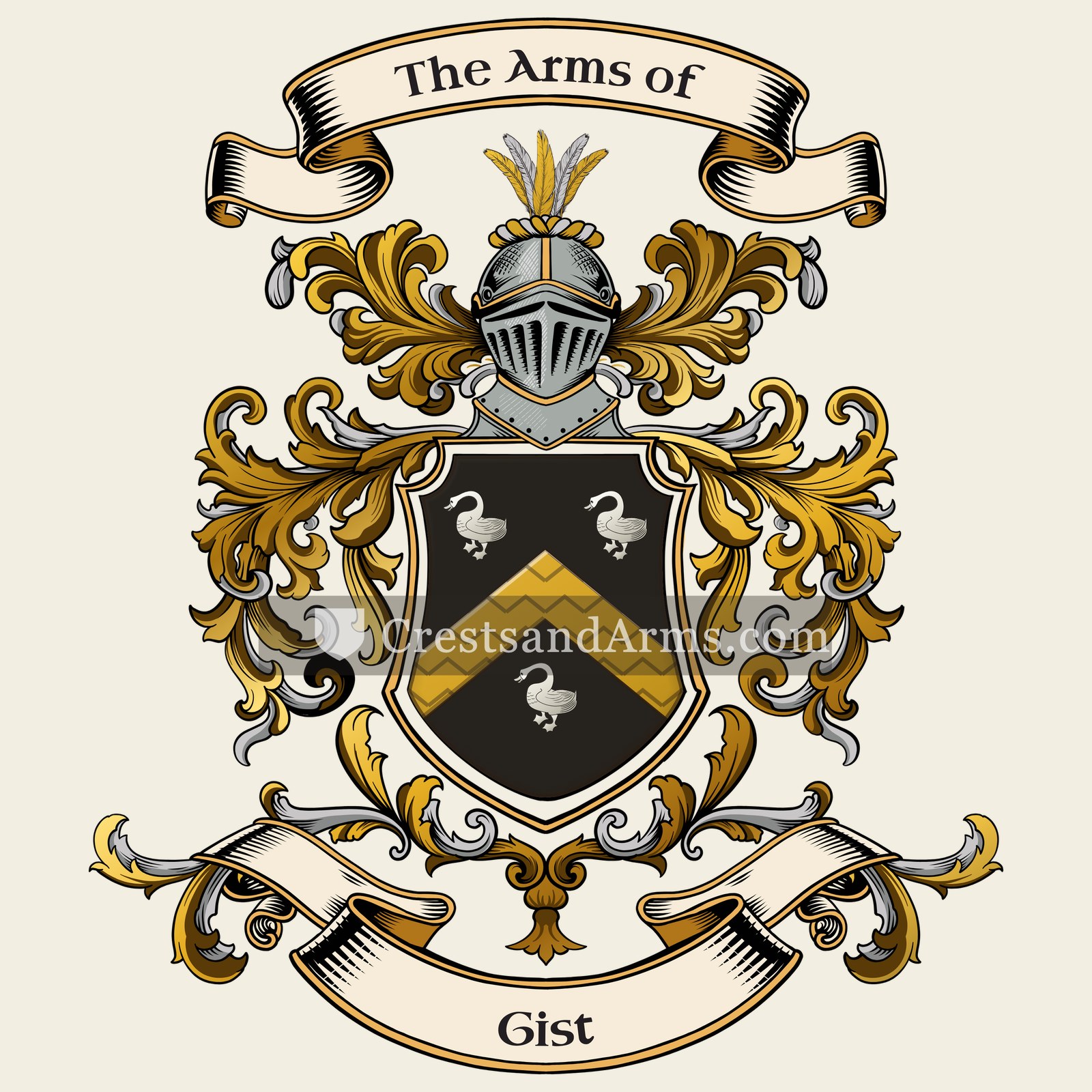
The Gist arms were recorded in England, c. 1620.
Arms such as these were typically recorded in York.
Yorkshire is the largest of the English counties, and it held more gentry families than any other. Land there was split among a great many households rather than a few, so a great many of them carried arms.
This is where the arms were entered in the register. Families often moved to other parts of the country, so the same name can turn up in more than one region.
The body that granted and recorded arms in England in this period.
James VI and I
Sovereign of the period
James VI and I
1603–1625
Reigning in England when the Gist arms are first recorded.
How Arms Worked in England
English heraldry allowed arms to be shared by all legitimate descendants of the original owner. These symbols were treated as personal property that moved through the generations to all children. While the eldest son kept the original design, other family members could use the same shield without needing to change it or register their own unique versions.
Granting authority
The College of Arms in London has regulated the use of coats of arms throughout England and Wales since 1484.
How they got arms
Families typically obtained their coats of arms through a formal grant from the Crown or by proving their ancient right to them.
Where arms were recorded
All official coats of arms are recorded in the registers kept at the College of Arms, which date back to the fifteenth century.
The family's standing
Recorded among the armigerous families of England.
Origin & History of the Gist Family in England
The family name Gist has roots that trace back to the early seventeenth century in England. Records indicate that members of the family were established in the city of York by 1620. During this period, the name was often associated with individuals who moved through the social and economic landscapes of northern England. As the century progressed, some members of the family sought new opportunities across the Atlantic Ocean. This migration led them to the American colonies, where they became notable figures in the exploration and settlement of the frontier. The family name eventually became linked to the expansion of the British colonies, particularly through the work of surveyors and scouts who helped map the wilderness. By maintaining a presence in both their ancestral home and their new territories, the Gist family played a quiet but consistent role in the history of the regions they inhabited.
Gist Meaning & Related Branches
Root word
geste
Old French word meaning a deed, exploit, or story.
This name
GistA nickname for a person who was a storyteller, a jester, or someone known for their notable deeds.
also spelled
Gyst
Gyste
Related arms
Guestvariant spelling
Documented Sources
Sir Bernard Burke, The General Armory of England, Scotland, Ireland and Wales, London: Harrison & Sons, 1884
Dorsey, Jean Muir and Maxwell Jay Dorsey, Christopher Gist of Maryland and Some of His Descendants, 1969
Maryland State Archives, Provincial Court Land Records, 1679–1700
York Minster Library and Archives, Parish Registers of York, 1620
Digital archive packCoat of arms PNG, gold border print PDF, vector SVG and the certificate of authenticity. Sent to your email in minutes.


 chevronProtection, and faithful service completed
 swanGrace, light and the poet's art
 chevronProtection, and faithful service completed
 swanGrace, light and the poet's art