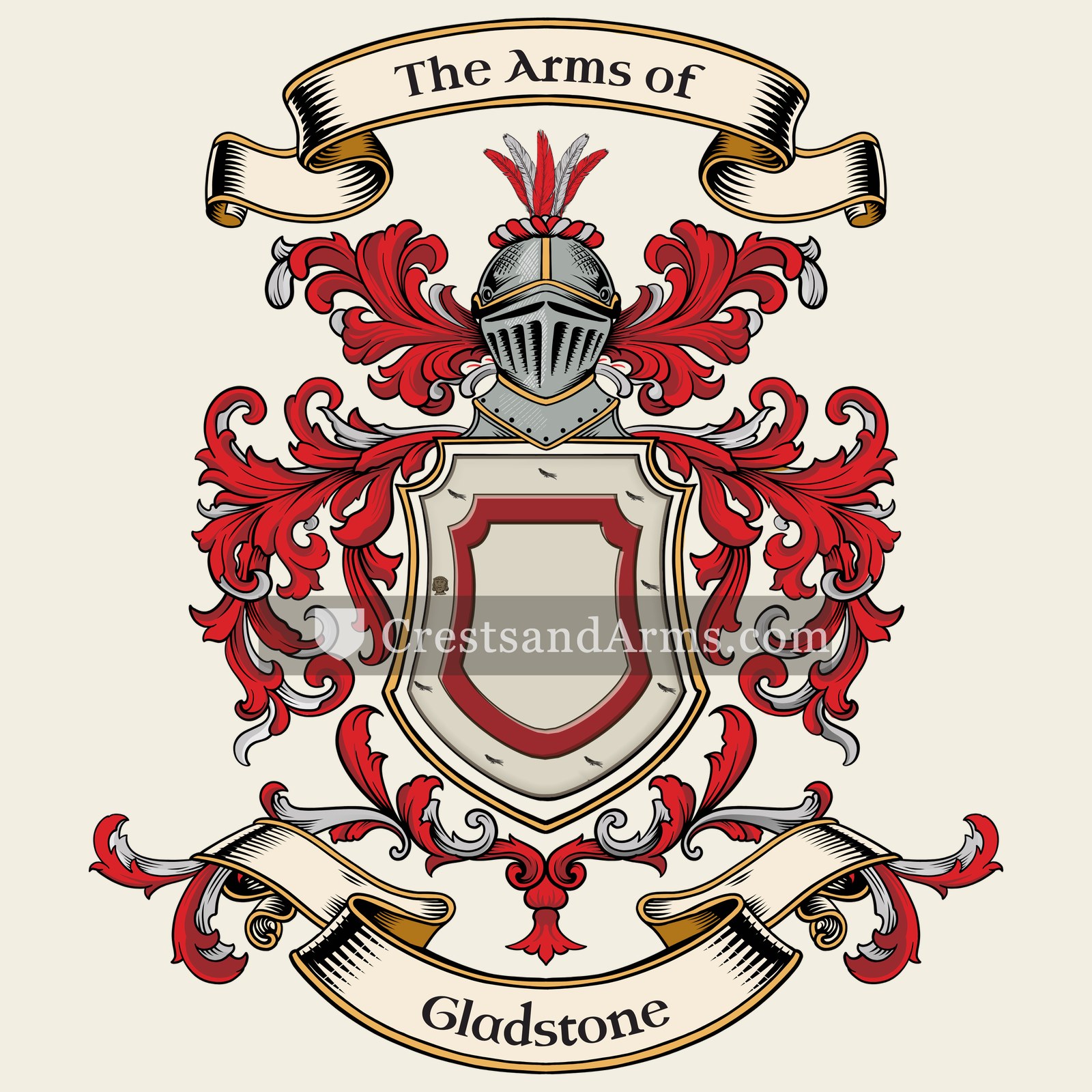
A record of documented arms, meaning and origin, researched for the Gladstone family lines. Documented in 2 countries.
Reg. 9816 · Britain, G–I
Coat of Arms & Family Crest Details
Symbols on this shield
orlePreservation, and protection in battle
martletA younger son, who must win his own land
Colours
Silver (Argent)Means: Peace and sincerity
Red (Gules)Means: Military strength
Black (Sable)Means: Constancy
Historical info
Source
J. B. Rietstap, Armorial Général, Gouda: G. B. van Goor Zonen, 1884–87
Blazon (the actual original written record)
“D'arg. à une tête de sauvage de carn., posée de front, dégouttante de sang, tort. d'une couronne de houx de sin., la tête enclose dans une orle fleur. à l'ext. de gu.; le tout acc. de huit martinets de sa., rangés entre ladite orle et les bords de l'écu. C.: un griffon iss. de sa., mouv. d'une couronne de houx de sin. et tenant dans ses pattes une épée d'arg., enfilée d'une couronne de chêne de sin. D.: FIDE ET VIRTUTE.”
Britainc. 1846
Digital archive packCoat of arms PNG, gold border print PDF, vector SVG and the certificate of authenticity. Sent to your email in minutes.
Map of Britain showing where the Gladstone arms are recorded
The Gladstone arms were recorded in Britain, c. 1846.
Arms such as these were typically recorded in Kent.
Kent sits between London and the short crossing to Europe, and the trade passing through made it wealthy. Merchant families bought land with that money, and it was landowners who took coats of arms.
This is where the arms were entered in the register. Families often moved to other parts of the country, so the same name can turn up in more than one region.
The body that granted and recorded arms in Britain in this period.
Victoria
Sovereign of the period
Victoria
1837–1901
Reigning in Britain when the Gladstone arms are first recorded.
How Arms Worked in Britain
English heraldry allowed arms to be shared by all legitimate descendants of the original owner. These symbols were treated as personal property that moved through the generations to all children. While the eldest son kept the original design, other family members could use the same shield without needing to change it or register their own unique versions.
Granting authority
The College of Arms in London has regulated the use of coats of arms throughout England and Wales since 1484.
How they got arms
Families typically obtained their coats of arms through a formal grant from the Crown or by proving their ancient right to them.
Where arms were recorded
All official coats of arms are recorded in the registers kept at the College of Arms, which date back to the fifteenth century.
The family's standing
Recorded among the armigerous families of Britain.
Origin & History of the Gladstone Family in Britain
The Gladstone family name originates from the northern regions of Britain, specifically deriving from the lands of Gledstanes in Lanarkshire, Scotland. The name itself is rooted in Old English, combining the words for a kite, which is a type of bird of prey, and a stony place. Over several centuries, the family migrated southward, moving from their ancestral Scottish roots toward the bustling centers of England. By the mid-nineteenth century, members of the family had established a notable presence in Kent. This period marked a time of significant social mobility and professional growth for the family as they integrated into the broader landscape of British society. Their transition from northern landowners to residents of the English countryside reflects the wider patterns of internal migration and economic change that defined the Victorian era.
Coat of Arms & Family Crest Details
Symbols on this shield
orlePreservation, and protection in battle
saracens head affronty coupedA crusade fought, and an enemy met in the field
martletA younger son, who must win his own land
Colours
Silver (Argent)Means: Peace and sincerity
Red (Gules)Means: Military strength
Black (Sable)Means: Constancy
Historical info
Source
Sir Bernard Burke, The General Armory of England, Scotland, Ireland and Wales, London: Harrison & Sons, 1884
Blazon (the actual original written record)
“Ar. a savage's head affrontée distilling drops of blood, about the temples a wreath of holly vert, within an orle flcury gu. all within eight martlets sa”
KincardineFasque · Kincardine, c. 1748
Digital archive packCoat of arms PNG, gold border print PDF, vector SVG and the certificate of authenticity. Sent to your email in minutes.
Map of Scotland showing where the Gladstone arms are recorded
The Gladstone arms were recorded in Kincardine, c. 1748.
Kincardineshire was a narrow strip of farmland between the hills and the North Sea. Its landed families were few but very long-settled, and long settlement brought arms.
This is where the arms were entered in the register. Families often moved to other parts of the country, so the same name can turn up in more than one region.
The body that granted and recorded arms in Scotland in this period.
George II of Great Britain
Sovereign of the period
George II of Great Britain
1727–1760
Reigning in Britain when the Gladstone arms are first recorded.
How Arms Worked in Scotland
Scottish heraldry is unique because it treats a coat of arms as a piece of personal property protected by law. Only one person can own a specific design at any given time. When a family grows, the head keeps the original shield while other relatives must apply for their own distinct version with slight changes to prove their specific identity.
Granting authority
The Court of the Lord Lyon acts as the official body that regulates and controls all heraldic matters throughout Scotland.
How they got arms
Individuals obtain a legal right to their arms through a formal petition process that confirms their identity and family connection.
Where arms were recorded
All valid coats of arms are officially entered into the Public Register of All Arms and Bearings starting from 1672.
The family's standing
Recorded among the armigerous families of Kincardine.
Origin & History of the Gladstone Family in Scotland
The surname Gladstone originates from the Scottish Borders, specifically deriving from the lands of Gledstanes in the parish of Liberton in Lanarkshire. The name itself is rooted in the Old English words for "hawk" and "stony ground," suggesting that the family’s earliest ancestors were associated with a rocky landscape favored by birds of prey. By the mid-eighteenth century, the family had established a firm presence in Kincardineshire, where records from 1748 document their involvement in the local community. During this era, the family transitioned from their origins in the southern uplands to the coastal regions of the northeast. This migration reflects the broader movement of Scottish families who sought new opportunities in trade and land management during the eighteenth century. Their history serves as a window into how Scottish surnames often evolved from specific geographic landmarks into family identities that spanned generations and regions.
Gladstone Meaning & Related Branches
Root word
Gledestanes
A rocky place frequented by kites or birds of prey.
This name
GladstoneDerived from a Scottish place name referring to a stony hill inhabited by kites.
also spelled
Gladstoon
Gladston
Gladstane
Gledstane
Gledstone
Related arms
Gladstanesvariant spelling
Documented Sources
J. B. Rietstap, Armorial Général, Gouda: G. B. van Goor Zonen, 1884–87
Black, George F., The Surnames of Scotland: Their Origin, Meaning, and History, 1946
Reaney, P.H. and Wilson, R.M., A Dictionary of English Surnames, 1991
The National Archives, Census Returns of England and Wales, 1841 and 1851, HO 107
Digital archive packCoat of arms PNG, gold border print PDF, vector SVG and the certificate of authenticity. Sent to your email in minutes.


 orlePreservation, and protection in battle
 martletA younger son, who must win his own land
 orlePreservation, and protection in battle
 martletA younger son, who must win his own land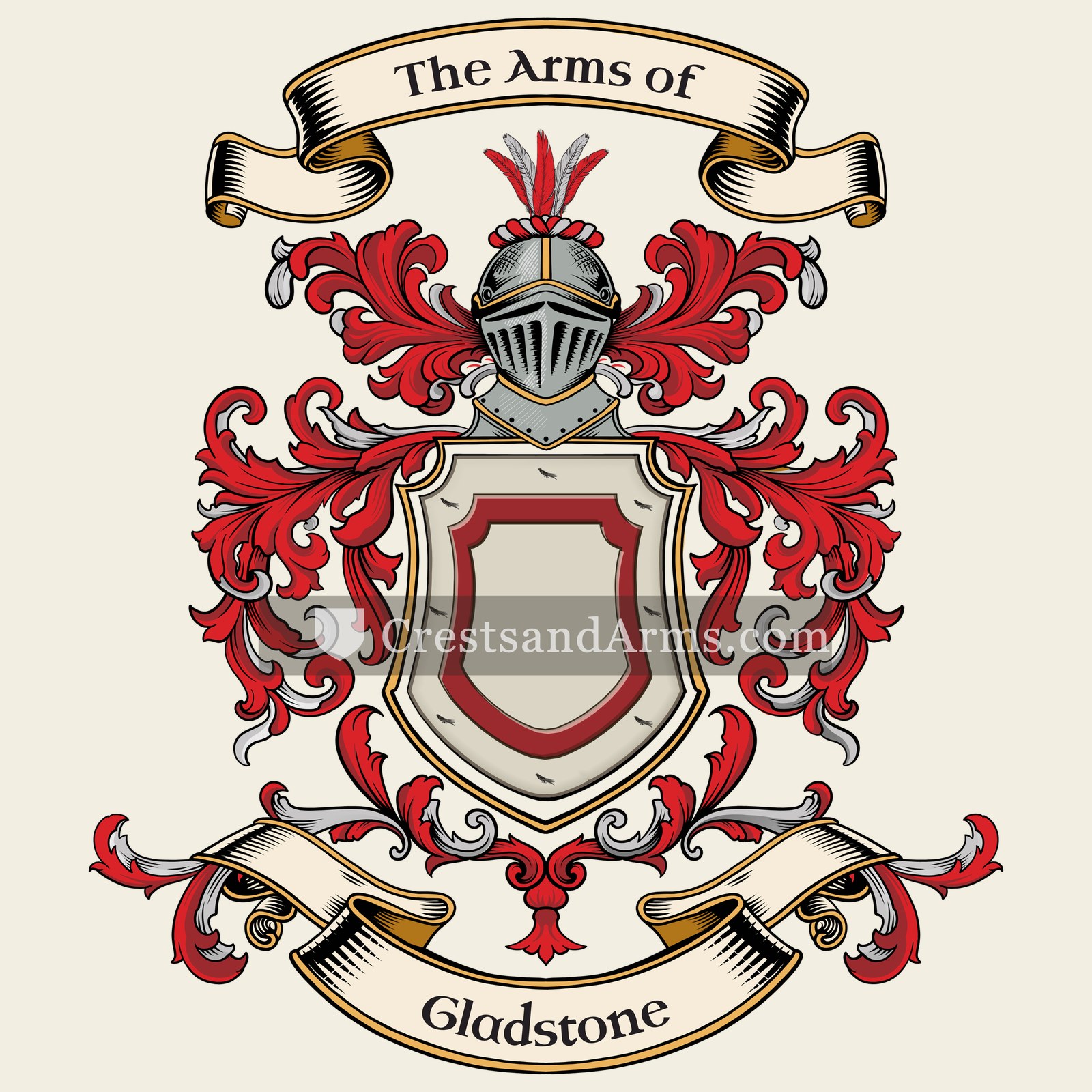


 saracens head affronty coupedA crusade fought, and an enemy met in the field