Map of Germany showing where the Glaser arms are recorded
The Glaser arms were recorded in Germany, c. 1765.
Arms such as these were typically recorded in Bavaria.
Bavaria was a country of old landed families and walled market towns. Estates passed down the same line for centuries, and both the landowners and the leading townsmen kept arms, which is why so many Bavarian names sit in the registers.
This is where the arms were entered in the register. Families often moved to other parts of the country, so the same name can turn up in more than one region.
The body that granted and recorded arms in Germany in this period.
Francis I, Holy Roman Emperor
Sovereign of the period
Francis I, Holy Roman Emperor
1745–1765
Reigning in Germany when the Glaser arms are first recorded.
How Arms Worked in Germany
In the Holy Roman Empire, coats of arms were often granted to individuals by the Emperor or his representatives. These arms were then passed down through the generations to all legitimate descendants of the original holder. Younger branches of a family usually kept the same shield design without needing to change it, as the arms belonged to the entire lineage.
Granting authority
The Holy Roman Emperor held the sole power to grant new coats of arms throughout his vast imperial territories.
How they got arms
Families typically obtained their coats of arms through a formal imperial grant or by proving their noble status to the authorities.
Where arms were recorded
These grants were officially recorded in the Imperial Chancery registers, which began keeping formal records of such honors during the Middle Ages.
The family's standing
Recorded among the armigerous families of Germany.
Origin & History of the Glaser Family in Germany
The surname Glaser is a classic example of an occupational name, originating from the Middle High German word "glasere," which refers to a glassmaker or a glazier. In the context of German history, families carrying this name were often part of the skilled artisan class that emerged during the late Middle Ages. By the time members of the family were documented in Bavaria in 1765, the name had already been established for centuries across various German-speaking regions. These early ancestors likely worked in the specialized trade of glass production, which was a vital industry in the forested areas of Southern Germany. Because glassmaking required specific technical knowledge and access to raw materials like silica and wood ash, families in this profession often settled near forest regions where fuel for furnaces was plentiful. Over generations, the name transitioned from a simple job description into a permanent family identifier, marking the lineage as part of the hardworking craft guilds that helped shape the local economy of the Bavarian countryside.
Coat of Arms & Family Crest Details
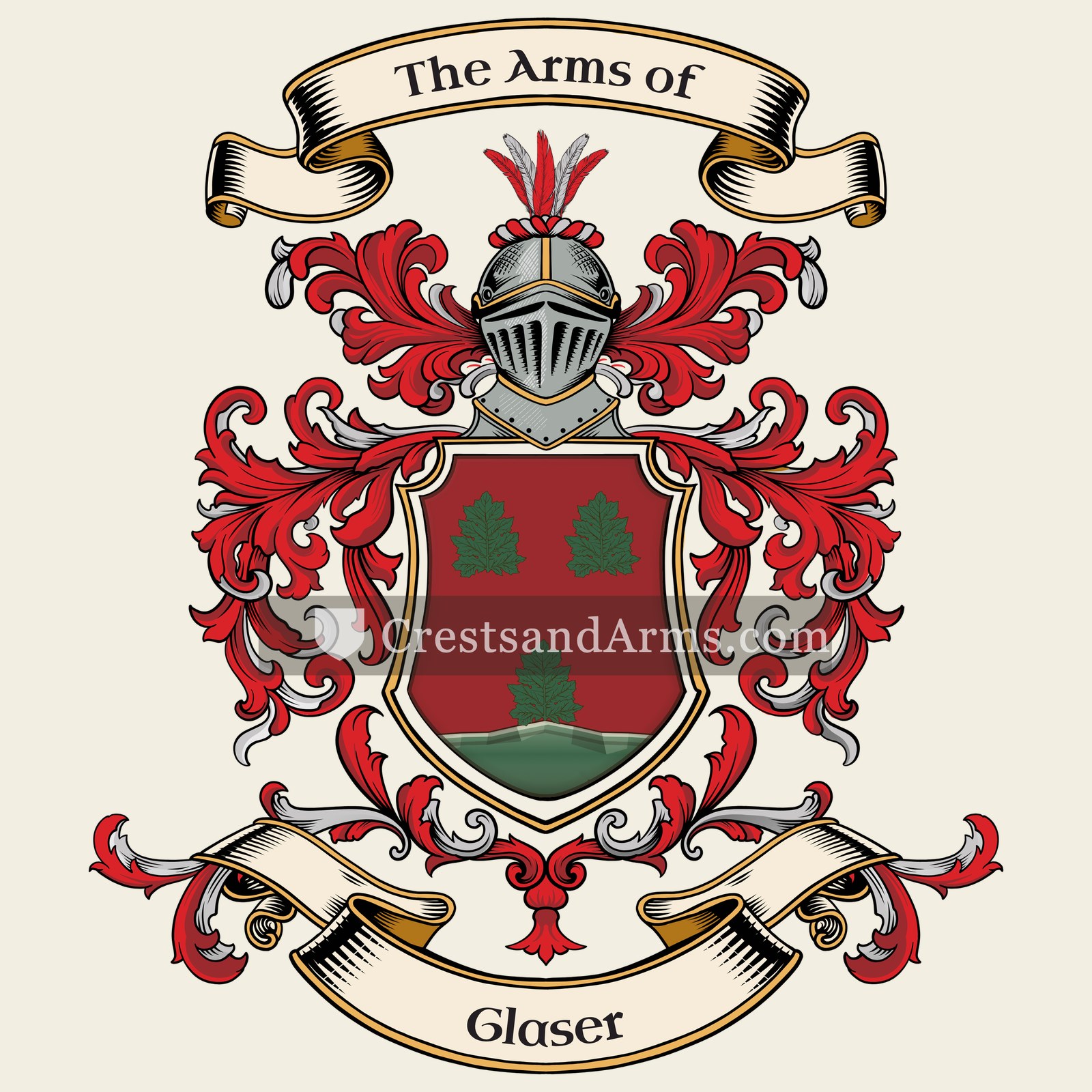
Symbols on this shield
mountThe ground held, and steadfastness upon it
leafHappiness and abundance
Colours
Red (Gules)Means: Military strength
Green (Vert)Means: Hope
Historical info
Source
J. B. Rietstap, Armorial Général, Gouda: G. B. van Goor Zonen, 1884–87
Blazon (the actual original written record)
“De gu. à trois feuilles de tilleul mal-ordonnées, mouv. d'une même tige posée sur un tertre, le tout de sin. C.: un homme iss., hab. de gu., rebr. d'arg., au rabat du même, la main sen. appuyée sur sa hanche et tenant de sa dextre un verre à vin, rempli de vin. L. de sin. et de gu.”
SwitzerlandBâle, c. 1745
Digital archive packCoat of arms PNG, gold border print PDF, vector SVG and the certificate of authenticity. Sent to your email in minutes.
Map of Switzerland showing where the Glaser arms are recorded
The Glaser arms were recorded in Bâle, c. 1745.
This is where the arms were entered in the register. Families often moved to other parts of the country, so the same name can turn up in more than one region.
The body that granted and recorded arms in Switzerland in this period.
How Arms Worked in Switzerland
In Switzerland, coats of arms were not restricted to the nobility and were often adopted by common citizens and families. These symbols were passed down through generations to show family identity. When branches of a family grew, they often changed small details of the design to distinguish their own line from the original group.
Granting authority
Cantonal and civic authorities managed the use of coats of arms within their specific regions and local jurisdictions.
How they got arms
Families typically assumed their own coats of arms based on local custom rather than receiving them from a central monarch.
Where arms were recorded
Arms were recorded in various cantonal and civic registers starting from the fourteenth century throughout the Swiss region.
The family's standing
Recorded among the armigerous families of Switzerland.
Origin & History of the Glaser Family in Switzerland
The surname Glaser originated as an occupational name for a glazier, or a person who worked with glass. In the context of Switzerland, the name became established in the city of Basel during the eighteenth century. By 1745, records confirm that members of the Glaser family were active residents within the city walls. During this period, Basel was a major center for trade and craftsmanship, and families often held specific roles within the local guilds to maintain their status. The Glasers were part of this urban middle class, contributing to the professional life of a city that served as a vital bridge between Swiss and European commerce. As the family settled into the region, they became deeply integrated into the social and economic fabric of the Swiss Confederation.
Glaser Meaning & Related Branches
Root word
Glas
A hard, brittle, transparent substance made by fusing sand with soda.
This name
GlaserAn occupational surname for a person who worked as a glassmaker or glazier.
also spelled
Glazer
Related arms
Glasservariant spelling
Baumannrecorded with Glaser, same area
Bergerrecorded with Glaser, same area
Kornrecorded with Glaser, same area
Documented Sources
J. B. Rietstap, Armorial Général, Gouda: G. B. van Goor Zonen, 1884–87
Bahlow, Hans, Deutsches Namenlexikon: Familien- und Vornamen nach Ursprung und Sinn erklärt, 1967
Heintze, Albert, Die deutschen Familien-Namen: geschichtlich, geographisch, sprachlich, 1903


 stagPeace and harmony, and one who will not fight unprovoked
 stagPeace and harmony, and one who will not fight unprovoked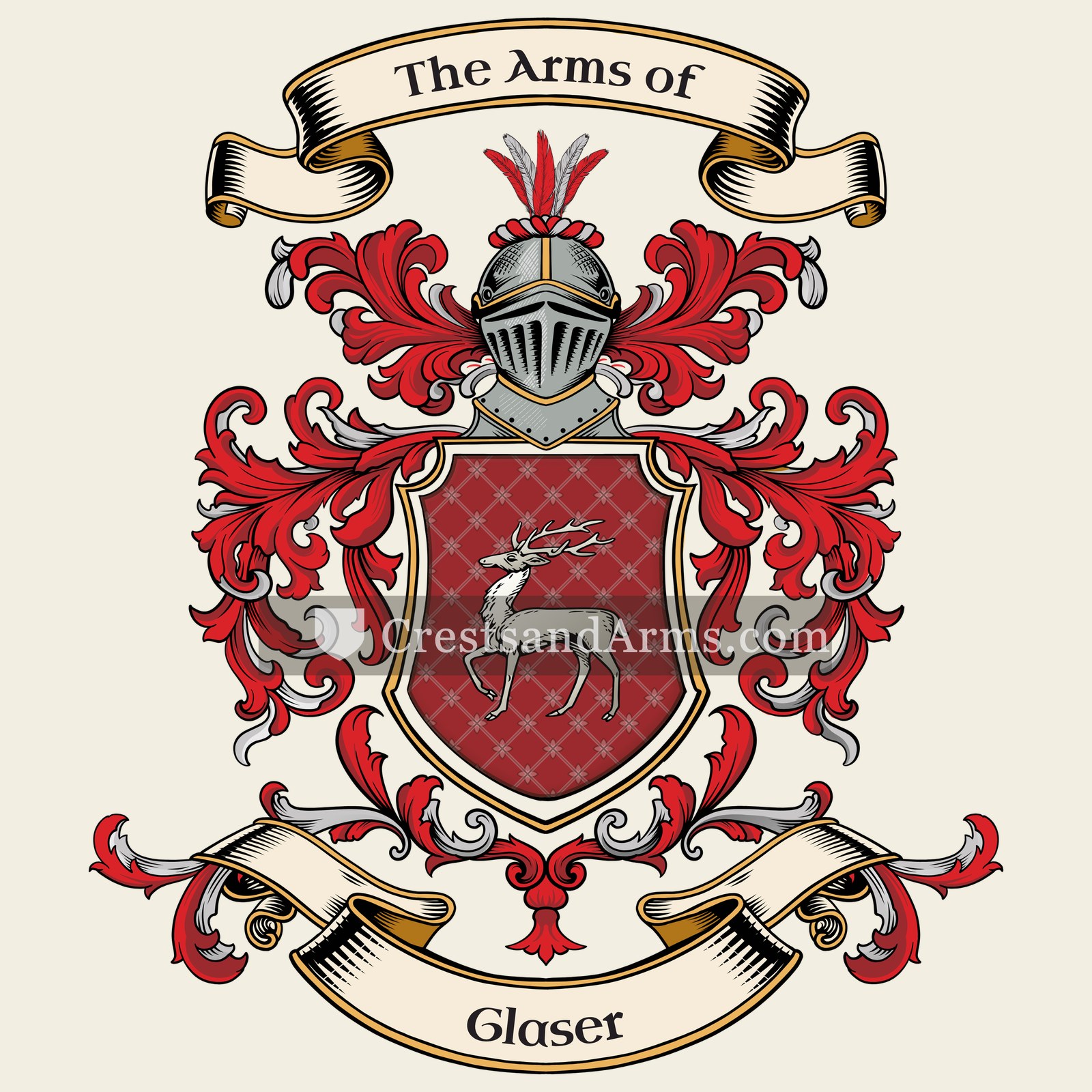


 mountThe ground held, and steadfastness upon it
 leafHappiness and abundance