Map of France showing where the Glasson arms are recorded
The Glasson arms were recorded in Dauphine, c. 1663.
Dauphine lay in the mountains of south-eastern France, a country of small estates and scattered valleys. Its gentry were many and mostly modest, and even a small landholding was enough to justify arms.
This is where the arms were entered in the register. Families often moved to other parts of the country, so the same name can turn up in more than one region.
The body that granted and recorded arms in France in this period.
Louis XIV of France
Sovereign of the period
Louis XIV of France
1643–1715
Reigning in France when the Glasson arms are first recorded.
How Arms Worked in France
In France, a coat of arms was a mark of honor that passed down through the male line to all legitimate descendants. Families often used the same shield without changes to show their shared heritage. If a branch wanted to stand out, they could add a small mark to their shield to show their specific place in the family tree.
Granting authority
The Juge d'armes de France acted as the official authority that regulated and verified coats of arms across the country.
How they got arms
Families typically inherited their arms from ancestors, though they could also receive them through royal grants or by proving their noble status.
Where arms were recorded
Coats of arms were officially recorded in the Armorial Général de France, which began its main collection in the year 1696.
The family's standing
Recorded among the armigerous families of Dauphine.
Origin & History of the Glasson Family in France
The family name Glasson has deep roots in the historical province of Dauphiné, a region nestled in the rugged mountains of southeastern France. By the year 1663, records confirm that members of the family were well-established residents of this area, which served as a gateway between the French kingdom and the Italian states. During the seventeenth century, the people of Dauphiné often lived in close-knit mountain communities where families were deeply tied to the land and local trade routes. The name likely evolved from regional dialects spoken in the foothills of the Alps, reflecting the unique linguistic blend of the area. As the family grew, they participated in the local social and economic life of the province, navigating the complex political shifts that defined the reign of Louis XIV. Their presence in this specific region suggests a history shaped by the challenges of mountain life and the steady development of provincial French society.
Coat of Arms & Family Crest Details
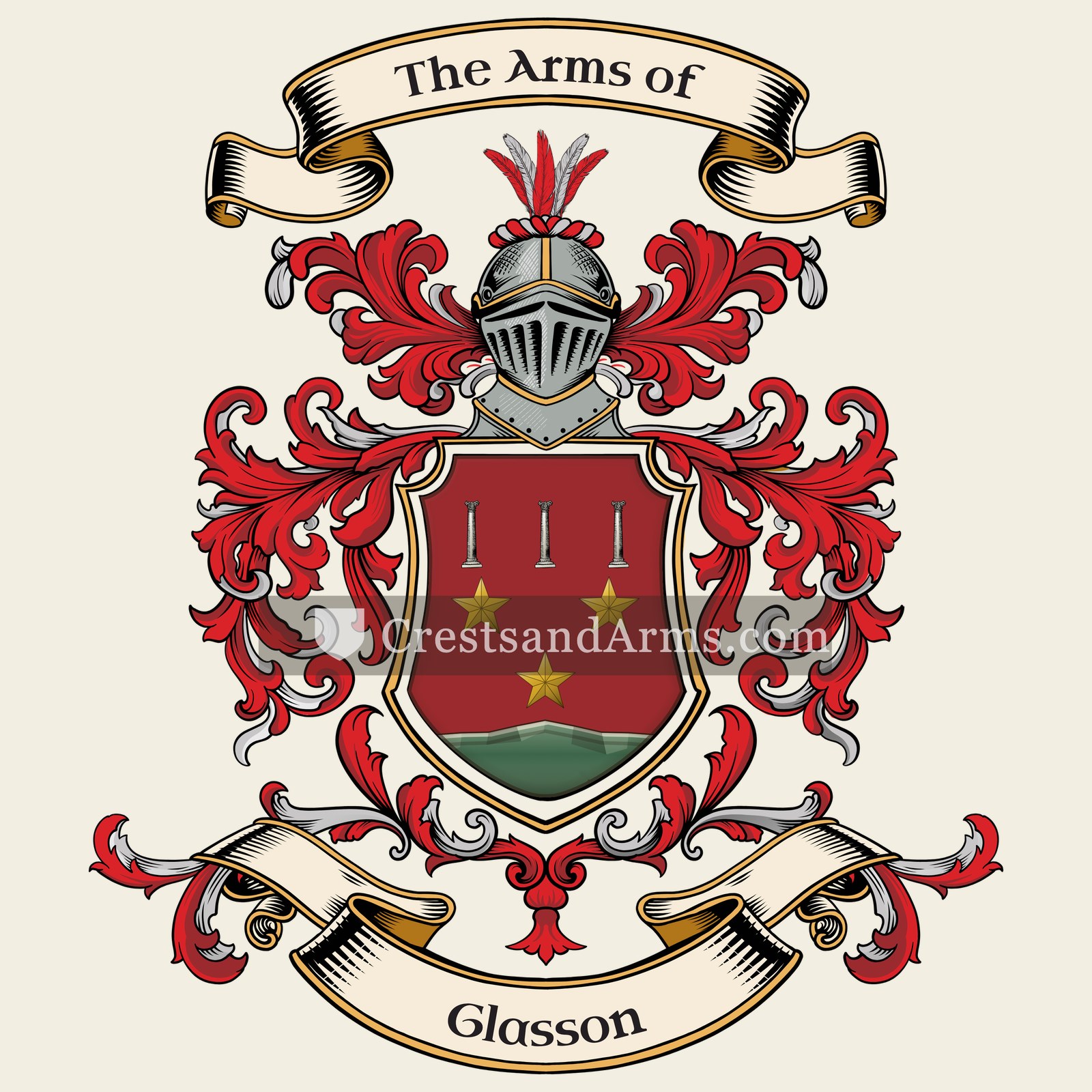
Symbols on this shield
mountThe ground held, and steadfastness upon it
columnFortitude and constancy
mulletThe third son, and a divine quality from above
Colours
Red (Gules)Means: Military strength
Green (Vert)Means: Hope
Silver (Argent)Means: Peace and sincerity
Gold (Or)Means: Generosity
Historical info
Source
J. B. Rietstap, Armorial Général, Gouda: G. B. van Goor Zonen, 1884–87
Blazon (the actual original written record)
“De gu. à un tertre de trois coupeaux de sin., supp. chacun une piramide d'arg., chaque piramide surm. d'une étoile (5) d'or.”
SwitzerlandFribourg, c. 1745
Digital archive packCoat of arms PNG, gold border print PDF, vector SVG and the certificate of authenticity. Sent to your email in minutes.
Map of Switzerland showing where the Glasson arms are recorded
The Glasson arms were recorded in Fribourg, c. 1745.
This is where the arms were entered in the register. Families often moved to other parts of the country, so the same name can turn up in more than one region.
The body that granted and recorded arms in Switzerland in this period.
How Arms Worked in Switzerland
In Switzerland, coats of arms were not restricted to the nobility and were often adopted by common citizens and families. These symbols were passed down through generations to show family identity. When branches of a family grew, they often changed small details of the design to distinguish their own line from the original group.
Granting authority
Cantonal and civic authorities managed the use of coats of arms within their specific regions and local jurisdictions.
How they got arms
Families typically assumed their own coats of arms based on local custom rather than receiving them from a central monarch.
Where arms were recorded
Arms were recorded in various cantonal and civic registers starting from the fourteenth century throughout the Swiss region.
The family's standing
Recorded among the armigerous families of Switzerland.
Origin & History of the Glasson Family in Switzerland
The history of the Glasson family in Switzerland is deeply rooted in the cultural landscape of the Fribourg region. By the year 1745, records confirm that members of the family were already established as active participants in local society. The name likely evolved from regional linguistic patterns, reflecting the diverse mix of French and German influences common in the area during the eighteenth century. Families like the Glassons often served as pillars of their communities, contributing to the agricultural and civic development of the Swiss cantons. Over generations, they integrated into the social fabric of Fribourg, maintaining a presence that spanned centuries of regional transition. Their early history serves as a window into how families established stability and identity within the complex political structure of historic Switzerland.
Glasson Meaning & Related Branches
Root word
Glaçon
A small piece of ice or icicle.
This name
GlassonA topographic or descriptive name for someone living near ice or having a cold temperament.
also spelled
Jlasson
Glason
Documented Sources
J. B. Rietstap, Armorial Général, Gouda: G. B. van Goor Zonen, 1884–87
Archives départementales de l'Isère, Série E, État civil et registres paroissiaux
Borel d'Hauterive, André, Annuaire de la noblesse de France et des maisons souveraines de l'Europe, 1855
Chorier, Nicolas, Histoire générale de Dauphiné, 1661
Digital archive packCoat of arms PNG, gold border print PDF, vector SVG and the certificate of authenticity. Sent to your email in minutes.


 cross symbolChristian faith and service
 roundelA coin, and one who has been to the crusades
 cross symbolChristian faith and service
 roundelA coin, and one who has been to the crusades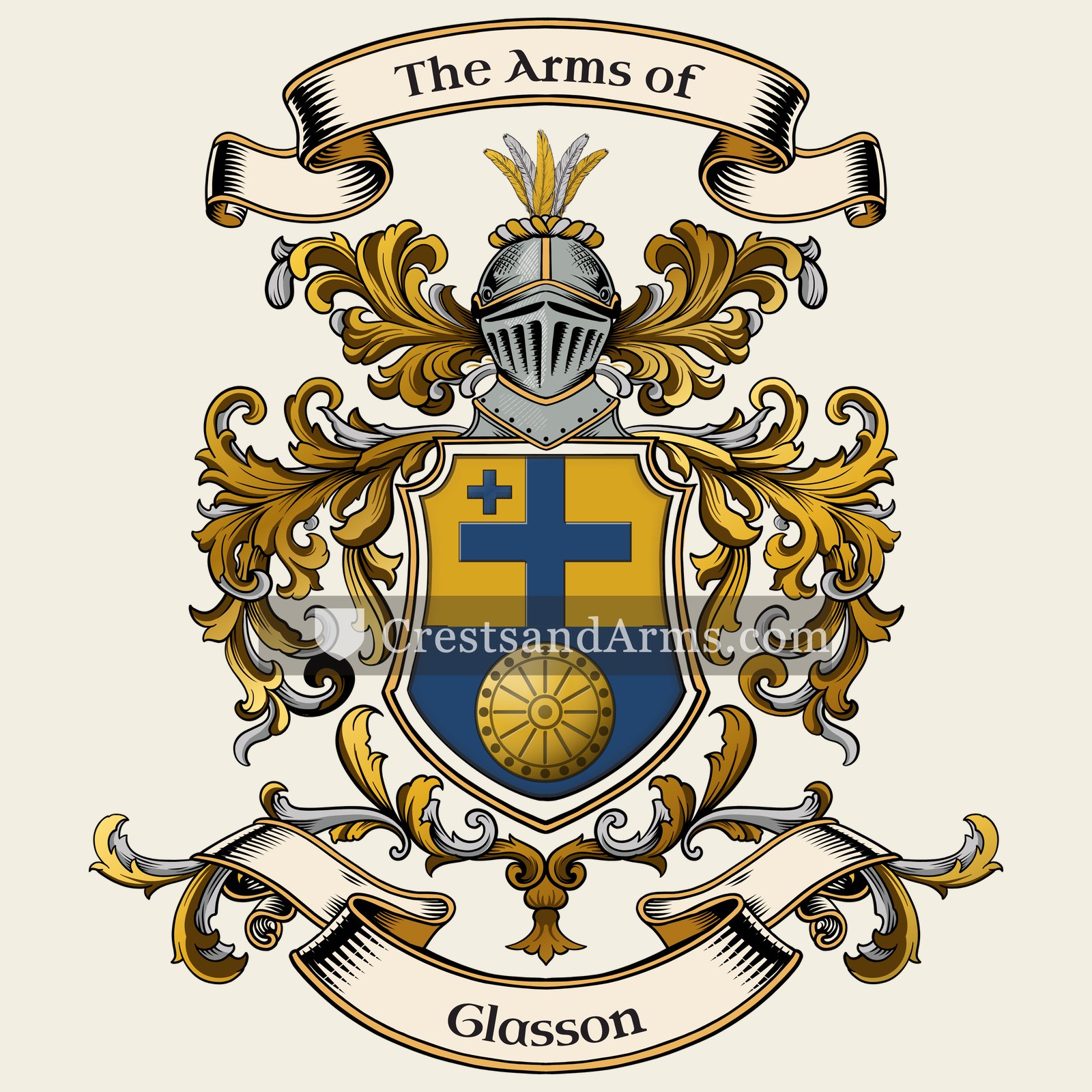


 mountThe ground held, and steadfastness upon it
 columnFortitude and constancy
 mulletThe third son, and a divine quality from above