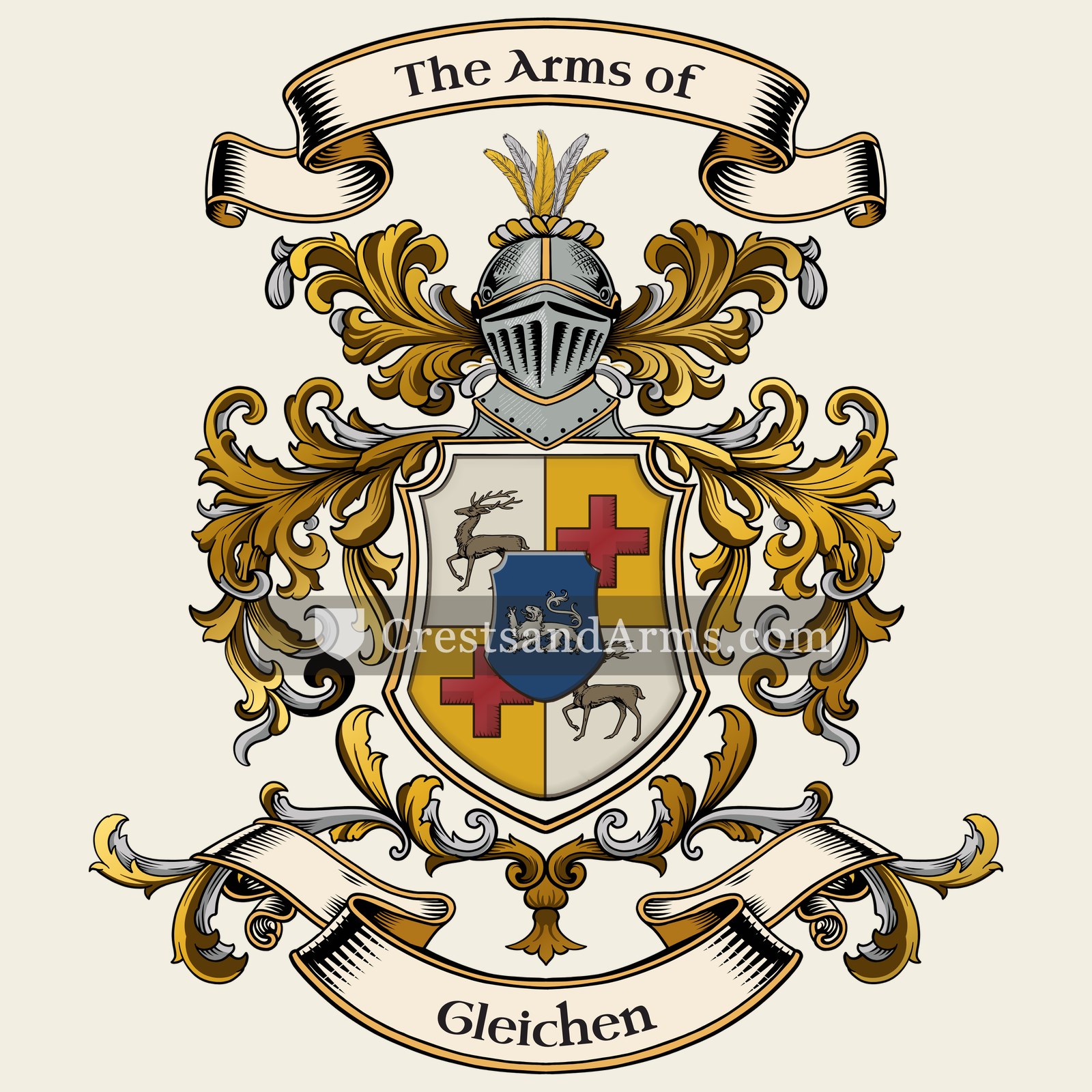
A record of documented arms, meaning and origin, researched for the Gleichen family lines. Documented in 2 countries.
Reg. 3179 · German, G–I
Coat of Arms & Family Crest Details
Symbols on this shield
cross symbolChristian faith and service
lionCourage, strength and royalty
stagPeace and harmony, and one who will not fight unprovoked
Colours
Silver (Argent)Means: Peace and sincerity
Gold (Or)Means: Generosity
Blue (Azure)Means: Loyalty and truth
Red (Gules)Means: Military strength
Historical info
Source
J. B. Rietstap, Armorial Général, Gouda: G. B. van Goor Zonen, 1884–87
Blazon (the actual original written record)
“Ec.: aux 1 et 4 d'arg. à un cerf pass. au nat.; aux 2 et 3 d'or à la croix ancrée de gu. Sur le tout d'azur au lion d'arg., cour. d'or. Trois cq. cour. C.: 1° un cerf au nat., pass. devant une colonne d'arg., sommée d'une queue de paon au nat.; 2° le lion iss., la couronne sommée de trois pl. d'aut. d'azur; 3° un chapeau pyramidal d'or, sommé d'une queue de paon au nat. et traversé d'une branche de la croix ancrée, en barre. L.: d'arg. et de gu.”
SwabiaSwabia, c. 1765
Digital archive packCoat of arms PNG, gold border print PDF, vector SVG and the certificate of authenticity. Sent to your email in minutes.
Map of Germany showing where the Gleichen arms are recorded
The Gleichen arms were recorded in Swabia, c. 1765.
Swabia was broken into a great many small territories in southern Germany, and each had its own landowners and its own leading townsmen. That fragmentation produced an unusual number of families with arms.
This is where the arms were entered in the register. Families often moved to other parts of the country, so the same name can turn up in more than one region.
The body that granted and recorded arms in Germany in this period.
Francis I, Holy Roman Emperor
Sovereign of the period
Francis I, Holy Roman Emperor
1745–1765
Reigning in Germany when the Gleichen arms are first recorded.
How Arms Worked in Germany
In the Holy Roman Empire, coats of arms were often granted to individuals by the Emperor or his representatives. These arms were then passed down through the generations to all legitimate descendants of the original holder. Younger branches of a family usually kept the same shield design without needing to change it, as the arms belonged to the entire lineage.
Granting authority
The Holy Roman Emperor held the sole power to grant new coats of arms throughout his vast imperial territories.
How they got arms
Families typically obtained their coats of arms through a formal imperial grant or by proving their noble status to the authorities.
Where arms were recorded
These grants were officially recorded in the Imperial Chancery registers, which began keeping formal records of such honors during the Middle Ages.
The family's standing
Recorded among the armigerous families of Swabia.
Origin & History of the Gleichen Family in Germany
The name Gleichen traces its roots to the historic regions of Germany, where it emerged as a locational surname tied to the landscape of Swabia. By the mid-18th century, families bearing this name were well-established in the Swabian territory, a region known for its complex social structures and deep agricultural traditions. The name itself is thought to derive from the Old High German word for a smooth or level piece of land, suggesting that the earliest ancestors were likely farmers or landowners who identified themselves by the specific geography of their home. As these families moved through the German states, they integrated into the local community life of the era, living through the significant social and economic shifts that defined the 1700s. While the family name became a marker of their regional identity, it also served as a link to the long history of the Swabian people who shaped the rural development of central Europe.
Coat of Arms & Family Crest Details
Symbols on this shield
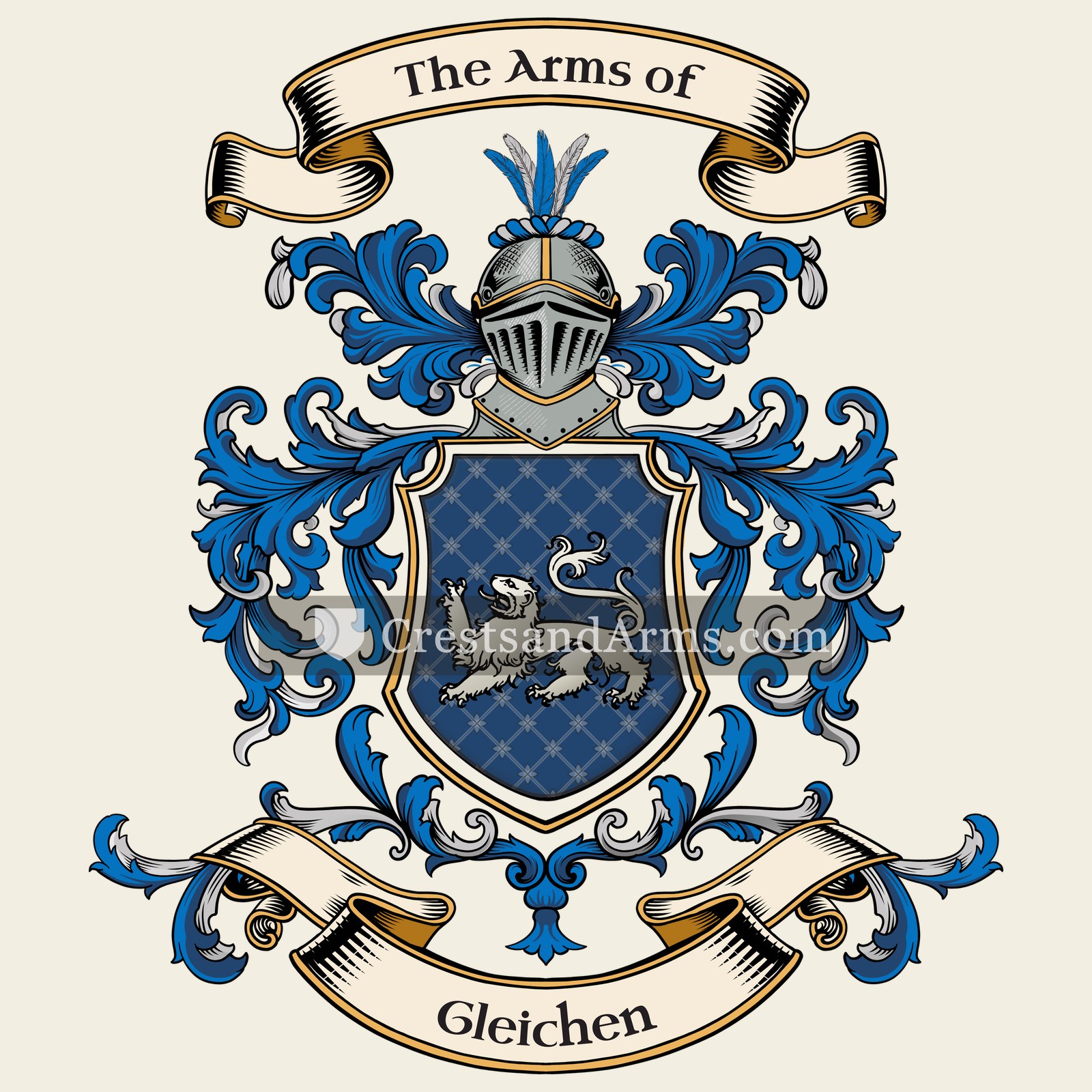
lionCourage, strength and royalty
Colours
Blue (Azure)Means: Loyalty and truth
Silver (Argent)Means: Peace and sincerity
Historical info
Source
J. B. Rietstap, Armorial Général, Gouda: G. B. van Goor Zonen, 1884–87
Blazon (the actual original written record)
“D'azur au lion d'arg., cour. d'or [Issus du mariage du prince Victor de Hohenlohe-Langenburg et de Laure Seymour, conclu le 26 janv. 1860.]”
Britainc. 1861
Digital archive packCoat of arms PNG, gold border print PDF, vector SVG and the certificate of authenticity. Sent to your email in minutes.
Map of Britain showing where the Gleichen arms are recorded
The Gleichen arms were recorded in Britain, c. 1861.
Arms such as these were typically recorded in Kent.
Kent sits between London and the short crossing to Europe, and the trade passing through made it wealthy. Merchant families bought land with that money, and it was landowners who took coats of arms.
This is where the arms were entered in the register. Families often moved to other parts of the country, so the same name can turn up in more than one region.
The body that granted and recorded arms in Britain in this period.
Victoria
Sovereign of the period
Victoria
1837–1901
Reigning in Germany when the Gleichen arms are first recorded.
How Arms Worked in Britain
English heraldry allowed arms to be shared by all legitimate descendants of the original owner. These symbols were treated as personal property that moved through the generations to all children. While the eldest son kept the original design, other family members could use the same shield without needing to change it or register their own unique versions.
Granting authority
The College of Arms in London has regulated the use of coats of arms throughout England and Wales since 1484.
How they got arms
Families typically obtained their coats of arms through a formal grant from the Crown or by proving their ancient right to them.
Where arms were recorded
All official coats of arms are recorded in the registers kept at the College of Arms, which date back to the fifteenth century.
The family's standing
Recorded among the armigerous families of Britain.
Origin & History of the Gleichen Family in Britain
The name Gleichen arrived in Britain during the nineteenth century, carrying with it a legacy rooted in the aristocratic traditions of Central Europe. By 1861, members of the family were established in Kent, a region that often served as a gateway for continental families settling into English society. The family gained significant prominence through Prince Victor of Hohenlohe-Langenburg, who was a member of the House of Gleichen and a distinguished officer in the Royal Navy. He and his relatives integrated into the British social fabric, often serving the monarchy and participating in the cultural life of the Victorian era. Because the name originated from a German noble house, its presence in Britain represents a unique intersection of European royal history and the evolving social landscape of mid-nineteenth-century England. The family’s transition from their ancestral lands to the quiet estates of Kent highlights how international figures contributed to the diverse heritage of the British aristocracy during this period.
Gleichen Meaning & Related Branches
Root word
Gleich
Old High German word meaning equal, alike, or similar.
This name
GleichenRefers to a person who lived near the Gleichen castles or someone of equal status.
also spelled
Gleichenn
Gleychen
Gleichene
Gliken
Documented Sources
J. B. Rietstap, Armorial Général, Gouda: G. B. van Goor Zonen, 1884–87
Bauer, Hermann, Schwäbische Geschichte, 1960
Staatsarchiv Ludwigsburg, Bestand B 146 (Personenstandsunterlagen), 1765
Zimmermann, Paul, Geschichte des Hauses Gleichen, 1892
Digital archive packCoat of arms PNG, gold border print PDF, vector SVG and the certificate of authenticity. Sent to your email in minutes.


 cross symbolChristian faith and service
 lionCourage, strength and royalty
 stagPeace and harmony, and one who will not fight unprovoked
 cross symbolChristian faith and service
 lionCourage, strength and royalty
 stagPeace and harmony, and one who will not fight unprovoked