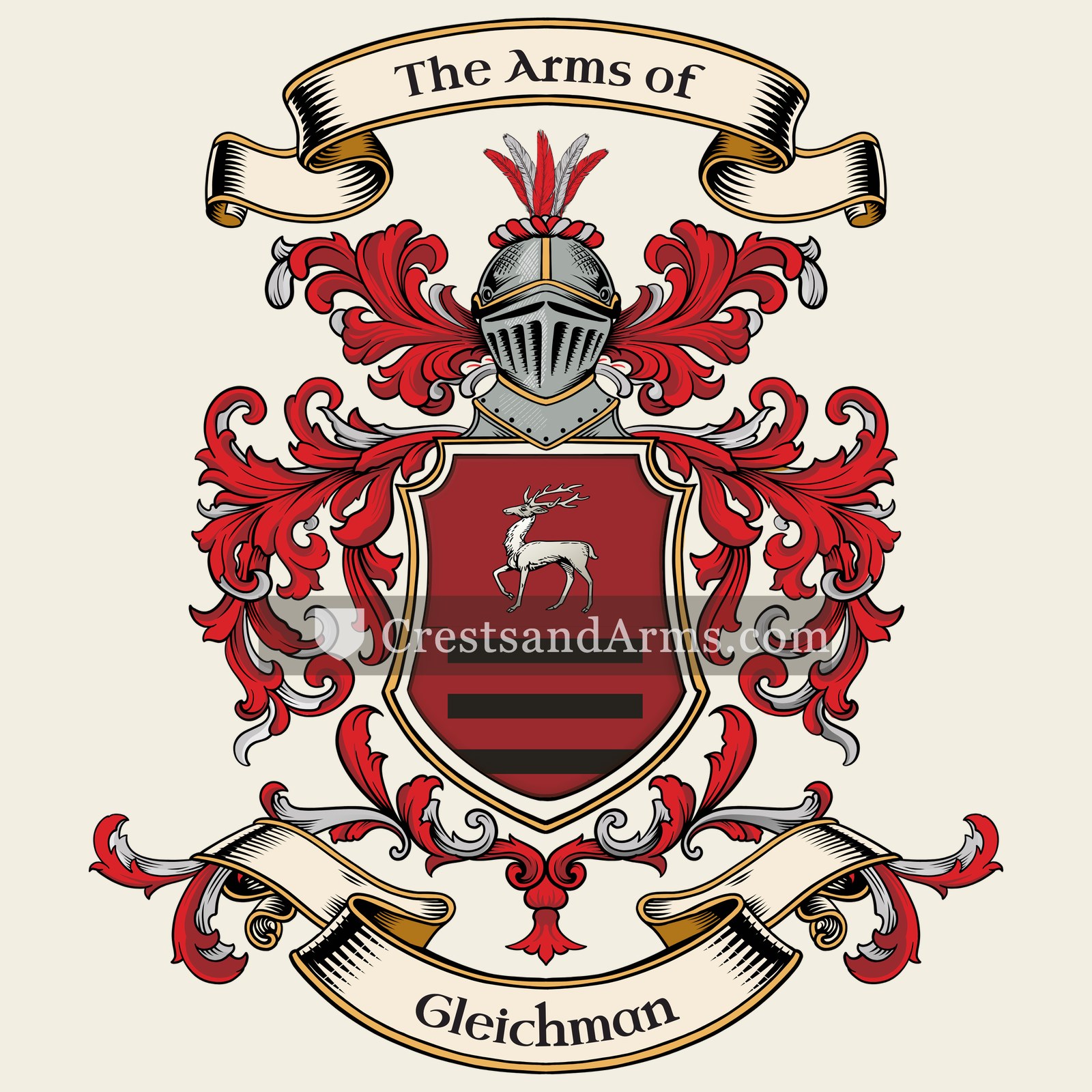
A record of documented arms, meaning and origin, researched for the Gleichman family of Netherlands.
Reg. 2602 · Dutch, G–I
Coat of Arms & Family Crest Details
Symbols on this shield
bendDefence, and the scarf of a commander
stagPeace and harmony, and one who will not fight unprovoked
Colours
Red (Gules)Means: Military strength
Black (Sable)Means: Constancy
Historical info
Source
J. B. Rietstap, Armorial Général, Gouda: G. B. van Goor Zonen, 1884–87
Blazon (the actual original written record)
“Coupé: au 1 de gu. à un cerf naiss. au nat., mouv. du coupé; au 2 de gu. à trois bandes de sa. Cq. cour. C.: deux pl. d'aut.”
NetherlandsRotterdam, c. 1815
Where the Gleichman Arms Were Recorded
Rotterdam
Map of Netherlands showing where the Gleichman arms are recorded
The Gleichman arms were recorded in Rotterdam, c. 1815.
This is where the arms were entered in the register. Families often moved to other parts of the country, so the same name can turn up in more than one region.
Region
Rotterdam
Town
Rotterdam
First recorded
1815
Granting Authority for the Gleichman Arms
Hoge Raad van Adel
Photograph made by me · CC BY-SA 3.0
The body that granted and recorded arms in Netherlands in this period.
William I of the Netherlands
Sovereign of the period
William I of the Netherlands
1815–1840
Reigning in Netherlands when the Gleichman arms are first recorded.
How Arms Worked in Netherlands
In the Netherlands, coats of arms were often used by noble families and those who held specific public offices. These arms were passed down through the generations to legitimate descendants. Younger branches of a family usually kept the original design without needing to add special marks. This system ensured that the family identity remained clear and consistent over many years.
Granting authority
The Hoge Raad van Adel is the official body that regulates and manages noble titles and coats of arms in the Netherlands.
How they got arms
Families typically obtained their coats of arms through official royal grants or by proving their long-standing historical use of the symbols.
Where arms were recorded
Coats of arms are officially recorded in the registers held by the Hoge Raad van Adel, which began its work in 1814.
The family's standing
Recorded among the armigerous families of Netherlands.
Origin & History of the Gleichman Family in Netherlands
The Gleichman family name originates from German roots, where it likely functioned as a descriptive surname based on the Middle High German term *gleich*, meaning equal or balanced. By the early 19th century, members of the family had established a notable presence in the bustling port city of Rotterdam. This move to the Netherlands was common for families involved in international trade, as Rotterdam served as a vital hub for commerce between German territories and the North Sea. Records from 1815 confirm that the family was well-integrated into the local society during a period of significant political change in Europe. Over time, the family became known for their contributions to the professional and civic life of the city, transitioning from their origins as merchants into various roles within the Dutch administrative and business sectors.
Related Branches & Arms
Root word
Gleich
Germanic term meaning equal, level, or similar.
This name
GleichmanRefers to a person of equal status or a neighborly individual.
also spelled
Gleichmann
Gleichmanne
Gleychman
Glaikman
Documented Sources
J. B. Rietstap, Armorial Général, Gouda: G. B. van Goor Zonen, 1884–87


 bendDefence, and the scarf of a commander
 stagPeace and harmony, and one who will not fight unprovoked
 bendDefence, and the scarf of a commander
 stagPeace and harmony, and one who will not fight unprovoked