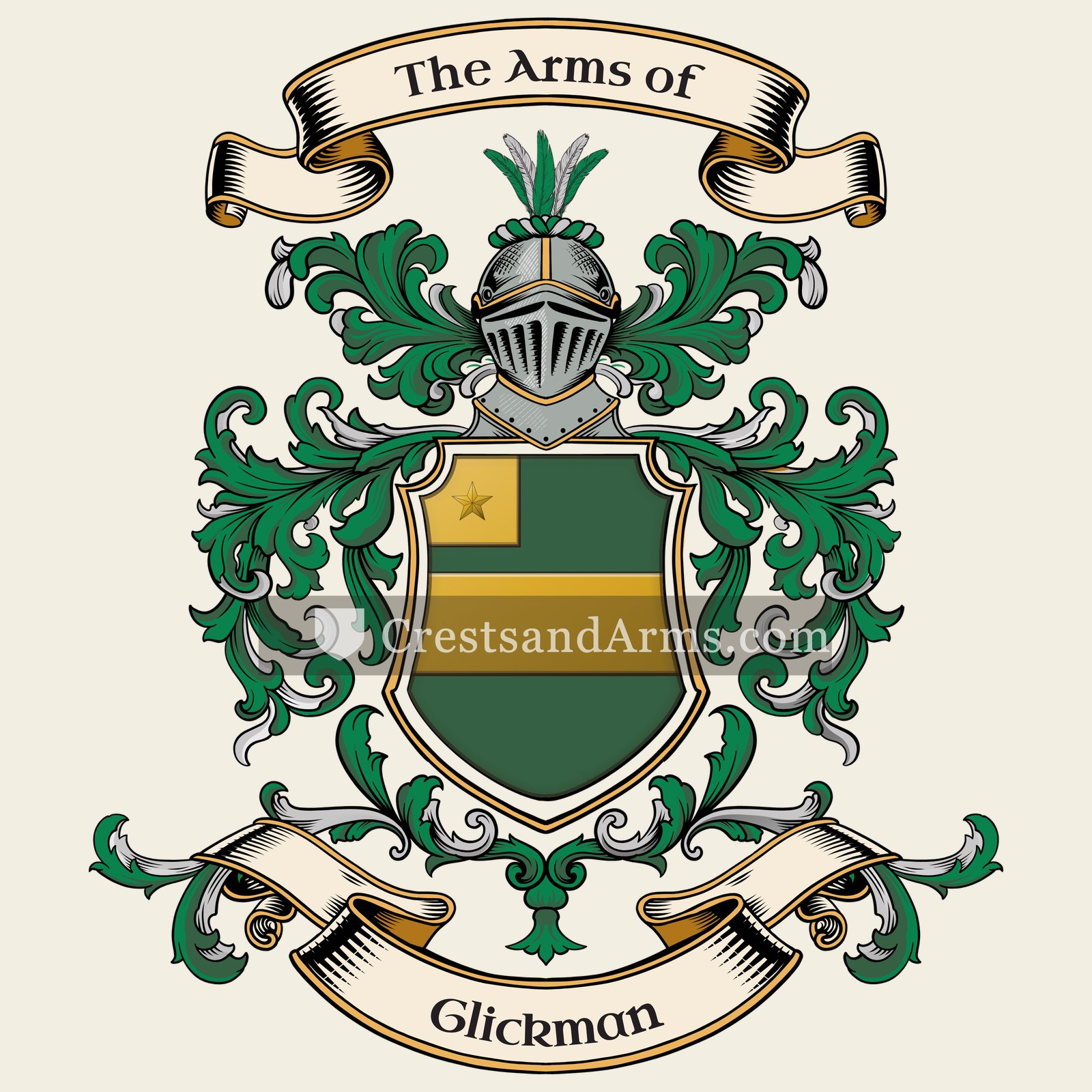
A record of documented arms, meaning and origin, researched for the Glickman family of Germany.
Reg. 5807 · German, G–I
Coat of Arms & Family Crest Details
Symbols on this shield
fessThe military belt, and readiness to serve
cantonA mark of honour granted by the sovereign
mulletThe third son, and a divine quality from above
Colours
Green (Vert)Means: Hope
Gold (Or)Means: Generosity
Historical info
Source
J. B. Rietstap, Armorial Général, Gouda: G. B. van Goor Zonen, 1884–87
Blazon (the actual original written record)
“De sin. à la fasce d'or, acc. au canton sen. du chef d'une étoile du même. Cq. cour. C.: cinq pl. d'aut. de sin., celle du milieu ch. d'une étoile d'or.”
SaxonySaxony, c. 1790
Digital archive packCoat of arms PNG, gold border print PDF, vector SVG and the certificate of authenticity. Sent to your email in minutes.
Map of Germany showing where the Glickman arms are recorded
The Glickman arms were recorded in Saxony, c. 1790.
Saxony had mines, trade and old landed families all at once. Silver made some fortunes and land held others, and both sorts of family kept arms, which is why Saxon names appear so often in the registers.
This is where the arms were entered in the register. Families often moved to other parts of the country, so the same name can turn up in more than one region.
The body that granted and recorded arms in Germany in this period.
Joseph II, Holy Roman Emperor
Sovereign of the period
Joseph II, Holy Roman Emperor
1765–1790
Reigning in Germany when the Glickman arms are first recorded.
How Arms Worked in Germany
In the Holy Roman Empire, coats of arms were often granted to individuals by the Emperor or his representatives. These arms were then passed down through the generations to all legitimate descendants of the original holder. Younger branches of a family usually kept the same shield design without needing to change it, as the arms belonged to the entire lineage.
Granting authority
The Holy Roman Emperor held the sole power to grant new coats of arms throughout his vast imperial territories.
How they got arms
Families typically obtained their coats of arms through a formal imperial grant or by proving their noble status to the authorities.
Where arms were recorded
These grants were officially recorded in the Imperial Chancery registers, which began keeping formal records of such honors during the Middle Ages.
The family's standing
Recorded among the armigerous families of Saxony.
Origin & History of the Glickman Family in Germany
The family name Glickman is rooted in the Germanic and Yiddish linguistic traditions of Central Europe. The name is derived from the Middle High German word *glück*, which translates to luck or happiness, combined with the suffix *man*. In the late 18th century, families carrying this name were well-established in the region of Saxony. During this period, the name likely functioned as a descriptive surname, potentially highlighting a person known for their good fortune or a cheerful disposition. As the family lived in Saxony in 1790, they were part of a complex social landscape where Jewish and German naming conventions often overlapped. Over time, the name evolved as families migrated across borders, but its origins remain tied to the cultural and linguistic shifts occurring in the German-speaking lands during the Enlightenment era.
Glickman Meaning & Related Branches
Root word
Glück
A German noun meaning luck, fortune, or happiness.
This name
GlickmanAn occupational or descriptive surname meaning a lucky man or a man of good fortune.
also spelled
Gleichman
Glaikman
Glickman
Documented Sources
J. B. Rietstap, Armorial Général, Gouda: G. B. van Goor Zonen, 1884–87
Bahlow, Hans, Deutsches Namenlexikon: Familien- und Vornamen nach Ursprung und Sinn erklärt, 1967
Sächsische Staatsarchiv, General-Tabellen der Judenschaft im Kurfürstentum Sachsen, 1790
Zoder, Rudolf, Familiennamen in Ostfalen, 1968
Digital archive packCoat of arms PNG, gold border print PDF, vector SVG and the certificate of authenticity. Sent to your email in minutes.


 fessThe military belt, and readiness to serve
 cantonA mark of honour granted by the sovereign
 mulletThe third son, and a divine quality from above
 fessThe military belt, and readiness to serve
 cantonA mark of honour granted by the sovereign
 mulletThe third son, and a divine quality from above