A record of documented arms, meaning and origin, researched for the Glo family lines. Documented in 3 countries.
Reg. 5349 · Belgian, G–I
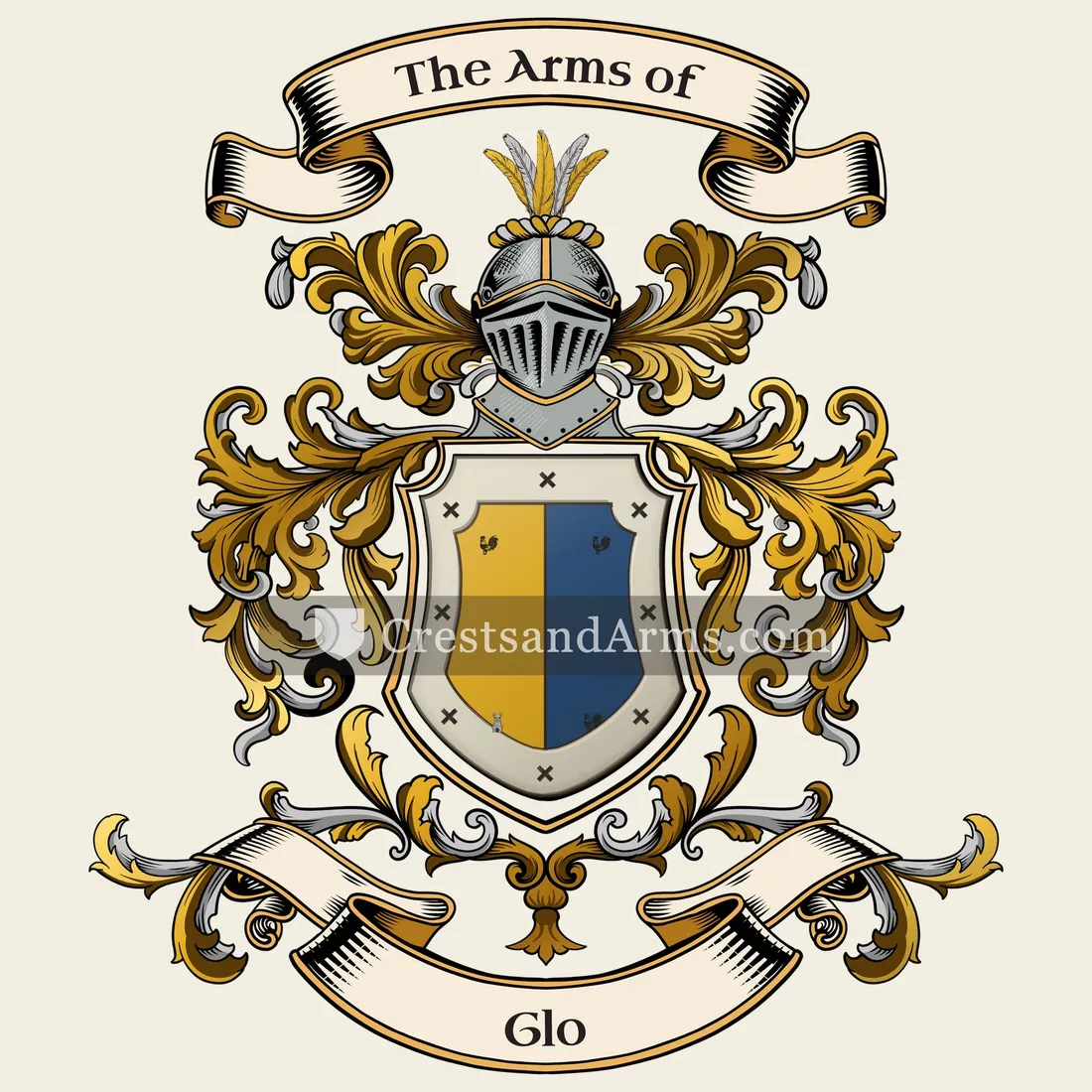
Meaning of the Glo family crest colors & symbols
Symbols on this shield
towerGrandeur and solidity, and a stronghold defended
cockCourage, vigilance and readiness for battle
saltire coupedResolution, and the cross of St Andrew
Colours
Gold (Or)Means: Generosity
Blue (Azure)Means: Loyalty and truth
Silver (Argent)Means: Peace and sincerity
Black (Sable)Means: Constancy
Historical info
Source
J. B. Rietstap, Armorial Général, Gouda: G. B. van Goor Zonen, 1884–87
Blazon (the actual original written record)
“D'or à trois coqs de sa., crêtés, bq. et m. de gu., rangés en pal. - Ou: Parti de sa. et d'azur; à un château d'arg., br. sur le tout. L'écu entouré d'une bord. d'arg. ch. de huit flanchis de sa.”
Belgiumc. 1564
Digital archive packCoat of arms PNG, gold border print PDF, vector SVG and the certificate of authenticity. Sent to your email in minutes.
Map of Belgium showing where the Glo arms are recorded
The Glo arms were recorded in Belgium, c. 1564.
Arms such as these were typically recorded in Brabant.
Brabant lay at the heart of the Low Countries, where the trade routes met. Its towns were wealthy and its landowners many, and both kinds of family kept arms, which is why the region is so heavily represented.
This is where the arms were entered in the register. Families often moved to other parts of the country, so the same name can turn up in more than one region.
The body that granted and recorded arms in Belgium in this period.
Philip II of Spain
Sovereign of the period
Philip II of Spain
1556–1598
Reigning in Belgium when the Glo arms are first recorded.
How Arms Worked in Belgium
In Belgium, a coat of arms is considered personal property that is passed down through the male line to legitimate descendants. Families often use the same shield design across generations to show their shared heritage. If a branch of the family wants to change the design, they must apply for an official update to their specific version of the arms.
Granting authority
The Conseil héraldique is the official body that regulates and approves all coats of arms in Belgium.
How they got arms
Families obtain their coats of arms through formal royal grants or by confirming their historical right to use existing designs.
Where arms were recorded
All approved coats of arms are officially recorded in the public registers of the Conseil héraldique since 1844.
The family's standing
Recorded among the armigerous families of Belgium.
Origin & History of the Glo Family in Belgium
The family name Glo has deep roots in the historical region of Brabant, where records confirm members of the family were established by 1564. During the sixteenth century, this area was a vibrant center of trade and culture within the Low Countries. Families living in Brabant at this time often navigated a landscape shaped by shifting political loyalties and the religious tensions of the Reformation. The name likely developed as a localized identifier for individuals living in or near specific rural settlements or administrative districts. As the family grew, they became part of the local fabric of the region, participating in the agricultural and civic life that defined the Duchy of Brabant. By remaining in this area for generations, the early members of the Glo family helped establish a lasting presence in what would eventually become modern-day Belgium.
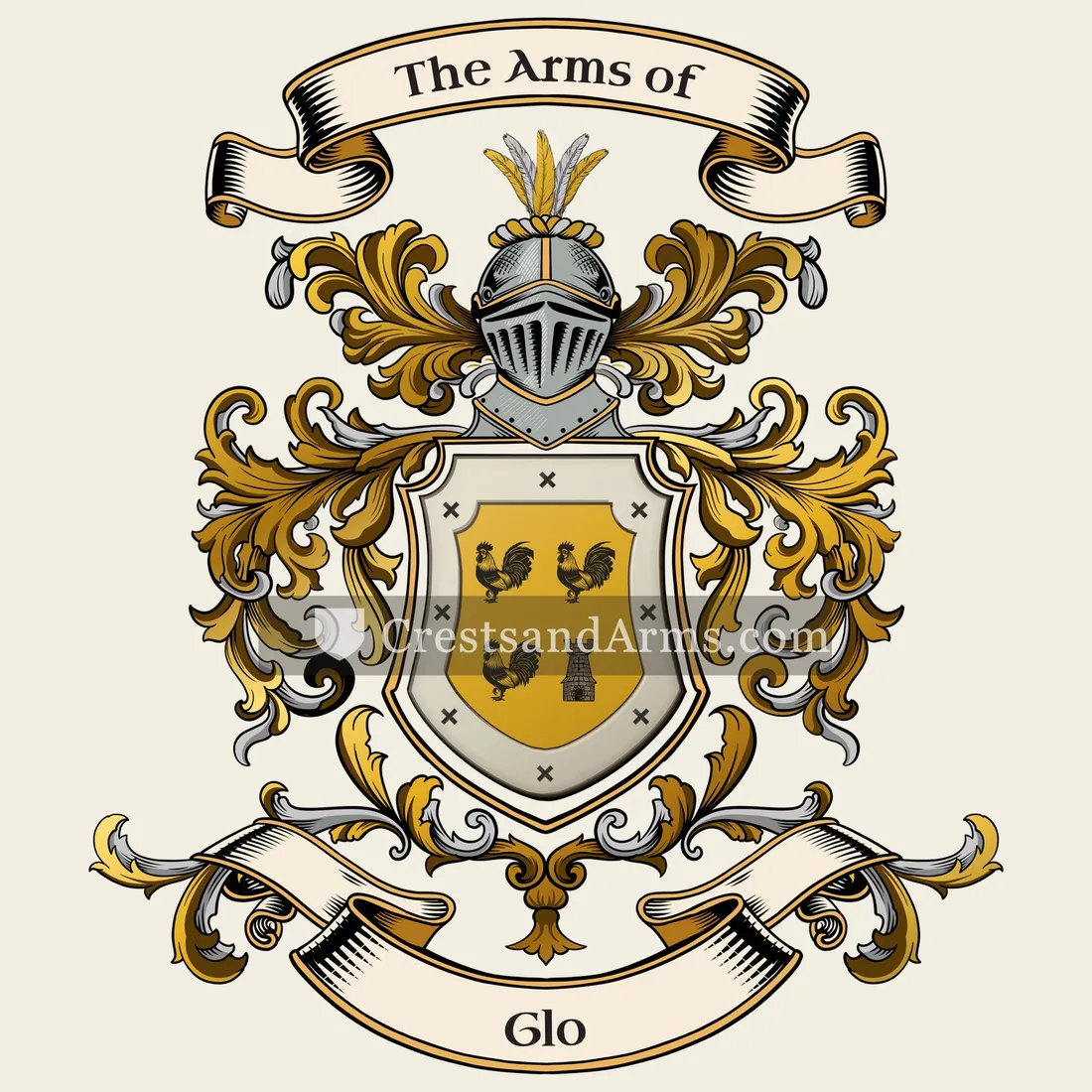
Meaning of the Glo family crest colors & symbols
Symbols on this shield
cockCourage, vigilance and readiness for battle
towerGrandeur and solidity, and a stronghold defended
saltire coupedResolution, and the cross of St Andrew
Colours
Gold (Or)Means: Generosity
Silver (Argent)Means: Peace and sincerity
Black (Sable)Means: Constancy
Historical info
Source
J. B. Rietstap, Armorial Général, Gouda: G. B. van Goor Zonen, 1884–87
Blazon (the actual original written record)
“D'or à trois coqs de sa., crêtés et barbés de gu., rangés en pal, posés à dextre, et une tour de deux étages au nat. à sen., embrasée de gu. dans les fenêtres et dans la porte. L'écu entouré d'une bord. d'arg., ch. de huit flanchis de sa.”
AragonAragon, c. 1722
Digital archive packCoat of arms PNG, gold border print PDF, vector SVG and the certificate of authenticity. Sent to your email in minutes.
Map of Spain showing where the Glo arms are recorded
The Glo arms were recorded in Aragon, c. 1722.
Aragon was mountain and river country in north-eastern Spain, with a strong tradition of small independent landholders. A great many families counted as gentry there, and each one needed a shield to be told apart.
This is where the arms were entered in the register. Families often moved to other parts of the country, so the same name can turn up in more than one region.
The body that granted and recorded arms in Spain in this period.
Philip V of Spain
Sovereign of the period
Philip V of Spain
1714–1724
Reigning in Belgium when the Glo arms are first recorded.
How Arms Worked in Spain
In Spain, a coat of arms was considered a form of property that belonged to the entire family line. These arms were passed down from a father to all his children equally. Younger branches of the family usually kept the original design without needing to add any special marks to distinguish their specific line.
Granting authority
The Cronista Rey de Armas was the official body that regulated and granted coats of arms throughout Spain.
How they got arms
Families often obtained their arms through royal grants or by proving their noble status to the official heraldic authority.
Where arms were recorded
Coats of arms were officially recorded in the registers of the Cronista Rey de Armas starting in 1496.
The family's standing
Recorded among the armigerous families of Aragon.
Origin & History of the Glo Family in Spain
The history of the Glo family in Spain is rooted in the rugged landscape of the Aragon region during the early 18th century. By 1722, records confirm that members of the family were established within this northeastern territory, which was a vital crossroads for trade and agriculture at the time. Life in Aragon during this period was defined by a mix of traditional farming practices and the influence of local administrative centers. Families like the Glos lived through a time of significant transition as the Spanish throne shifted during the War of the Spanish Succession. Because the name is quite rare, it suggests that the family likely held a specific local role or belonged to a small community that maintained strong ties to the land. Over time, these early ancestors helped shape the social fabric of their villages by participating in the local parish systems and regional economic activities that defined life in the Ebro River valley.
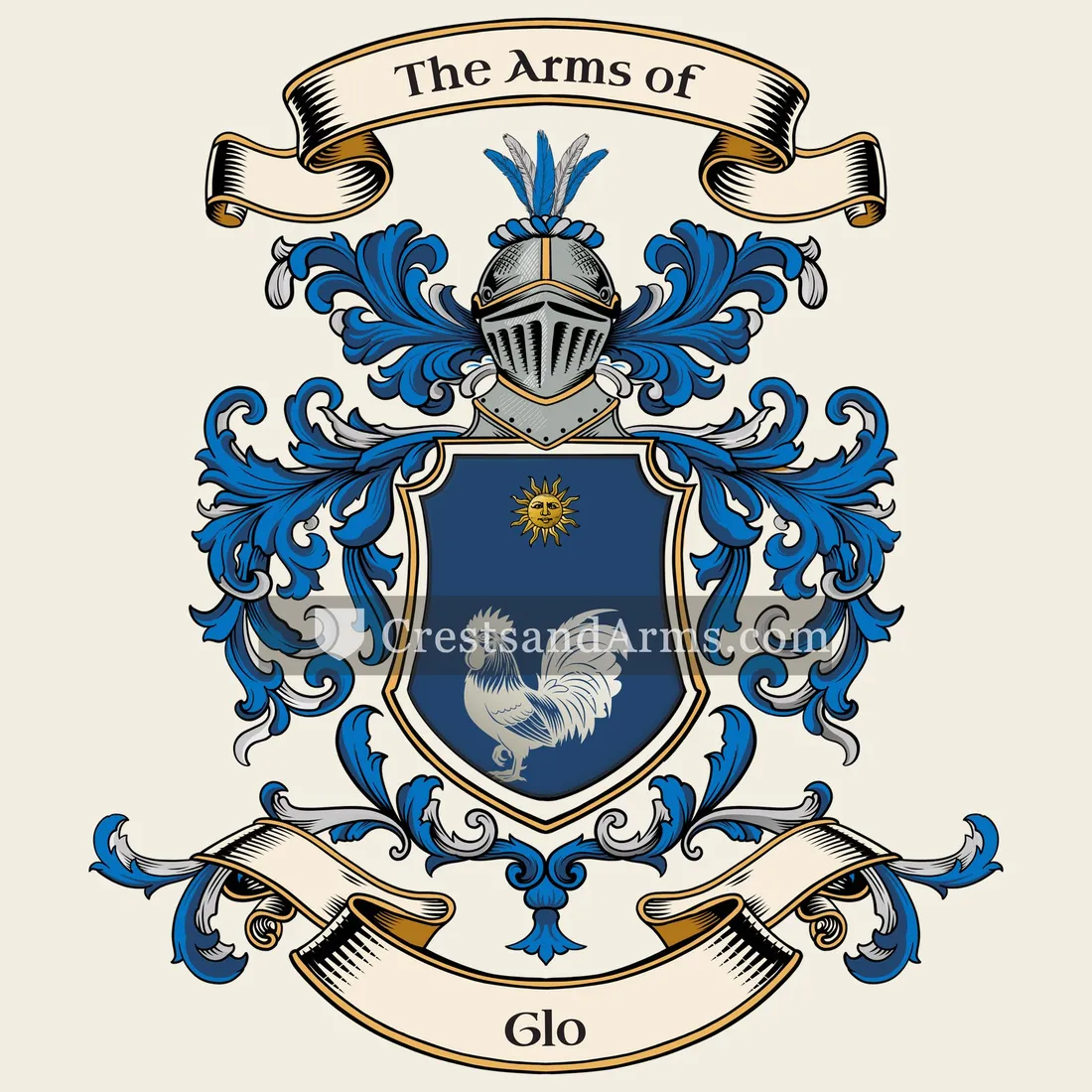
Meaning of the Glo family crest colors & symbols
Symbols on this shield
cockCourage, vigilance and readiness for battle
sunGlory, splendour and the source of life
Colours
Blue (Azure)Means: Loyalty and truth
Silver (Argent)Means: Peace and sincerity
Gold (Or)Means: Generosity
Historical info
Source
J. B. Rietstap, Armorial Général, Gouda: G. B. van Goor Zonen, 1884–87
Blazon (the actual original written record)
“D'azur à un coq d'arg., crêté et barbé de gu., acc. en chef à sen. d'un soleil d'or.”
FranceToulouse, c. 1663
Digital archive packCoat of arms PNG, gold border print PDF, vector SVG and the certificate of authenticity. Sent to your email in minutes.
Map of France showing where the Glo arms are recorded
The Glo arms were recorded in Toulouse, c. 1663.
This is where the arms were entered in the register. Families often moved to other parts of the country, so the same name can turn up in more than one region.
The body that granted and recorded arms in France in this period.
Louis XIV of France
Sovereign of the period
Louis XIV of France
1643–1715
Reigning in Belgium when the Glo arms are first recorded.
How Arms Worked in France
In France, a coat of arms was a mark of honor that passed down through the male line to all legitimate descendants. Families often used the same shield without changes to show their shared heritage. If a branch wanted to stand out, they could add a small mark to their shield to show their specific place in the family tree.
Granting authority
The Juge d'armes de France acted as the official authority that regulated and verified coats of arms across the country.
How they got arms
Families typically inherited their arms from ancestors, though they could also receive them through royal grants or by proving their noble status.
Where arms were recorded
Coats of arms were officially recorded in the Armorial Général de France, which began its main collection in the year 1696.
The family's standing
Recorded among the armigerous families of France.
Origin & History of the Glo Family in France
The family name Glo traces its documented roots to the vibrant city of Toulouse in the mid-seventeenth century. By 1663, records indicate that family members were established within this region, which served as a major cultural and economic hub in southern France. During this era, Toulouse was a center for trade and legal administration, suggesting that the early Glo family likely participated in the urban life of a city defined by its distinctive pink brick architecture and its role as a gateway to the Pyrenees. Families in this area often navigated the complex social structures of the Languedoc province, where local customs and the influence of the Catholic Church shaped daily existence. While the name remains relatively rare, its presence in the historical registers of Toulouse highlights a long-standing connection to the Languedoc region, marking the family as part of the historical fabric of southern France during the reign of King Louis XIV.
Glo Meaning & Related Branches
Root word
Glowe
Middle Low German term for a glowing or bright light.
This name
GloA topographic or descriptive surname likely referring to a person living near a bright location or beacon.
also spelled
Galloe
Galloo
Galloi
Galo
Documented Sources
J. B. Rietstap, Armorial Général, Gouda: G. B. van Goor Zonen, 1884–87
State Archives in Belgium (Rijksarchief in België), Registers van de Raad van Brabant
State Archives in Belgium (Rijksarchief in België), Parochieregisters van het Hertogdom Brabant
Fruin, Robert, Geschiedenis der Staatsinstellingen in Nederland tot den val der Republiek, 1901
Pirenne, Henri, Histoire de Belgique, 1900
Digital archive packCoat of arms PNG, gold border print PDF, vector SVG and the certificate of authenticity. Sent to your email in minutes.


 towerGrandeur and solidity, and a stronghold defended
 cockCourage, vigilance and readiness for battle
 saltire coupedResolution, and the cross of St Andrew
 towerGrandeur and solidity, and a stronghold defended
 cockCourage, vigilance and readiness for battle
 saltire coupedResolution, and the cross of St Andrew




 sunGlory, splendour and the source of life