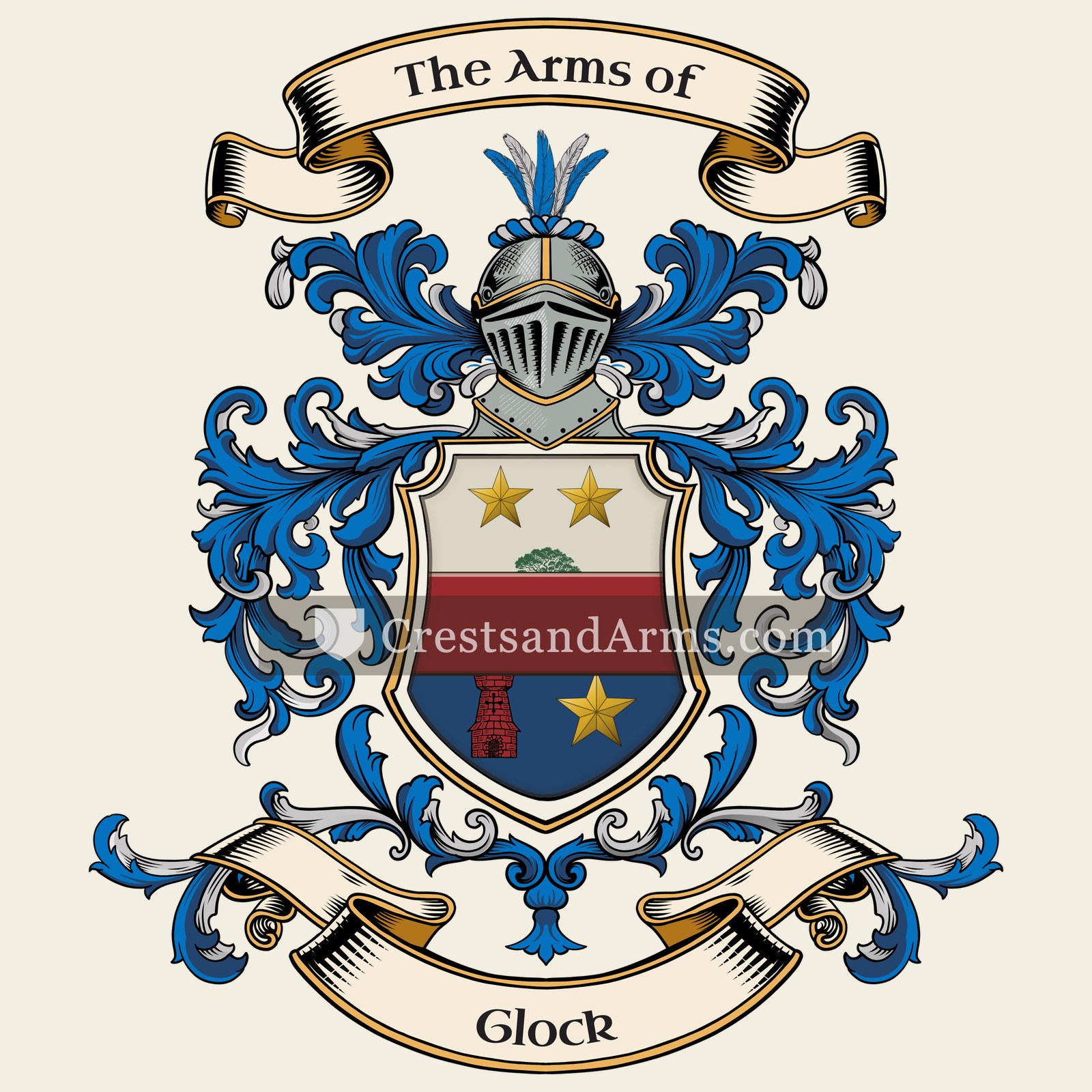
A record of documented arms, meaning and origin, researched for the Glock family of Switzerland.
Reg. 6011 · Swiss, G–I
Coat of Arms & Family Crest Details
Symbols on this shield
treeLife, endurance and deep roots
mulletThe third son, and a divine quality from above
towerGrandeur and solidity, and a stronghold defended
Colours
Silver (Argent)Means: Peace and sincerity
Blue (Azure)Means: Loyalty and truth
Red (Gules)Means: Military strength
Green (Vert)Means: Hope
Gold (Or)Means: Generosity
Historical info
Source
J. B. Rietstap, Armorial Général, Gouda: G. B. van Goor Zonen, 1884–87
Blazon (the actual original written record)
“Coupé: au 1 d'arg. à un arbre de sin., mouv. du coupé et acc. en chef de deux étoiles d'or; au 2 d'azur à une tour de gu. sommée de deux tourelles du même, entre lesquelles se trouve une étoile d'or, la tour ouv. du champ. Brl. de gu. et d'arg. C.: une cloche d'or. L. d'arg. et de gu.”
SwitzerlandBâle, c. 1745
Digital archive packCoat of arms PNG, gold border print PDF, vector SVG and the certificate of authenticity. Sent to your email in minutes.
Map of Switzerland showing where the Glock arms are recorded
The Glock arms were recorded in Bâle, c. 1745.
This is where the arms were entered in the register. Families often moved to other parts of the country, so the same name can turn up in more than one region.
The body that granted and recorded arms in Switzerland in this period.
How Arms Worked in Switzerland
In Switzerland, coats of arms were not restricted to the nobility and were often adopted by common citizens and families. These symbols were passed down through generations to show family identity. When branches of a family grew, they often changed small details of the design to distinguish their own line from the original group.
Granting authority
Cantonal and civic authorities managed the use of coats of arms within their specific regions and local jurisdictions.
How they got arms
Families typically assumed their own coats of arms based on local custom rather than receiving them from a central monarch.
Where arms were recorded
Arms were recorded in various cantonal and civic registers starting from the fourteenth century throughout the Swiss region.
The family's standing
Recorded among the armigerous families of Switzerland.
Origin & History of the Glock Family in Switzerland
The surname Glock is rooted in the German language, where the word "Glocke" refers to a bell. During the Middle Ages, names were often derived from a person’s occupation, and it is highly likely that the earliest individuals to carry this name were bell-founders or makers of bells. By the mid-18th century, the family had established a notable presence in the city of Bâle, which is known today as Basel, Switzerland. Records confirm that members of the Glock family were living and working in this region by 1745. Given the city’s historical importance as a center for trade and craftsmanship, the family likely integrated into the local economy through skilled labor or merchant activities. Over time, the name spread throughout German-speaking lands, carried by generations who maintained the family identity while adapting to the social and political changes of the era.
Glock Meaning & Related Branches
Root word
Glocke
A bell or a metal vessel used for ringing.
This name
GlockAn occupational name for a bell maker or a bell ringer.
also spelled
Glocke
Glockk
Gloc
Documented Sources
J. B. Rietstap, Armorial Général, Gouda: G. B. van Goor Zonen, 1884–87
Staatsarchiv Basel-Stadt, Bürgerverzeichnisse und Einwohnerregister 1745
Bahlow, Hans, Deutsches Namenlexikon: Familien- und Vornamen nach Ursprung und Sinn erklärt, 1967
Heintze, Albert, Die deutschen Familien-Namen: geschichtlich, geographisch, sprachlich, 1903
Digital archive packCoat of arms PNG, gold border print PDF, vector SVG and the certificate of authenticity. Sent to your email in minutes.


 treeLife, endurance and deep roots
 mulletThe third son, and a divine quality from above
 towerGrandeur and solidity, and a stronghold defended
 treeLife, endurance and deep roots
 mulletThe third son, and a divine quality from above
 towerGrandeur and solidity, and a stronghold defended