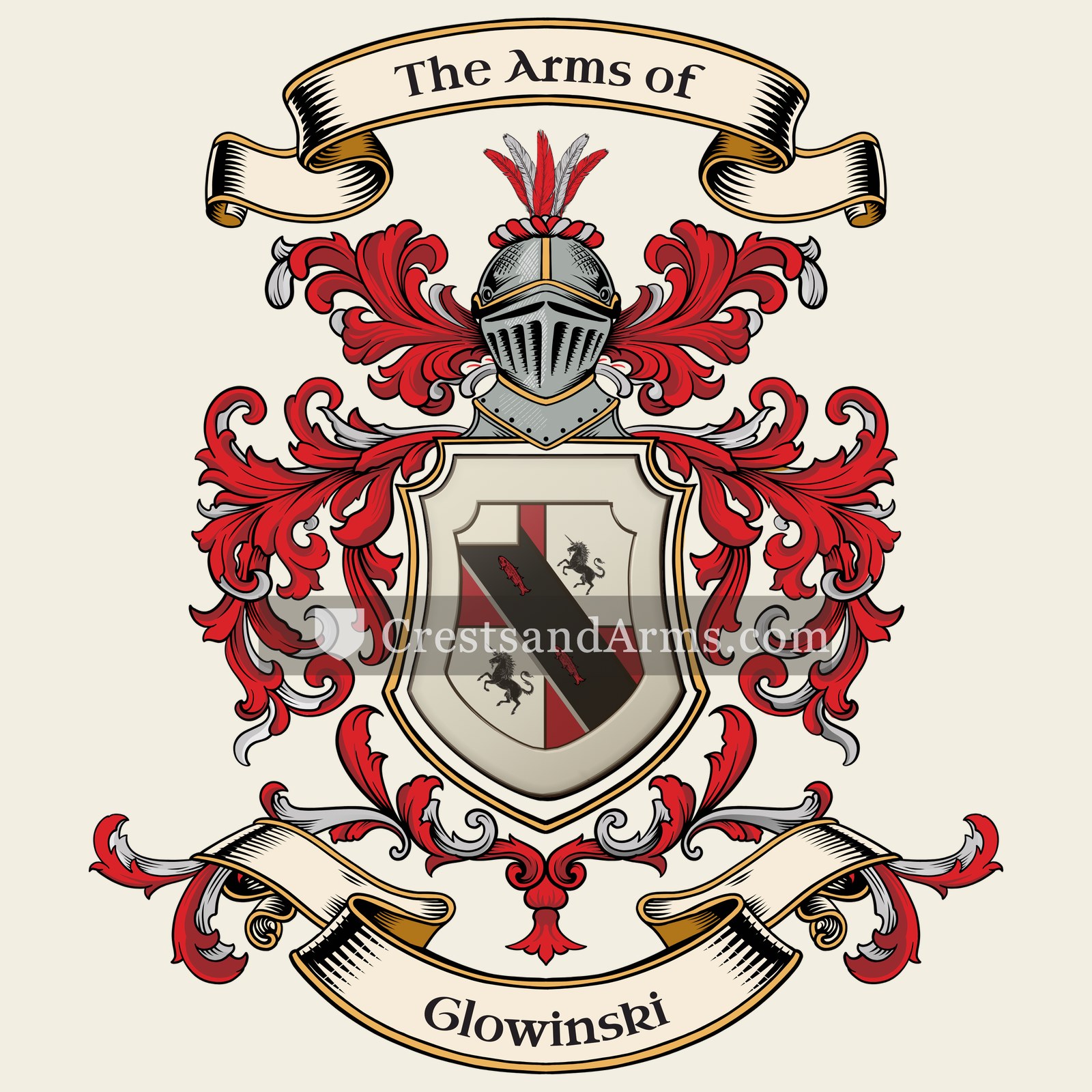
A record of documented arms, meaning and origin, researched for the Glowinski family of Poland.
Reg. 9611 · Polish, G–I
Coat of Arms & Family Crest Details
Symbols on this shield
bendDefence, and the scarf of a commander
fishA true and generous mind, and Christian faith
unicornPurity, and extreme courage in defence of honour
Colours
Red (Gules)Means: Military strength
Silver (Argent)Means: Peace and sincerity
Black (Sable)Means: Constancy
Historical info
Source
J. B. Rietstap, Armorial Général, Gouda: G. B. van Goor Zonen, 1884–87
Blazon (the actual original written record)
“de gu. plein; b. et c. d'arg. à trois bandes de sa.; aux 2 et 3 de gu. à une licorne ramp. d'arg. Sur le tout tranché de sa. sur arg., à deux poissons de l'un à l'autre, posés en bandes, celui en p. ayant la tête en bas. Deux cq. cour. C.: 1° à dextre une prob. d'arg., ch. de trois barres de sa., ornée à l'ext. de quatre plumes de paon et dans l'embouchure de trois plumes pareilles; à sen. un poisson renv. d'arg., orné à l'ext. de quatre plumes de paon et dans l'interstice de la queue de trois plumes pareilles; 1. d'arg. et de sa.; 2° une licorne iss. d'arg., cour. d'or; 1. d'arg. et de gu. - (Barons:) Parti: au 1. éc.: au 1 c.-éc.: a. et d. de gu. plein; b. d'arg. à deux bandes de sa.; c. d'arg. à trois barres de sa.; aux 2 et 3 de gu. à une licorne ramp. d'arg., celle du 3 cont.; au 4 c.-éc.: a. d'arg. à deux bandes de sa.; b. et c. de gu. plein; d. d'arg. à trois barres de sa.; au II. éc.: aux 1 et 4 d'or à l'aigle de sa., celle du 1 cont.; aux 2 et 3 d'arg. à un sanglier ramp. de sa., celui du 3 cont. Sur le tout tranché de sa. sur arg., à deux poissons de l'un à l'autre, posés en bandes, la tête en bas. Quatre cq. cour. C.: 1° une proboscide barrée d'arg. et de sa., et un poisson renv. de sa., ornés chacun à l'ext. de feuilles de sin.; 2° une licorne iss. et cont. d'arg.; 3° un buste d'homme, hab. de gu., coiffé d'un bonnet pointu de sa., retr. et tort. d'arg.; 4° un sanglier iss. de sa. L. d'arg. et de gu.”
Polandc. 1772
Digital archive packCoat of arms PNG, gold border print PDF, vector SVG and the certificate of authenticity. Sent to your email in minutes.
Map of Poland showing where the Glowinski arms are recorded
The Glowinski arms were recorded in Poland, c. 1772.
Arms such as these were typically recorded in Mazovia.
Mazovia held Warsaw, the Polish court and the assemblies where the szlachta met. Poland's nobles were unusually numerous and every one of them bore arms, and Warsaw is where those arms were argued over and recorded.
This is where the arms were entered in the register. Families often moved to other parts of the country, so the same name can turn up in more than one region.
Region
Mazovia
First recorded
1772
Granting Authority for the Glowinski Arms
Ennoblement by the Sejm
Author: Olek Remesz · CC BY-SA 3.0
The body that granted and recorded arms in Poland in this period.
Stanisław August Poniatowski
Sovereign of the period
Stanisław August Poniatowski
1764–1795
Reigning in Poland when the Glowinski arms are first recorded.
How Arms Worked in Poland
Polish noble families shared a single coat of arms across many different surnames, creating large clans rather than individual designs. These symbols were held collectively by all members of the clan regardless of their specific family name. When a new family joined the nobility, they were adopted into an existing clan and began using that group's established shield.
Granting authority
The Sejm, which was the Polish parliament, held the power to grant noble status and the right to bear arms.
How they got arms
Families typically received their coat of arms through a formal act of ennoblement granted by the Sejm for distinguished service.
Where arms were recorded
These grants were officially recorded in the Crown Metrica, which served as the central archive for state documents starting in the sixteenth century.
The family's standing
Recorded among the armigerous families of Poland.
Origin & History of the Glowinski Family in Poland
The family name Glowinski is rooted in the historical region of Mazovia, a central part of Poland known for its flat plains and deep connection to the Vistula River. By 1772, records confirm that members of the family were well-established in this area, living during a time of significant political change as the First Partition of Poland began to reshape the map of Europe. The name itself follows a traditional Polish naming pattern, likely derived from the word "głowa," which means head, or from a specific geographic location where the family first settled. Families in this region often lived in small agricultural villages or served in local administrative roles, helping to maintain the social structure of the Mazovian countryside. As the family grew and moved across the landscape, they carried this name as a marker of their regional identity and their long-standing ties to the Polish heartland.
Glowinski Meaning & Related Branches
Root word
głowa
A Polish noun referring to the human head.
This name
GlowinskiA topographic or descriptive surname indicating someone with a large head or a headman.
also spelled
Glowinsky
Documented Sources
J. B. Rietstap, Armorial Général, Gouda: G. B. van Goor Zonen, 1884–87
Dziadulewicz, Stanisław. Herbarz rodzin tatarskich w Polsce. 1929. (Note: While focused on Tatar families, this work provides essential context on the naming conventions and social structures of the Polish-Lithuanian Commonwealth during the 18th century.)
Gloger, Zygmunt. Geografia historyczna ziem dawnej Polski. 1903
Archiwum Główne Akt Dawnych (Central Archives of Historical Records in Warsaw), Księgi metrykalne parafii rzymskokatolickich z terenu Mazowsza (Parish registers of Roman Catholic parishes in the Mazovia region)
Digital archive packCoat of arms PNG, gold border print PDF, vector SVG and the certificate of authenticity. Sent to your email in minutes.


 bendDefence, and the scarf of a commander
 fishA true and generous mind, and Christian faith
 unicornPurity, and extreme courage in defence of honour