Map of England showing where the Goddard arms are recorded
The Goddard arms were recorded in Berks, c. 1574.
Berkshire sat on the road west from London with the royal castle at Windsor in the middle of it. Court families bought estates within reach, and an estate near the court almost always came with a coat of arms.
This is where the arms were entered in the register. Families often moved to other parts of the country, so the same name can turn up in more than one region.
The body that granted and recorded arms in England in this period.
Elizabeth I of England
Sovereign of the period
Elizabeth I of England
1558–1603
Reigning in England when the Goddard arms are first recorded.
How Arms Worked in England
English heraldry allowed arms to be shared by all legitimate descendants of the original owner. These symbols were treated as personal property that moved through the generations to all children. While the eldest son kept the original design, other family members could use the same shield without needing to change it or register their own unique versions.
Granting authority
The College of Arms in London has regulated the use of coats of arms throughout England and Wales since 1484.
How they got arms
Families typically obtained their coats of arms through a formal grant from the Crown or by proving their ancient right to them.
Where arms were recorded
All official coats of arms are recorded in the registers kept at the College of Arms, which date back to the fifteenth century.
The family's standing
Recorded among the armigerous families of Berks.
Origin & History of the Goddard Family in England
The surname Goddard is rooted in the Old English language, derived from the personal name Godard, which combines the words for "god" and "hard" or "brave." This name became popular across England following the Norman Conquest, as it reflected the cultural blending of Germanic and French naming traditions. By the late sixteenth century, the family had established a notable presence in the county of Berkshire. Records from 1574 confirm that members of the Goddard family were settled in this region, where they were often involved in local land ownership and community administration. As the family grew, they became deeply integrated into the social and economic life of the English countryside, moving from simple landholders to figures who helped shape the local history of their respective parishes.
Meaning of the Goddard family crest colors & symbols
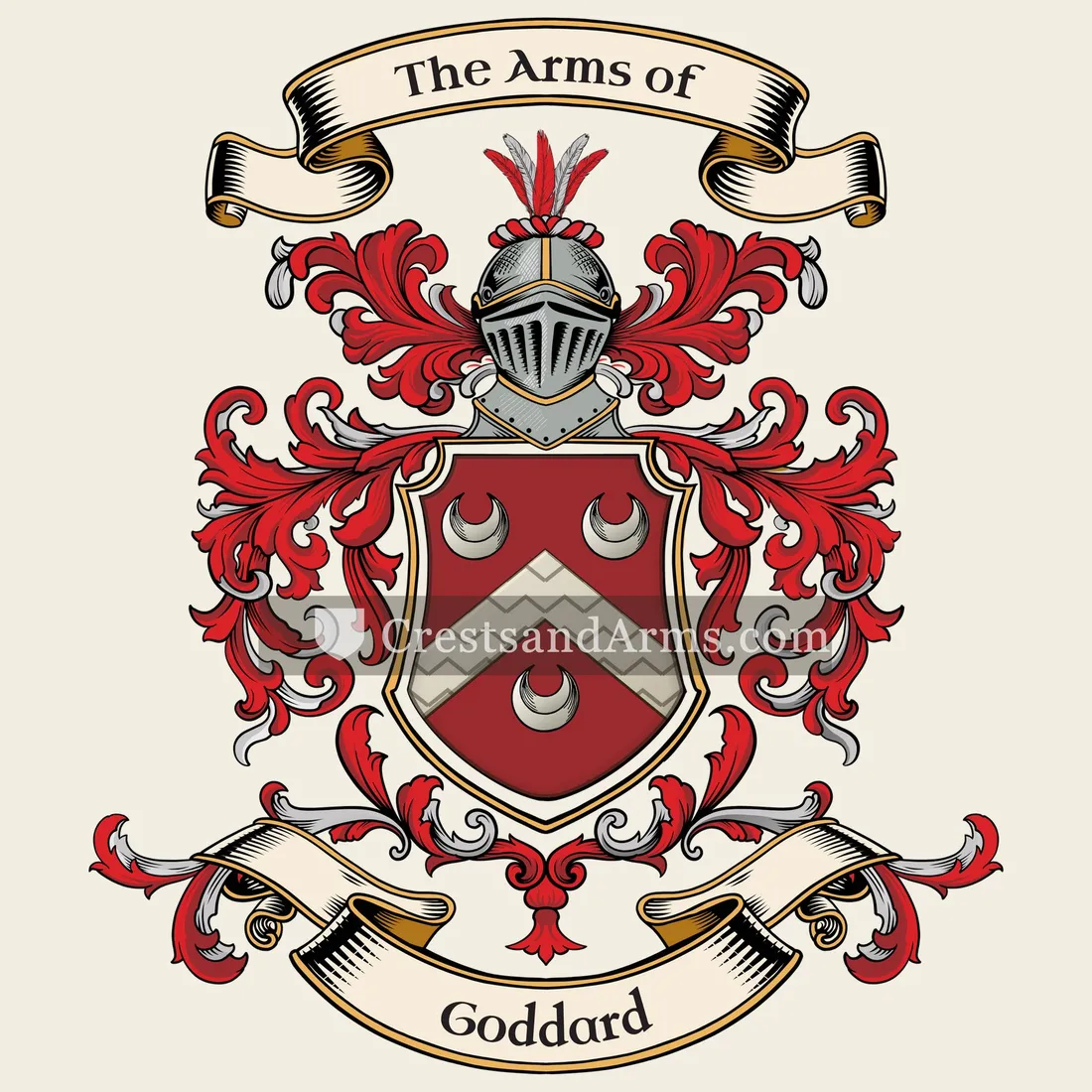
Symbols on this shield
chevronProtection, and faithful service completed
vairProtection, and the winter fur
crescentHonour by the sovereign, and the second son
Colours
Red (Gules)Means: Military strength
Silver (Argent)Means: Peace and sincerity
Historical info
Source
Sir Bernard Burke, The General Armory of England, Scotland, Ireland and Wales, London: Harrison & Sons, 1884
Blazon (the actual original written record)
“Gu. a chev. vair betw. three crescents ar”
Scotlandc. 1748
Digital archive packCoat of arms PNG, gold border print PDF, vector SVG and the certificate of authenticity. Sent to your email in minutes.
Map of Scotland showing where the Goddard arms are recorded
The Goddard arms were recorded in Scotland, c. 1748.
Arms such as these were typically recorded in Edinburgh.
Edinburgh was the seat of Scotland's government, its courts and its heralds. Families with business there settled nearby, and being close to where arms were recorded is exactly why so many of them appear.
This is where the arms were entered in the register. Families often moved to other parts of the country, so the same name can turn up in more than one region.
The body that granted and recorded arms in Scotland in this period.
George II of Great Britain
Sovereign of the period
George II of Great Britain
1727–1760
Reigning in England when the Goddard arms are first recorded.
How Arms Worked in Scotland
Scottish heraldry is unique because it treats a coat of arms as a piece of personal property protected by law. Only one person can own a specific design at any given time. When a family grows, the head keeps the original shield while other relatives must apply for their own distinct version with slight changes to prove their specific identity.
Granting authority
The Court of the Lord Lyon acts as the official body that regulates and controls all heraldic matters throughout Scotland.
How they got arms
Individuals obtain a legal right to their arms through a formal petition process that confirms their identity and family connection.
Where arms were recorded
All valid coats of arms are officially entered into the Public Register of All Arms and Bearings starting from 1672.
The family's standing
Recorded among the armigerous families of Scotland.
Origin & History of the Goddard Family in Scotland
The surname Goddard originates from the Old English words for "good" and "god," combined with the term for "hard" or "brave," essentially meaning a person of firm or pious character. While the name has deep roots in England, its presence in Scotland became notable by the mid-eighteenth century. By 1748, records confirm that members of the Goddard family were living and working in Edinburgh, which was then a bustling center of the Scottish Enlightenment. During this period, the city was expanding rapidly, and families like the Goddards were often involved in the growing trade and professional sectors that defined urban Scottish life. As they integrated into the local community, these early residents contributed to the social fabric of the capital, leaving behind a legacy that reflects the movement of people and ideas across the British Isles during the eighteenth century.
Goddard Meaning & Related Branches
Root word
God-hard
Derived from the Germanic elements for god or good and hardy.
This name
GoddardA name signifying a person who is brave, strong, or firm in their faith.
also spelled
Godart
Goderd
Related arms
Gothardvariant spelling
Gibsonrecorded with Goddard, same area
Groobyrecorded with Goddard, same area
Sadlerrecorded with Goddard, same area
Documented Sources
Sir Bernard Burke, The General Armory of England, Scotland, Ireland and Wales, London: Harrison & Sons, 1884
Bardsley, Charles Wareing, A Dictionary of English and Welsh Surnames, 1901
Reaney, Percy Hide, A Dictionary of British Surnames, 1958
The National Archives, Prerogative Court of Canterbury and related Probate Jurisdictions: Will Registers, 1384–1858
Berkshire Record Office, Quarter Sessions Records, 1574
Digital archive packCoat of arms PNG, gold border print PDF, vector SVG and the certificate of authenticity. Sent to your email in minutes.


 chevronProtection, and faithful service completed
 crescentHonour by the sovereign, and the second son
 chevronProtection, and faithful service completed
 crescentHonour by the sovereign, and the second son