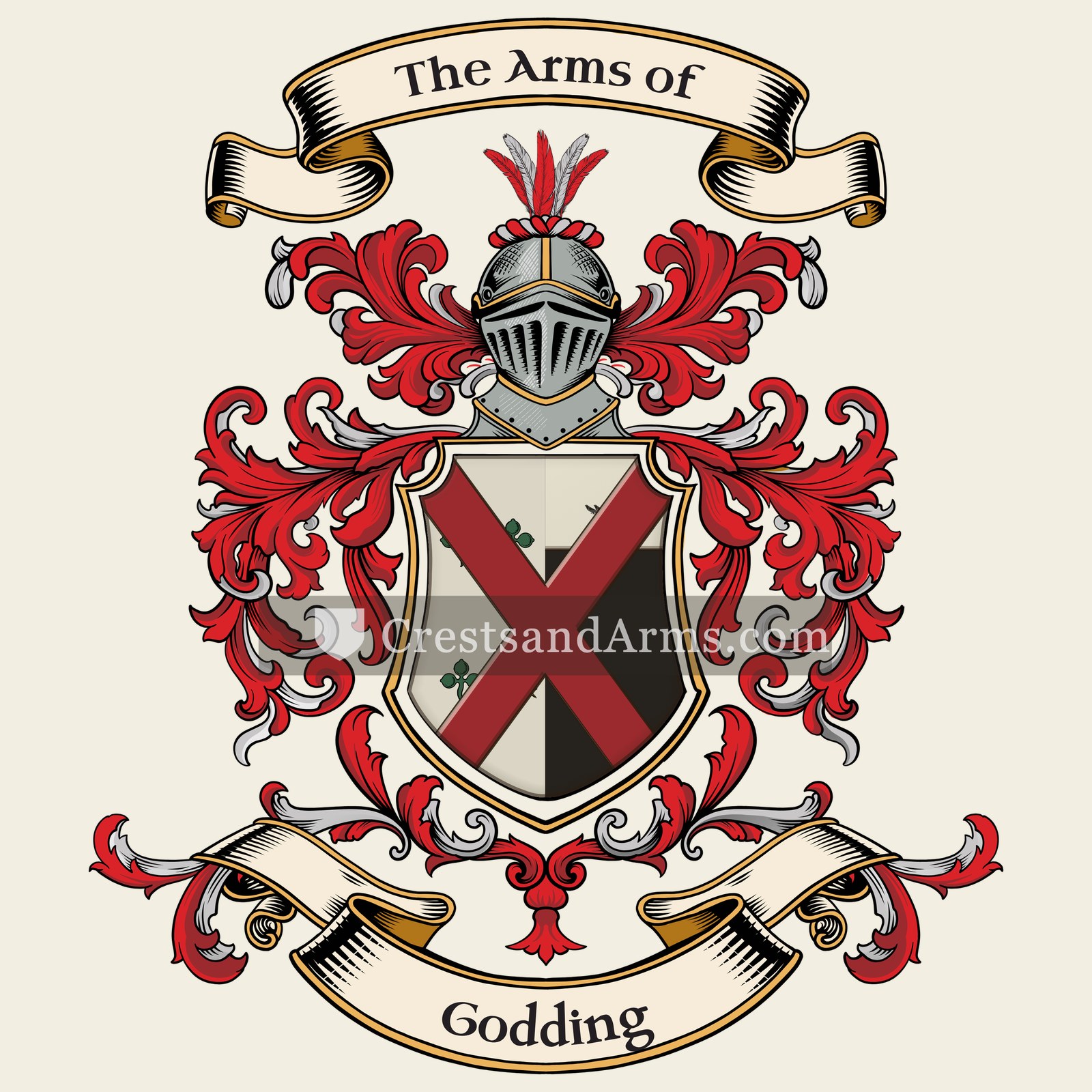
A record of documented arms, meaning and origin, researched for the Godding family of Netherlands.
Reg. 9663 · Dutch, G–I
Coat of Arms & Family Crest Details
Symbols on this shield
saltireResolution, and St Andrew's cross
chiefAuthority, wisdom and dominion
trefoilPerpetuity, and the Trinity
martletA younger son, who must win his own land
Colours
Silver (Argent)Means: Peace and sincerity
Black (Sable)Means: Constancy
Red (Gules)Means: Military strength
Green (Vert)Means: Hope
Gold (Or)Means: Generosity
Historical info
Source
J. B. Rietstap, Armorial Général, Gouda: G. B. van Goor Zonen, 1884–87
Blazon (the actual original written record)
“Parti: au 1 d'arg. au saut. de gu., acc. de trois trèfles de sin., 1 en chef et 2 en flancs, et d'un oiseau d'or perché sur une boule du même en p.; au 2 de sa., au chef d'arg. ch. de trois merlettes de sa.”
NetherlandsMaestricht, c. 1725
Where the Godding Arms Were Recorded
Maestricht
Map of Netherlands showing where the Godding arms are recorded
The Godding arms were recorded in Maestricht, c. 1725.
This is where the arms were entered in the register. Families often moved to other parts of the country, so the same name can turn up in more than one region.
Region
Maestricht
Town
Maestricht
First recorded
1725
Granting Authority for the Godding Arms
Hoge Raad van Adel
Photograph made by me · CC BY-SA 3.0
The body that granted and recorded arms in Netherlands in this period.
How Arms Worked in Netherlands
In the Netherlands, coats of arms were often used by noble families and those who held specific public offices. These arms were passed down through the generations to legitimate descendants. Younger branches of a family usually kept the original design without needing to add special marks. This system ensured that the family identity remained clear and consistent over many years.
Granting authority
The Hoge Raad van Adel is the official body that regulates and manages noble titles and coats of arms in the Netherlands.
How they got arms
Families typically obtained their coats of arms through official royal grants or by proving their long-standing historical use of the symbols.
Where arms were recorded
Coats of arms are officially recorded in the registers held by the Hoge Raad van Adel, which began its work in 1814.
The family's standing
Recorded among the armigerous families of Netherlands.
Origin & History of the Godding Family in Netherlands
The family name Godding has deep roots in the region surrounding Maastricht, where records confirm members of the family were established by the early eighteenth century. The name itself is likely derived from the Germanic word "god," which often served as a root for names implying a connection to the divine or a person of good character. During the 1700s, Maastricht was a strategically vital city located at the crossroads of trade routes between the Netherlands, Belgium, and Germany. This location suggests that the early Godding family were likely involved in the bustling mercantile or craft industries that defined the city’s economy at the time. As the family grew, they became part of the local social fabric, contributing to the development of the region during a period of significant political transition in the Low Countries. By studying these early residents, we gain a clearer picture of how families in the Meuse valley navigated the complex social and economic landscape of the eighteenth century.
Related Branches & Arms
Root word
Gode
Derived from the Germanic word for god or good.
This name
GoddingA patronymic surname indicating descent from a person named Gode or Godo.
also spelled
Goddinge
Goddingg
Documented Sources
J. B. Rietstap, Armorial Général, Gouda: G. B. van Goor Zonen, 1884–87
Regionaal Historisch Centrum Limburg, Doop-, trouw- en begraafregisters Maastricht
Nationaal Archief, Collectie van de Staten-Generaal
Ubachs, P.J.H. and Evers, I.M.H., Historische Encyclopedie Maastricht, 2005
Panhuysen, T.A.S.M., Maastricht staat op zijn verleden, 1984
Digital archive packCoat of arms PNG, gold border print PDF, vector SVG and the certificate of authenticity. Sent to your email in minutes.


 saltireResolution, and St Andrew's cross
 chiefAuthority, wisdom and dominion
 trefoilPerpetuity, and the Trinity
 martletA younger son, who must win his own land
 saltireResolution, and St Andrew's cross
 chiefAuthority, wisdom and dominion
 trefoilPerpetuity, and the Trinity
 martletA younger son, who must win his own land