A record of documented arms, meaning and origin, researched for the Godet family lines. Documented in 2 countries.
Reg. 9295 · French, G–I
Coat of Arms & Family Crest Details
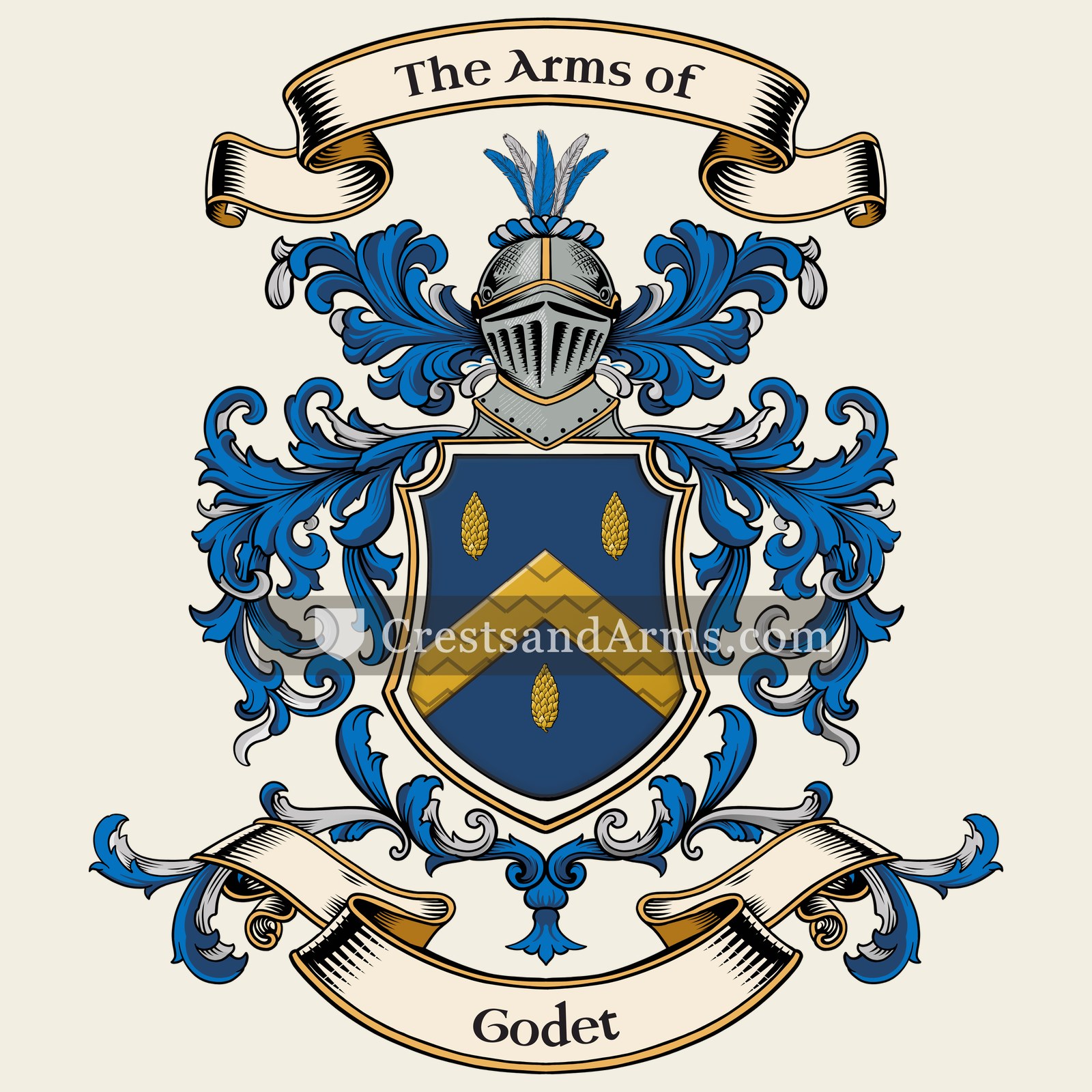
Symbols on this shield
chevronProtection, and faithful service completed
pine coneLife and fertility
Colours
Blue (Azure)Means: Loyalty and truth
Gold (Or)Means: Generosity
Historical info
Source
J. B. Rietstap, Armorial Général, Gouda: G. B. van Goor Zonen, 1884–87
Blazon (the actual original written record)
“D'azur au chev. d'or, acc. de trois pommes de pin du même.”
ChampagneChampagne, c. 1663
Where the Godet Arms Were Recorded
Champagne
Map of France showing where the Godet arms are recorded
The Godet arms were recorded in Champagne, c. 1663.
Champagne made its money at its great trade fairs, where merchants from across Europe met. Wealth of that kind bought land, and land brought arms, so the region carries a lot of names.
This is where the arms were entered in the register. Families often moved to other parts of the country, so the same name can turn up in more than one region.
The body that granted and recorded arms in France in this period.
Louis XIV of France
Sovereign of the period
Louis XIV of France
1643–1715
Reigning in France when the Godet arms are first recorded.
How Arms Worked in France
In France, a coat of arms was a mark of honor that passed down through the male line to all legitimate descendants. Families often used the same shield without changes to show their shared heritage. If a branch wanted to stand out, they could add a small mark to their shield to show their specific place in the family tree.
Granting authority
The Juge d'armes de France acted as the official authority that regulated and verified coats of arms across the country.
How they got arms
Families typically inherited their arms from ancestors, though they could also receive them through royal grants or by proving their noble status.
Where arms were recorded
Coats of arms were officially recorded in the Armorial Général de France, which began its main collection in the year 1696.
The family's standing
Recorded among the armigerous families of Champagne.
Origin & History of the Godet Family in France
The Godet family name is deeply rooted in the historical landscape of France, with documented evidence placing its members in the Champagne region as early as 1663. During this period, the name was closely associated with the social and economic fabric of northeastern France, a territory defined by its rolling vineyards and strategic importance to the French monarchy. Families like the Godets often lived in close proximity to the centers of local administration and trade, which allowed them to participate in the growth of the regional economy. As the seventeenth century progressed, the name became established within the local parish records, reflecting the family's integration into the community life of the era. By maintaining a presence in Champagne, the early Godets were part of a resilient population that navigated the shifting political tides of the French kingdom, eventually laying the foundation for the family's long-term legacy in the region.
Coat of Arms & Family Crest Details
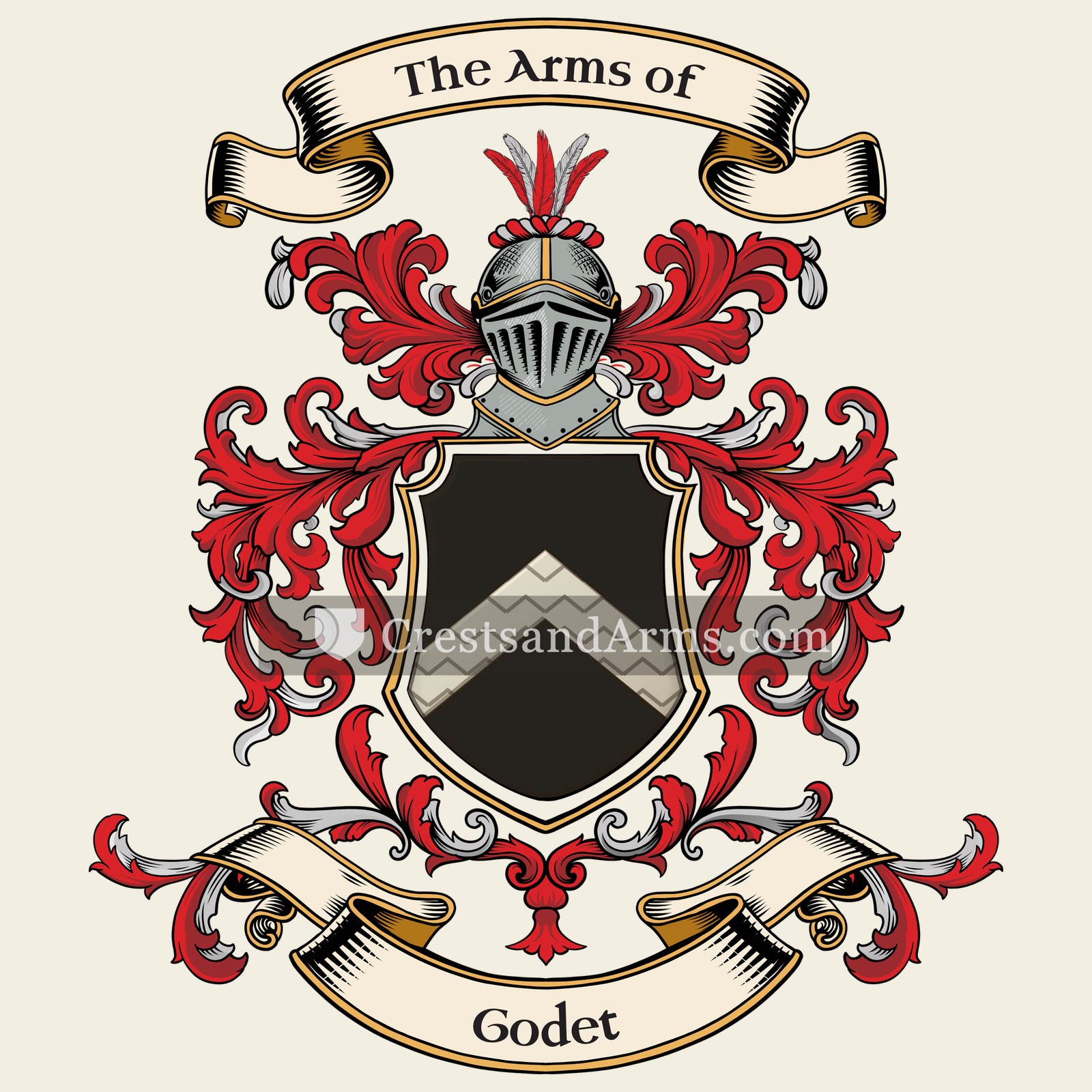
Symbols on this shield
chevronProtection, and faithful service completed
Colours
Black (Sable)Means: Constancy
Silver (Argent)Means: Peace and sincerity
Historical info
Source
J. B. Rietstap, Armorial Général, Gouda: G. B. van Goor Zonen, 1884–87
Blazon (the actual original written record)
“De sa. au chev. d'arg., acc. de trois brosses d'or, le manche en bas.”
SwitzerlandNeufchâtel, c. 1745
Where the Godet Arms Were Recorded
Neufchâtel
Map of Switzerland showing where the Godet arms are recorded
The Godet arms were recorded in Neufchâtel, c. 1745.
This is where the arms were entered in the register. Families often moved to other parts of the country, so the same name can turn up in more than one region.
The body that granted and recorded arms in Switzerland in this period.
How Arms Worked in Switzerland
In Switzerland, coats of arms were not restricted to the nobility and were often adopted by common citizens and families. These symbols were passed down through generations to show family identity. When branches of a family grew, they often changed small details of the design to distinguish their own line from the original group.
Granting authority
Cantonal and civic authorities managed the use of coats of arms within their specific regions and local jurisdictions.
How they got arms
Families typically assumed their own coats of arms based on local custom rather than receiving them from a central monarch.
Where arms were recorded
Arms were recorded in various cantonal and civic registers starting from the fourteenth century throughout the Swiss region.
The family's standing
Recorded among the armigerous families of Switzerland.
Origin & History of the Godet Family in Switzerland
The Godet family established a significant presence in the Swiss canton of Neuchâtel by the middle of the eighteenth century. Historical records confirm that members of the family were settled in this region by 1745, where they became integrated into the local social and economic fabric. During this era, Neuchâtel was a unique principality with strong ties to the Prussian crown, which created a distinct environment for families to develop their livelihoods. The name itself likely originated from older French roots, reflecting the linguistic blending common in the Jura mountain region. As the family grew, they participated in the local trades and civic life that defined the Swiss watchmaking and mercantile industries of the time. Their early history in Neuchâtel serves as a window into how families moved and settled within the shifting borders of central Europe during the Enlightenment.
Related Branches & Arms
Root word
Gode
Derived from the Germanic element god meaning good or god.
This name
GodetA diminutive form referring to a person who is good or godly.
also spelled
Godete
Godett
Goday
Related arms
Chambièresame arms
Guevetsame arms
Perrièresame arms
Documented Sources
J. B. Rietstap, Armorial Général, Gouda: G. B. van Goor Zonen, 1884–87
Archives départementales de la Marne, Registres paroissiaux et d'état civil, 1663
Boutillier, A., Histoire de la province de Champagne, 1905
Moréri, L., Le Grand Dictionnaire Historique, 1759
Digital archive packCoat of arms PNG, gold border print PDF, vector SVG and the certificate of authenticity. Sent to your email in minutes.


 chevronProtection, and faithful service completed
 pine coneLife and fertility
 chevronProtection, and faithful service completed
 pine coneLife and fertility