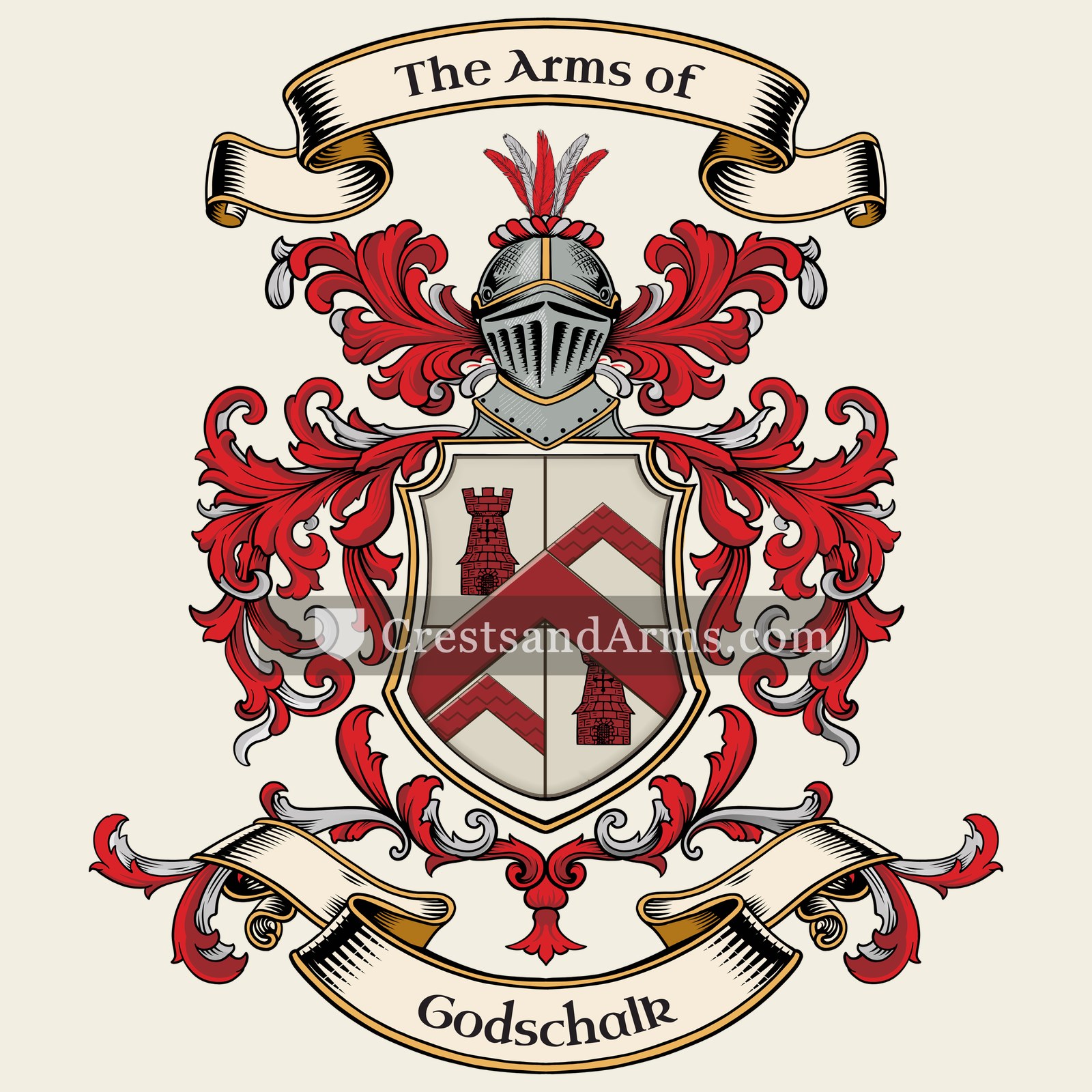
A record of documented arms, meaning and origin, researched for the Godschalk family of France.
Reg. 8224 · French, G–I
Coat of Arms & Family Crest Details
Symbols on this shield
chevronProtection, and faithful service completed
towerGrandeur and solidity, and a stronghold defended
Colours
Silver (Argent)Means: Peace and sincerity
Red (Gules)Means: Military strength
Historical info
Source
J. B. Rietstap, Armorial Général, Gouda: G. B. van Goor Zonen, 1884–87
Blazon (the actual original written record)
“Ec.: aux 1 et 4 d'arg. à une tour de gu., aux 2 et 3 d'arg. au chev. de gu.”
FranceLille, c. 1663
Where the Godschalk Arms Were Recorded
Lille
Map of France showing where the Godschalk arms are recorded
The Godschalk arms were recorded in Lille, c. 1663.
This is where the arms were entered in the register. Families often moved to other parts of the country, so the same name can turn up in more than one region.
The body that granted and recorded arms in France in this period.
Louis XIV of France
Sovereign of the period
Louis XIV of France
1643–1715
Reigning in France when the Godschalk arms are first recorded.
How Arms Worked in France
In France, a coat of arms was a mark of honor that passed down through the male line to all legitimate descendants. Families often used the same shield without changes to show their shared heritage. If a branch wanted to stand out, they could add a small mark to their shield to show their specific place in the family tree.
Granting authority
The Juge d'armes de France acted as the official authority that regulated and verified coats of arms across the country.
How they got arms
Families typically inherited their arms from ancestors, though they could also receive them through royal grants or by proving their noble status.
Where arms were recorded
Coats of arms were officially recorded in the Armorial Général de France, which began its main collection in the year 1696.
The family's standing
Recorded among the armigerous families of France.
Origin & History of the Godschalk Family in France
The name Godschalk originates from the Germanic roots "god," meaning god, and "schalk," meaning servant or apprentice, effectively translating to "servant of God." This name was frequently used in the Middle Ages as a sign of religious devotion or as a way to honor a patron saint. By the mid-17th century, the family had established a notable presence in the city of Lille, which was a major center for trade and textile manufacturing in the Spanish Netherlands. Living in a bustling urban hub like Lille suggests that early family members were likely involved in the merchant class or skilled trades that defined the region’s economy during that era. As the name spread through Northern Europe, it evolved into various spellings, but it remained a marker of a lineage rooted in the cultural and religious traditions of the Low Countries.
Related Branches & Arms
Root word
Godescalcus
A Germanic compound derived from words for god and servant.
This name
GodschalkRefers to a servant or follower of God, often used as a pious given name.
also spelled
Godschalk
Gotschalck
Godshalk
Gottschalk
Documented Sources
J. B. Rietstap, Armorial Général, Gouda: G. B. van Goor Zonen, 1884–87
Debrabandere, Frans. Woordenboek van de familienamen in België en Noord-Frankrijk. 1993
Archives départementales du Nord. Registres paroissiaux de Lille (baptêmes, mariages, sépultures). 1663
Digital archive packCoat of arms PNG, gold border print PDF, vector SVG and the certificate of authenticity. Sent to your email in minutes.


 chevronProtection, and faithful service completed
 towerGrandeur and solidity, and a stronghold defended
 chevronProtection, and faithful service completed
 towerGrandeur and solidity, and a stronghold defended