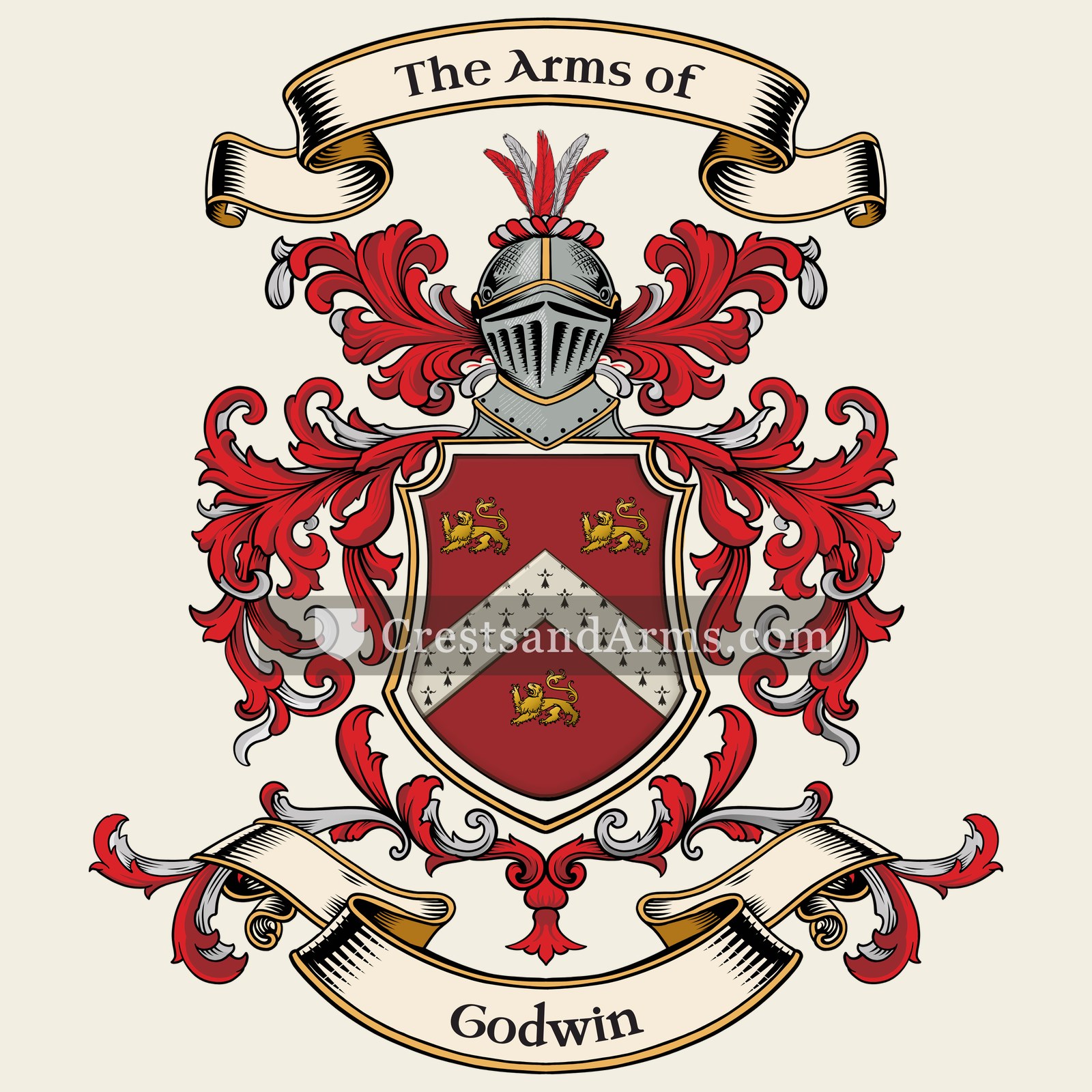
A record of documented arms, meaning and origin, researched for the Godwin family of England.
Reg. 3321 · English, G–I
Coat of Arms & Family Crest Details
Symbols on this shield
chevronProtection, and faithful service completed
lionCourage, strength and royalty
Colours
Red (Gules)Means: Military strength
ErmineMeans: Dignity
Gold (Or)Means: Generosity
Historical info
Source
Sir Bernard Burke, The General Armory of England, Scotland, Ireland and Wales, London: Harrison & Sons, 1884
Blazon (the actual original written record)
“Gu. a chev. erm. betw. three leopards' faces or”
DorsetDorset, c. 1620
Where the Godwin Arms Were Recorded
Dorset
Map of England showing where the Godwin arms are recorded
The Godwin arms were recorded in Dorset, c. 1620.
Dorset was quiet farming and grazing country along the south coast. Its gentry were middling rather than grand, but they held their manors for a very long time, and long holding is what puts a name in the records.
This is where the arms were entered in the register. Families often moved to other parts of the country, so the same name can turn up in more than one region.
The body that granted and recorded arms in England in this period.
James VI and I
Sovereign of the period
James VI and I
1603–1625
Reigning in England when the Godwin arms are first recorded.
How Arms Worked in England
English heraldry allowed arms to be shared by all legitimate descendants of the original owner. These symbols were treated as personal property that moved through the generations to all children. While the eldest son kept the original design, other family members could use the same shield without needing to change it or register their own unique versions.
Granting authority
The College of Arms in London has regulated the use of coats of arms throughout England and Wales since 1484.
How they got arms
Families typically obtained their coats of arms through a formal grant from the Crown or by proving their ancient right to them.
Where arms were recorded
All official coats of arms are recorded in the registers kept at the College of Arms, which date back to the fifteenth century.
The family's standing
Recorded among the armigerous families of Dorset.
Origin & History of the Godwin Family in England
The name Godwin originates from the Old English words "god," meaning good or god, and "wine," meaning friend. This name was popular in Anglo-Saxon England and was famously held by the powerful Earl Godwin of Wessex, who was the father of King Harold II. By the time the family was established in Dorset in 1620, the name had transitioned from a personal given name into a hereditary surname used to identify specific family lines. Families living in the rural landscapes of Dorset during the early seventeenth century were often tied to the land through farming or local trade. During this period, the name was recorded in parish registers as families began to settle more permanently in specific villages. These early records show that the Godwins were part of the foundational social structure of the region, contributing to the local community long before the era of mass migration.
Related Branches & Arms
Root word
Godwine
Derived from Old English words for god and friend.
This name
GodwinA name signifying a friend of God or a divine companion.
also spelled
Godwyn
Godewyn
Godwynne
Goodwyn
Related arms
Godewynvariant spelling
Godwynvariant spelling
Goodwynvariant spelling
Documented Sources
Sir Bernard Burke, The General Armory of England, Scotland, Ireland and Wales, London: Harrison & Sons, 1884
Reaney, P.H. and Wilson, R.M., A Dictionary of English Surnames, 1991
Hanks, Patrick and Hodges, Flavia, A Dictionary of Surnames, 1988
Dorset History Centre, Dorset Parish Registers, 1620
Digital archive packCoat of arms PNG, gold border print PDF, vector SVG and the certificate of authenticity. Sent to your email in minutes.


 chevronProtection, and faithful service completed
 lionCourage, strength and royalty
 chevronProtection, and faithful service completed
 lionCourage, strength and royalty