A record of documented arms, meaning and origin, researched for the Goedecke family lines. Documented in 2 countries.
Reg. 8436 · Dutch, G–I
Coat of Arms & Family Crest Details
Symbols on this shield
fessThe military belt, and readiness to serve
mulletThe third son, and a divine quality from above
Colours
Silver (Argent)Means: Peace and sincerity
Red (Gules)Means: Military strength
Gold (Or)Means: Generosity
Historical info
Source
J. B. Rietstap, Armorial Général, Gouda: G. B. van Goor Zonen, 1884–87
Blazon (the actual original written record)
“D'arg. à la fasce ondée de gu., soutenant une étoile (5) d'or. Cq. cour. C.: deux plumes de faisan d'arg. T.: deux sauvages de carn., ceints et cour. de lierre, arm. de massues.”
Netherlandsc. 1815
Digital archive packCoat of arms PNG, gold border print PDF, vector SVG and the certificate of authenticity. Sent to your email in minutes.
Map of Netherlands showing where the Goedecke arms are recorded
The Goedecke arms were recorded in Netherlands, c. 1815.
Arms such as these were typically recorded in Friesland.
Friesland was low, wet country on the northern coast of the Netherlands, farmed by families who had held the same land for centuries. Free landholders were unusually common there, and a free landholder could carry arms.
This is where the arms were entered in the register. Families often moved to other parts of the country, so the same name can turn up in more than one region.
Region
Friesland
First recorded
1815
Granting Authority for the Goedecke Arms
Hoge Raad van Adel
Photograph made by me · CC BY-SA 3.0
The body that granted and recorded arms in Netherlands in this period.
William I of the Netherlands
Sovereign of the period
William I of the Netherlands
1815–1840
Reigning in Netherlands when the Goedecke arms are first recorded.
How Arms Worked in Netherlands
In the Netherlands, coats of arms were often used by noble families and those who held specific public offices. These arms were passed down through the generations to legitimate descendants. Younger branches of a family usually kept the original design without needing to add special marks. This system ensured that the family identity remained clear and consistent over many years.
Granting authority
The Hoge Raad van Adel is the official body that regulates and manages noble titles and coats of arms in the Netherlands.
How they got arms
Families typically obtained their coats of arms through official royal grants or by proving their long-standing historical use of the symbols.
Where arms were recorded
Coats of arms are officially recorded in the registers held by the Hoge Raad van Adel, which began its work in 1814.
The family's standing
Recorded among the armigerous families of Netherlands.
Origin & History of the Goedecke Family in Netherlands
The surname Goedecke finds its roots in the Germanic naming traditions of Northern Europe, where it evolved as a diminutive form of names starting with the element "gode," meaning good or god. By the early 19th century, members of the family were firmly established in the province of Friesland, a region known for its strong sense of independence and unique cultural identity. In 1815, the Netherlands underwent a significant transformation as it became a kingdom, and the government began to standardize civil registration across all provinces. This period required families to formally record their surnames in official state registers for the first time. The presence of the Goedecke name in Frisian records during this era suggests that the family was part of a stable, land-owning or trade-oriented class that integrated into the newly formed Dutch administrative system. Over generations, the family adapted to the local Frisian dialect and customs while maintaining the linguistic heritage of their ancestral name.
Coat of Arms & Family Crest Details
Symbols on this shield
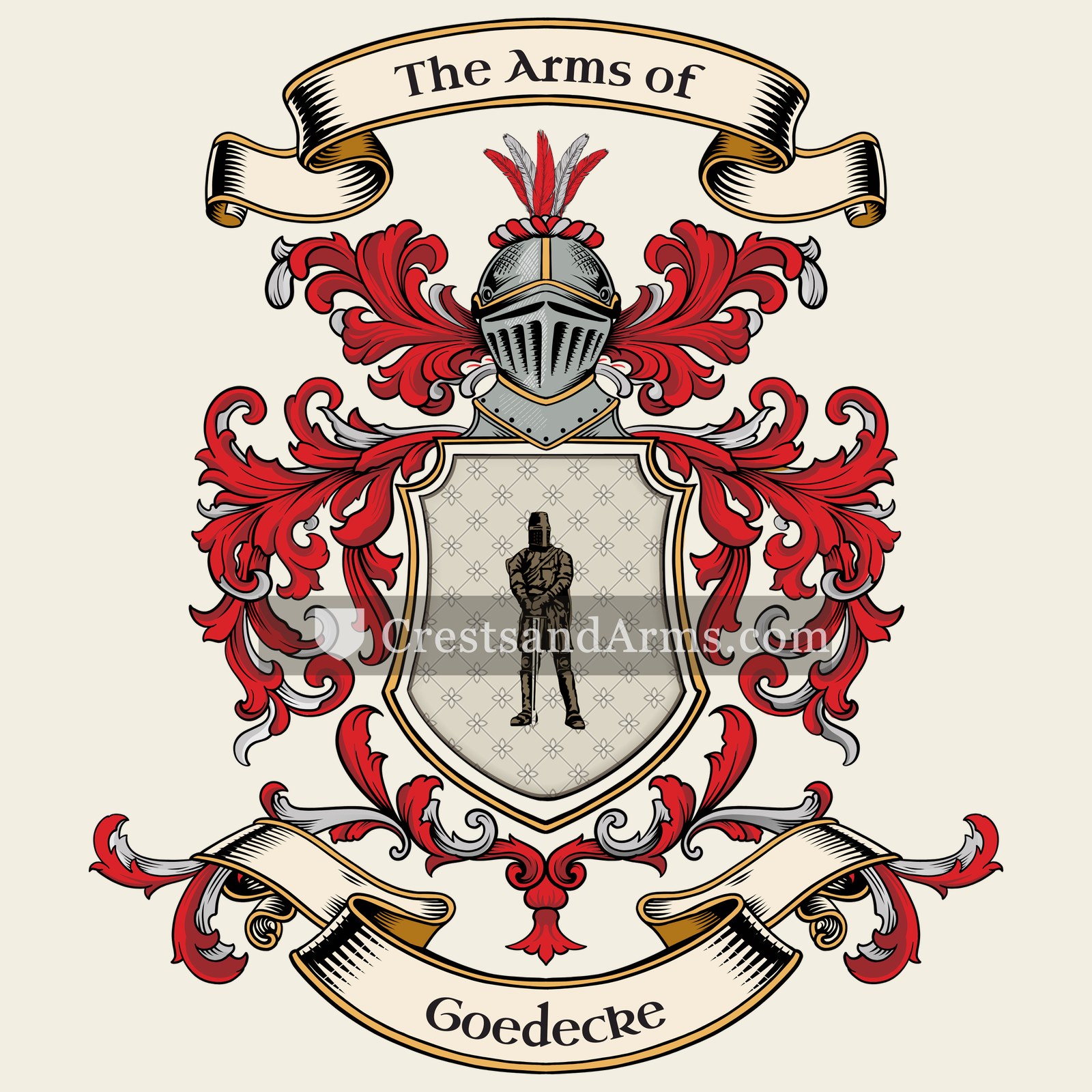
knightChivalry and service in arms
Colours
Silver (Argent)Means: Peace and sincerity
Historical info
Source
J. B. Rietstap, Armorial Général, Gouda: G. B. van Goor Zonen, 1884–87
Blazon (the actual original written record)
“D'arg. à un sauvage de carn., ceint et cour. de lierre, tenant de sa main dextre une hallebarde au nat., la hampe de sa. Cq. cour. C.: un coeur de gu., sommé d'une croix latine de sa., entre un vol d'arg. L. d'arg. et de sin.”
GermanyNassau, c. 1765
Digital archive packCoat of arms PNG, gold border print PDF, vector SVG and the certificate of authenticity. Sent to your email in minutes.
Map of Germany showing where the Goedecke arms are recorded
The Goedecke arms were recorded in Nassau, c. 1765.
This is where the arms were entered in the register. Families often moved to other parts of the country, so the same name can turn up in more than one region.
The body that granted and recorded arms in Germany in this period.
Francis I, Holy Roman Emperor
Sovereign of the period
Francis I, Holy Roman Emperor
1745–1765
Reigning in Netherlands when the Goedecke arms are first recorded.
How Arms Worked in Germany
In the Holy Roman Empire, coats of arms were often granted to individuals by the Emperor or his representatives. These arms were then passed down through the generations to all legitimate descendants of the original holder. Younger branches of a family usually kept the same shield design without needing to change it, as the arms belonged to the entire lineage.
Granting authority
The Holy Roman Emperor held the sole power to grant new coats of arms throughout his vast imperial territories.
How they got arms
Families typically obtained their coats of arms through a formal imperial grant or by proving their noble status to the authorities.
Where arms were recorded
These grants were officially recorded in the Imperial Chancery registers, which began keeping formal records of such honors during the Middle Ages.
The family's standing
Recorded among the armigerous families of Germany.
Origin & History of the Goedecke Family in Germany
The name Goedecke originates from the German regions as a variation of the personal name Godeke, which served as a diminutive form of names beginning with the Germanic element "god," meaning good or god. During the Middle Ages, names like this were common throughout Northern and Central Germany as people began adopting hereditary surnames to distinguish themselves in growing communities. By the mid-18th century, the family had established a clear presence in the region of Nassau, a territory known for its complex political history and its role within the Holy Roman Empire. Records from 1765 confirm that members of the Goedecke family were active in this area, likely working as farmers, craftsmen, or local officials who contributed to the stability of the village life typical of the Nassau countryside. This transition from a simple personal name to a fixed family identity reflects the broader social changes occurring in Germany as families became more rooted in specific geographic locations over several generations.
Goedecke Meaning & Related Branches
Root word
Gode
Derived from the Germanic word for god or good.
This name
GoedeckeA diminutive form indicating a person who is good or godly.
also spelled
Godecke
Gedeka
Related arms
Cremersimilar arms
Rouffaersimilar arms
Schmiterlöwsimilar arms
Sivers de Dackernsimilar arms
Documented Sources
J. B. Rietstap, Armorial Général, Gouda: G. B. van Goor Zonen, 1884–87
Tresoar (Fries Historisch en Letterkundig Centrum), Burgerlijke Stand (Civil Registration) records for Friesland, 1811–1815
Van der Schaar, J., Woordenboek van voornamen, 1964
Meertens, P.J., De betekenis van de Nederlandse familienamen, 1950
Digital archive packCoat of arms PNG, gold border print PDF, vector SVG and the certificate of authenticity. Sent to your email in minutes.


 fessThe military belt, and readiness to serve
 mulletThe third son, and a divine quality from above
 fessThe military belt, and readiness to serve
 mulletThe third son, and a divine quality from above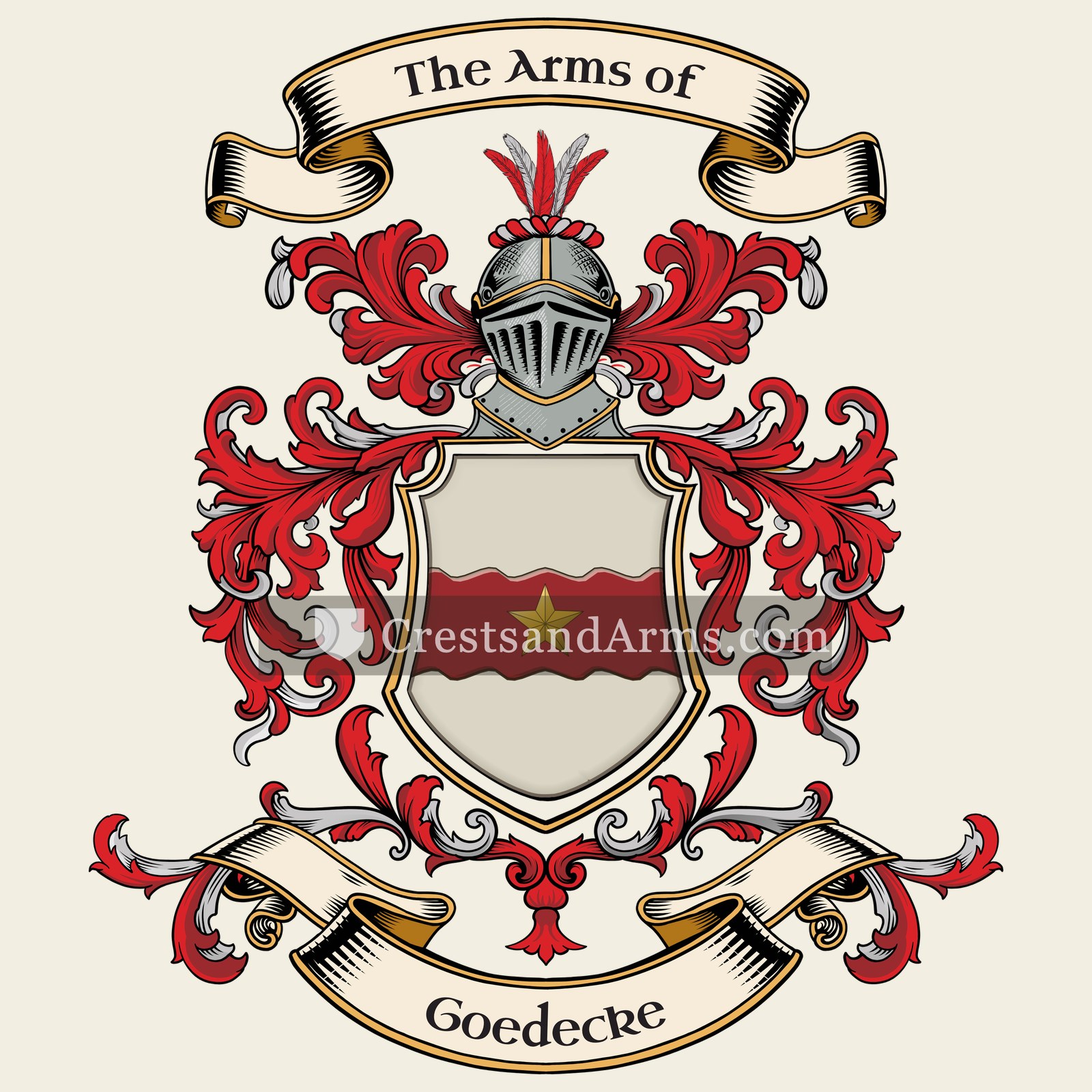


 knightChivalry and service in arms