Map of Germany showing where the Goering arms are recorded
The Goering arms were recorded in Germany, c. 1646.
Arms such as these were typically recorded in Bavaria.
Bavaria was a country of old landed families and walled market towns. Estates passed down the same line for centuries, and both the landowners and the leading townsmen kept arms, which is why so many Bavarian names sit in the registers.
This is where the arms were entered in the register. Families often moved to other parts of the country, so the same name can turn up in more than one region.
The body that granted and recorded arms in Germany in this period.
Ferdinand III, Holy Roman Emperor
Sovereign of the period
Ferdinand III, Holy Roman Emperor
1637–1657
Reigning in Germany when the Goering arms are first recorded.
How Arms Worked in Germany
In the Holy Roman Empire, coats of arms were often granted to individuals by the Emperor or his representatives. These arms were then passed down through the generations to all legitimate descendants of the original holder. Younger branches of a family usually kept the same shield design without needing to change it, as the arms belonged to the entire lineage.
Granting authority
The Holy Roman Emperor held the sole power to grant new coats of arms throughout his vast imperial territories.
How they got arms
Families typically obtained their coats of arms through a formal imperial grant or by proving their noble status to the authorities.
Where arms were recorded
These grants were officially recorded in the Imperial Chancery registers, which began keeping formal records of such honors during the Middle Ages.
The family's standing
Recorded among the armigerous families of Germany.
Origin & History of the Goering Family in Germany
The Goering family name finds its historical roots in the southern regions of Germany, specifically within the state of Bavaria. Records confirm that members of the family were established in this area as early as 1646, a time when the region was still recovering from the long and destructive Thirty Years' War. The name itself is thought to be a topographic or occupational surname, likely derived from the Middle High German word "gör," which was a term used to describe a young person or a boy. Families during this period often settled in small rural communities where they worked as farmers or local tradespeople. Because the population was relatively stable in these Bavarian villages, the Goering name became deeply tied to the local land and the specific parish records kept by the church. These early generations lived through a time of significant social change, helping to shape the cultural identity of the Bavarian countryside as they moved through the seventeenth and eighteenth centuries.
Meaning of the Goering family crest colors & symbols
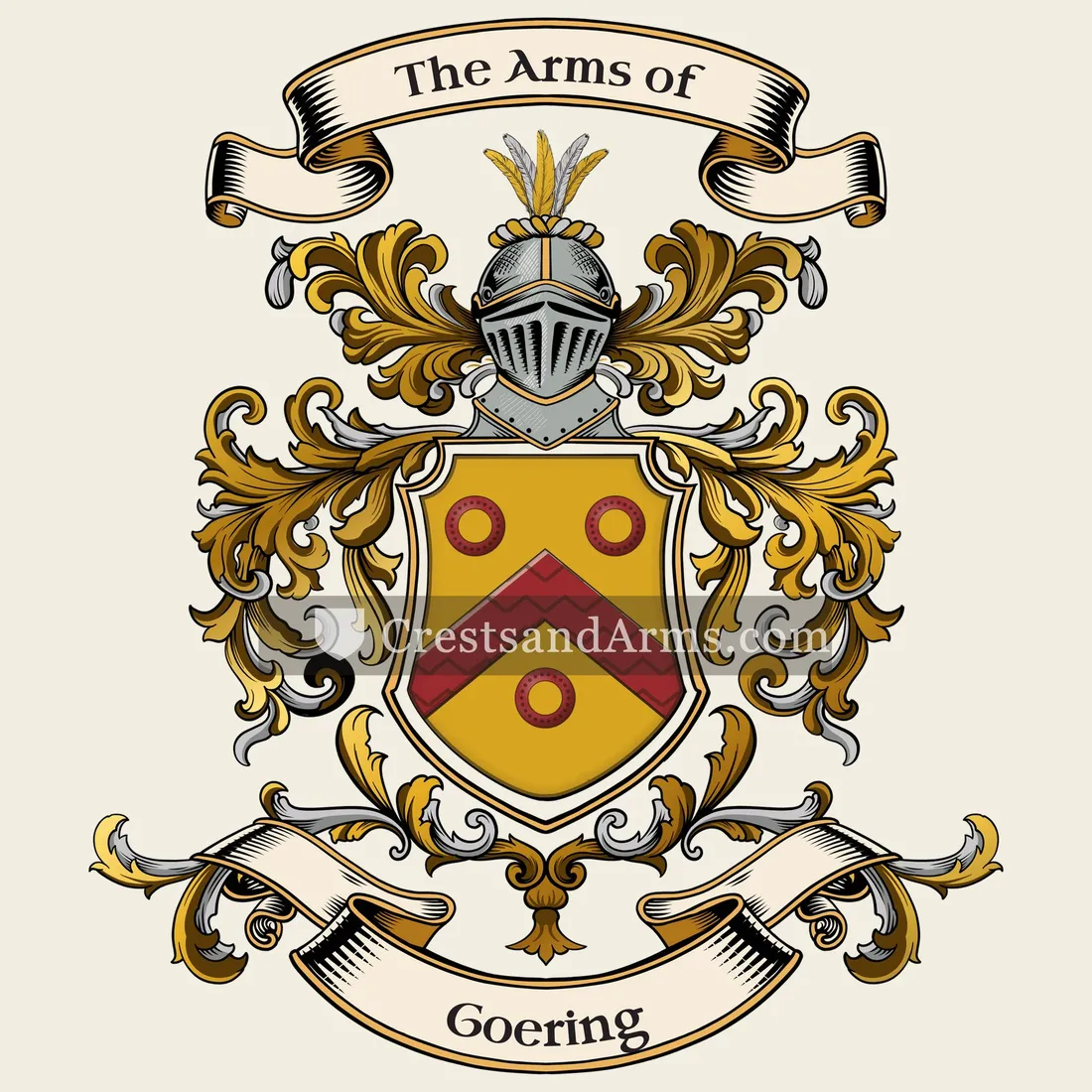
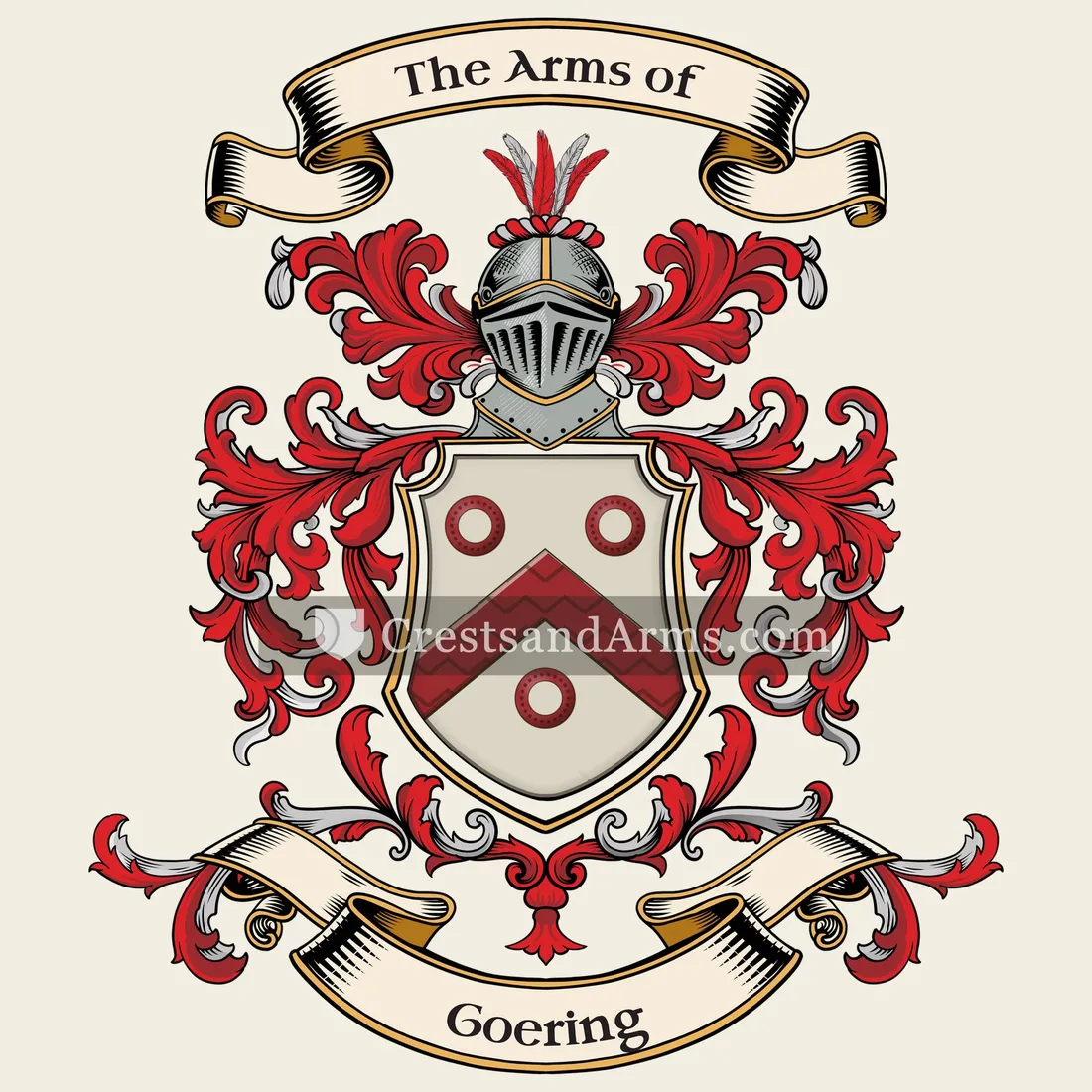
Symbols on this shield
chevronProtection, and faithful service completed
ringFidelity, and a promise kept
Colours
Silver (Argent)Means: Peace and sincerity
Red (Gules)Means: Military strength
Historical info
Source
Sir Bernard Burke, The General Armory of England, Scotland, Ireland and Wales, London: Harrison & Sons, 1884
Blazon (the actual original written record)
“Ar. a chev. betw. three annulets gu”
SussexHighden · Sussex, c. 1620
Digital archive packCoat of arms PNG, gold border print PDF, vector SVG and the certificate of authenticity. Sent to your email in minutes.
Map of England showing where the Goering arms are recorded
The Goering arms were recorded in Sussex, c. 1620.
Sussex had ironworks in its woods and good farmland on its downs. Both made money, and families who made it bought manors, which is what put their names in the heraldic records.
This is where the arms were entered in the register. Families often moved to other parts of the country, so the same name can turn up in more than one region.
The body that granted and recorded arms in England in this period.
James VI and I
Sovereign of the period
James VI and I
1603–1625
Reigning in Germany when the Goering arms are first recorded.
How Arms Worked in England
English heraldry allowed arms to be shared by all legitimate descendants of the original owner. These symbols were treated as personal property that moved through the generations to all children. While the eldest son kept the original design, other family members could use the same shield without needing to change it or register their own unique versions.
Granting authority
The College of Arms in London has regulated the use of coats of arms throughout England and Wales since 1484.
How they got arms
Families typically obtained their coats of arms through a formal grant from the Crown or by proving their ancient right to them.
Where arms were recorded
All official coats of arms are recorded in the registers kept at the College of Arms, which date back to the fifteenth century.
The family's standing
Recorded among the armigerous families of Sussex.
Origin & History of the Goering Family in England
The name Goering, often spelled Goring in its English context, is deeply rooted in the landscape of Sussex. By the year 1620, the family had established a significant presence in this southern county, where they became prominent landowners and local figures. The name itself is believed to be locative, meaning it was originally derived from the place name Goring-by-Sea. In the early seventeenth century, members of the family were active participants in the social and political life of the region. They held influential positions that allowed them to shape the development of their local communities. Their history during this period reflects the broader experiences of the English gentry, as they managed estates and navigated the complex legal and social structures of the time. Through their long-standing residency in Sussex, the family became a permanent part of the historical fabric of the English countryside.
Goering Meaning & Related Branches
Root word
Gero
Derived from the Germanic word for spear.
This name
GoeringRefers to a descendant or follower of a person named Gero.
also spelled
Goryng
Gorynge
Documented Sources
J. B. Rietstap, Armorial Général, Gouda: G. B. van Goor Zonen, 1884–87


 chevronProtection, and faithful service completed
 ringFidelity, and a promise kept
 chevronProtection, and faithful service completed
 ringFidelity, and a promise kept