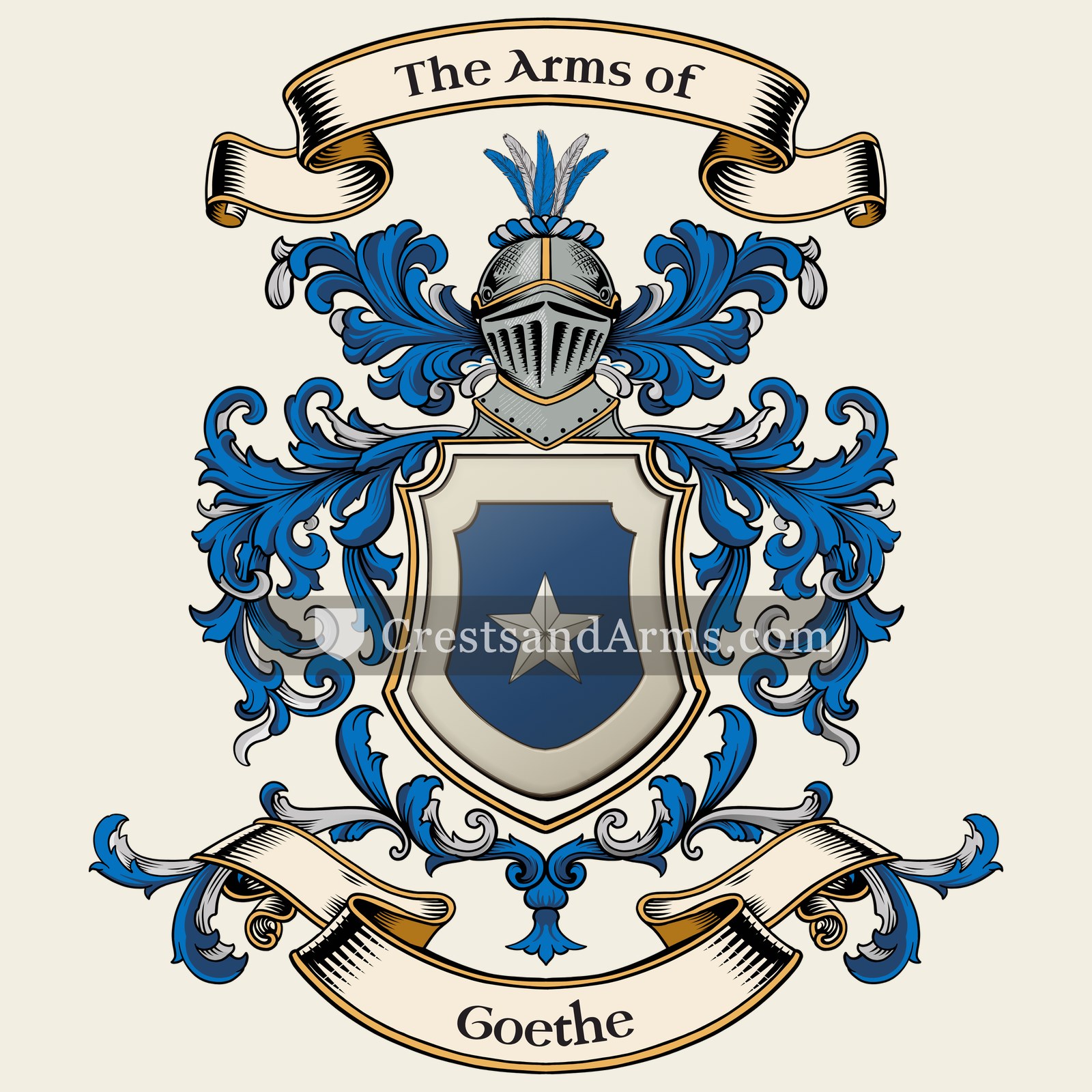
A record of documented arms, meaning and origin, researched for the Goethe family of Germany.
Reg. 3733 · German, G–I
Coat of Arms & Family Crest Details
Symbols on this shield
mulletThe third son, and a divine quality from above
Colours
Blue (Azure)Means: Loyalty and truth
Silver (Argent)Means: Peace and sincerity
Historical info
Source
J. B. Rietstap, Armorial Général, Gouda: G. B. van Goor Zonen, 1884–87
Blazon (the actual original written record)
“D'azur à une étoile (6) d'arg.; à la bord. du même. Cq. cour. C.: l'étoile [Armes de J. W. von Goethe.]”
SaxonySaxony, c. 1782
Where the Goethe Arms Were Recorded
Saxony
Map of Germany showing where the Goethe arms are recorded
The Goethe arms were recorded in Saxony, c. 1782.
Saxony had mines, trade and old landed families all at once. Silver made some fortunes and land held others, and both sorts of family kept arms, which is why Saxon names appear so often in the registers.
This is where the arms were entered in the register. Families often moved to other parts of the country, so the same name can turn up in more than one region.
The body that granted and recorded arms in Germany in this period.
Joseph II, Holy Roman Emperor
Sovereign of the period
Joseph II, Holy Roman Emperor
1765–1790
Reigning in Germany when the Goethe arms are first recorded.
How Arms Worked in Germany
In the Holy Roman Empire, coats of arms were often granted to individuals by the Emperor or his representatives. These arms were then passed down through the generations to all legitimate descendants of the original holder. Younger branches of a family usually kept the same shield design without needing to change it, as the arms belonged to the entire lineage.
Granting authority
The Holy Roman Emperor held the sole power to grant new coats of arms throughout his vast imperial territories.
How they got arms
Families typically obtained their coats of arms through a formal imperial grant or by proving their noble status to the authorities.
Where arms were recorded
These grants were officially recorded in the Imperial Chancery registers, which began keeping formal records of such honors during the Middle Ages.
The family's standing
Recorded among the armigerous families of Saxony.
Origin & History of the Goethe Family in Germany
The family name Goethe originates from the German regions of Thuringia and Saxony, where it first appeared in historical records during the late Middle Ages. The name is likely derived from an old German given name or a local nickname, though its exact linguistic roots remain a subject of study among historians. By the time the family became prominent in the eighteenth century, they had established themselves as skilled artisans and tradespeople within the social structure of the Holy Roman Empire. Members of the family were well-documented in the region of Saxony by 1782, where they participated in the professional and civic life of their communities. This period marked a transition for the family as they moved from local craftsmanship into the broader intellectual and administrative circles of German society. Their steady rise in status allowed them to preserve their family history through detailed church records and local government documents that still exist today.
Related Branches & Arms
Root word
Gode
Derived from the Germanic word for god or deity.
This name
GoetheA topographic name for someone living near a god-like or sacred place.
also spelled
Gothe
Goete
Geta
Documented Sources
J. B. Rietstap, Armorial Général, Gouda: G. B. van Goor Zonen, 1884–87
Biedermann, Flodoard von. Goethes Gespräche. 1909
Friedenthal, Richard. Goethe: Sein Leben und seine Zeit. 1963
Goethe- und Schiller-Archiv. Familienarchiv Goethe. 1782
Digital archive packCoat of arms PNG, gold border print PDF, vector SVG and the certificate of authenticity. Sent to your email in minutes.


 mulletThe third son, and a divine quality from above
 mulletThe third son, and a divine quality from above