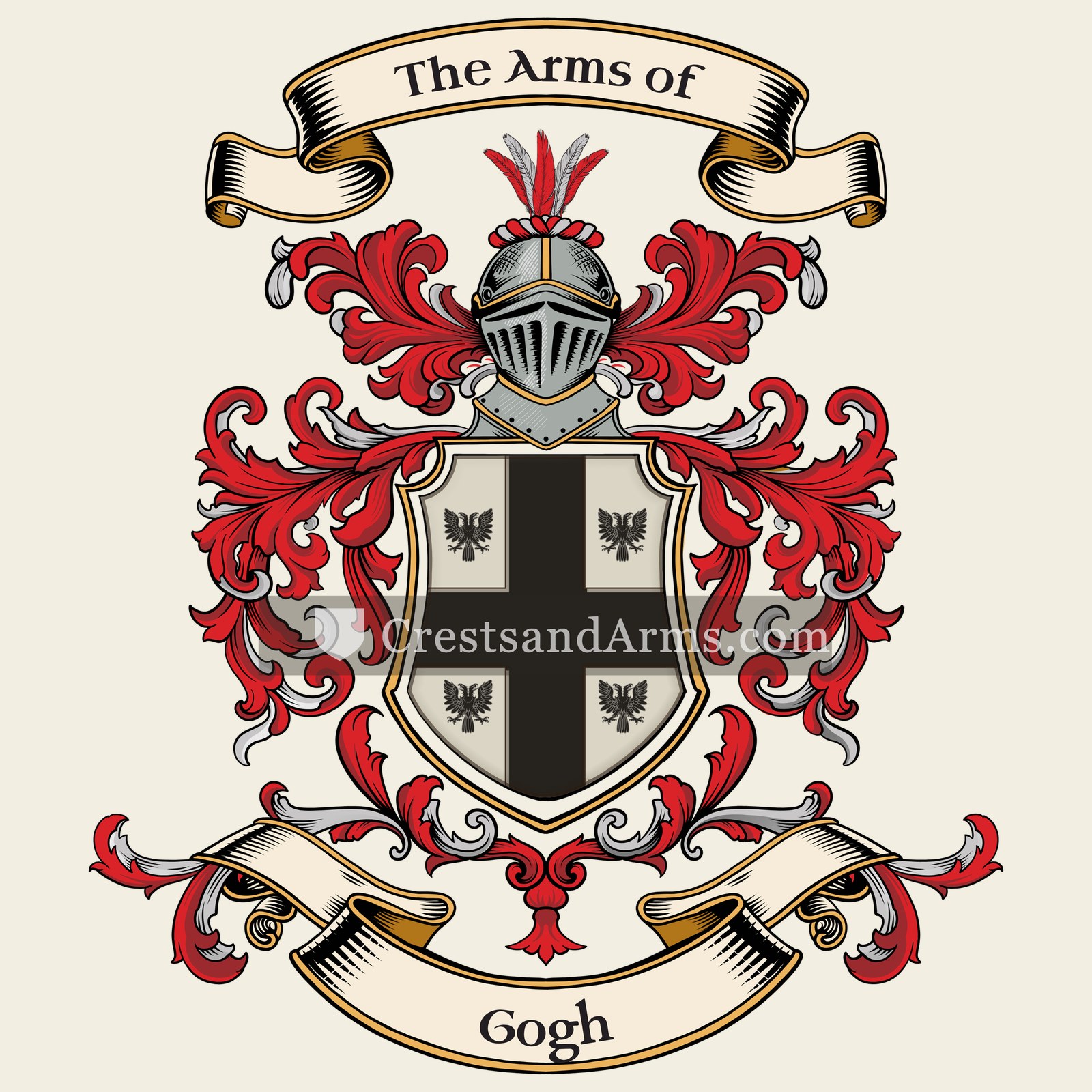
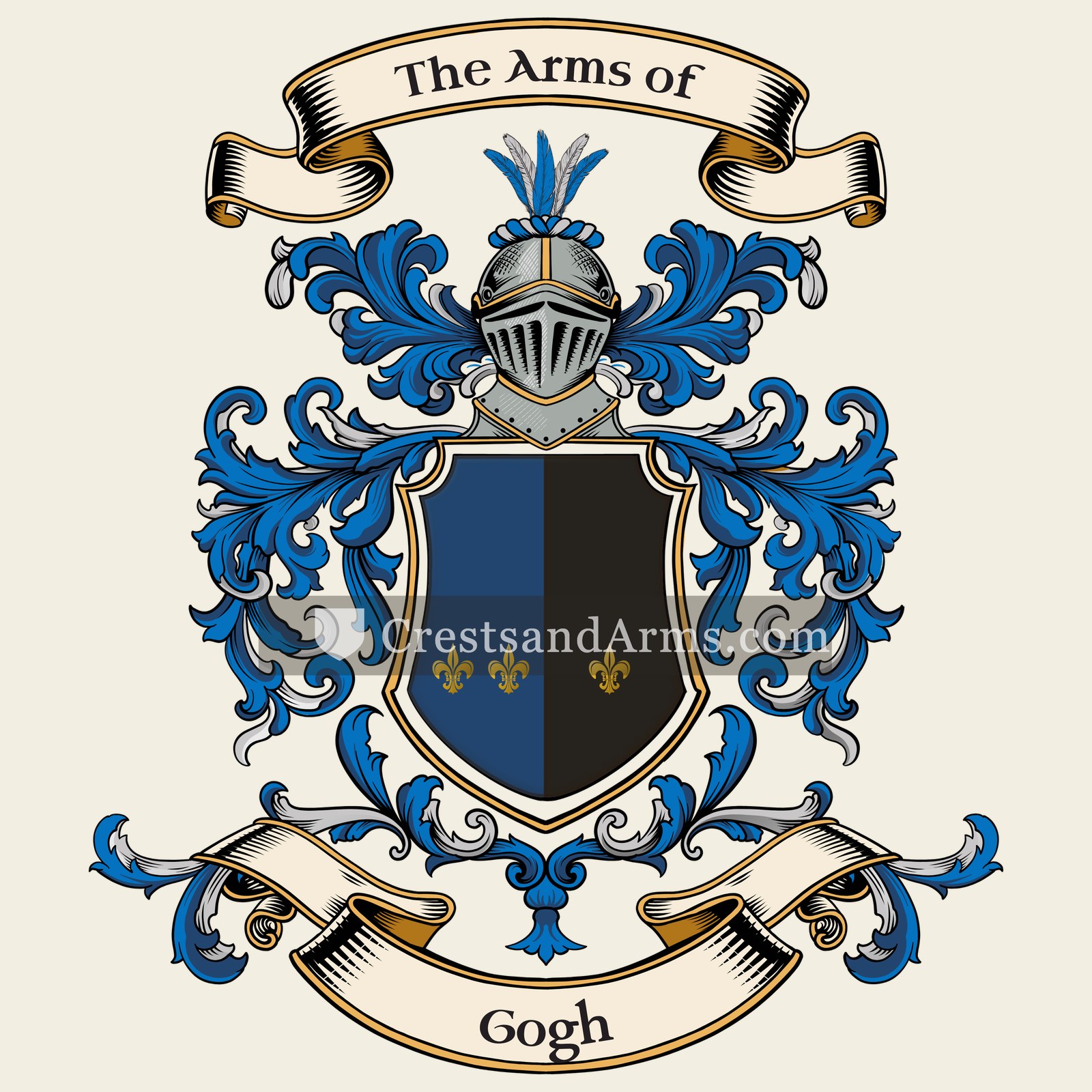
A record of documented arms, meaning and origin, researched for the Gogh family lines. Documented in 2 countries.
Reg. 7528 · English, G–I
Coat of Arms & Family Crest Details
Symbols on this shield
cross symbolChristian faith and service
eagleNobility, strength and a keen mind
Colours
Silver (Argent)Means: Peace and sincerity
Black (Sable)Means: Constancy
Historical info
Source
Sir Bernard Burke, The General Armory of England, Scotland, Ireland and Wales, London: Harrison & Sons, 1884
Blazon (the actual original written record)
“Ar. a cross fusily betw. four eagles displ. sa”
DevonDevon, c. 1620
Where the Gogh Arms Were Recorded
Devon
Map of England showing where the Gogh arms are recorded
The Gogh arms were recorded in Devon, c. 1620.
Devon was a county of small manors and seafaring families. Its gentry were spread thickly across the countryside, and money made at sea often bought an estate, which in turn brought a coat of arms.
This is where the arms were entered in the register. Families often moved to other parts of the country, so the same name can turn up in more than one region.
The body that granted and recorded arms in England in this period.
James VI and I
Sovereign of the period
James VI and I
1603–1625
Reigning in England when the Gogh arms are first recorded.
How Arms Worked in England
English heraldry allowed arms to be shared by all legitimate descendants of the original owner. These symbols were treated as personal property that moved through the generations to all children. While the eldest son kept the original design, other family members could use the same shield without needing to change it or register their own unique versions.
Granting authority
The College of Arms in London has regulated the use of coats of arms throughout England and Wales since 1484.
How they got arms
Families typically obtained their coats of arms through a formal grant from the Crown or by proving their ancient right to them.
Where arms were recorded
All official coats of arms are recorded in the registers kept at the College of Arms, which date back to the fifteenth century.
The family's standing
Recorded among the armigerous families of Devon.
Origin & History of the Gogh Family in England
The history of the Gogh family in England begins with their presence in the county of Devon by the year 1620. During this period, the name was often associated with families living in the rural landscapes of the West Country. While the name is frequently linked to Dutch origins, its early appearance in English parish registers suggests that members of the family had established themselves as part of the local community long before the name became famous elsewhere. These early settlers likely worked in agriculture or local trades, blending into the social fabric of Devonshire villages. By settling in this region, the family became part of the long history of migration and regional development that defined England in the early seventeenth century. Their presence in these records provides a clear window into how the family name took root in English soil during a time of great social change.
Coat of Arms & Family Crest Details
Symbols on this shield
paleMilitary strength, and a fortified defence
fleur de lisPurity, light, and the sixth son
Colours
Blue (Azure)Means: Loyalty and truth
Black (Sable)Means: Constancy
Gold (Or)Means: Generosity
Historical info
Source
Sir Bernard Burke, The General Armory of England, Scotland, Ireland and Wales, London: Harrison & Sons, 1884
Blazon (the actual original written record)
“Per pale az. and sa. three fleurs-de-lis or”
Walesc. 1647
Where the Gogh Arms Were Recorded
Denbigh
Map of Wales showing where the Gogh arms are recorded
The Gogh arms were recorded in Wales, c. 1647.
Arms such as these were typically recorded in Denbigh.
Denbighshire was north Welsh country of hills and small estates. Land was held by a great many families rather than a few, and each holding brought its own claim to a coat of arms.
This is where the arms were entered in the register. Families often moved to other parts of the country, so the same name can turn up in more than one region.
The body that granted and recorded arms in Wales in this period.
Charles I of England
Sovereign of the period
Charles I of England
1625–1649
Reigning in England when the Gogh arms are first recorded.
How Arms Worked in Wales
English heraldry allowed arms to be shared by all legitimate descendants of the original owner. These symbols were treated as personal property that moved through the generations to all children. While the eldest son kept the original design, other family members could use the same shield without needing to change it or register their own unique versions.
Granting authority
The College of Arms in London has regulated the use of coats of arms throughout England and Wales since 1484.
How they got arms
Families typically obtained their coats of arms through a formal grant from the Crown or by proving their ancient right to them.
Where arms were recorded
All official coats of arms are recorded in the registers kept at the College of Arms, which date back to the fifteenth century.
The family's standing
Recorded among the armigerous families of Wales.
Origin & History of the Gogh Family in Wales
The family name Gogh has deep roots in the Welsh landscape, reflecting the linguistic traditions of the region. The name is derived from the Welsh word *coch*, which translates to red. In the Welsh language, initial consonants often change based on the surrounding words, a process known as mutation. Over time, the spelling shifted to Gogh to reflect how the name sounded to speakers of other languages. By 1647, records confirm that members of the family were established in the town of Denbigh. This area was a significant hub for trade and administration in North Wales during the seventeenth century. Living in a town like Denbigh suggests that these early family members were likely involved in the local economy or civic life of the period. Their presence in the historical record provides a clear link to the social fabric of early modern Wales.
Related Branches & Arms
Root word
Gogh
Derived from the Dutch word for a region or district.
This name
GoghRefers to someone who originated from a specific geographical area or settlement.
also spelled
Gogh
Gochee
Gooche
Documented Sources
Sir Bernard Burke, The General Armory of England, Scotland, Ireland and Wales, London: Harrison & Sons, 1884
Devon Archives and Local Studies Service, Parish Registers of Devon, 1620
Hoskins, W. G., Devon, 1954
Reaney, P. H., A Dictionary of British Surnames, 1958
Digital archive packCoat of arms PNG, gold border print PDF, vector SVG and the certificate of authenticity. Sent to your email in minutes.


 cross symbolChristian faith and service
 eagleNobility, strength and a keen mind
 cross symbolChristian faith and service
 eagleNobility, strength and a keen mind

 paleMilitary strength, and a fortified defence
 fleur de lisPurity, light, and the sixth son