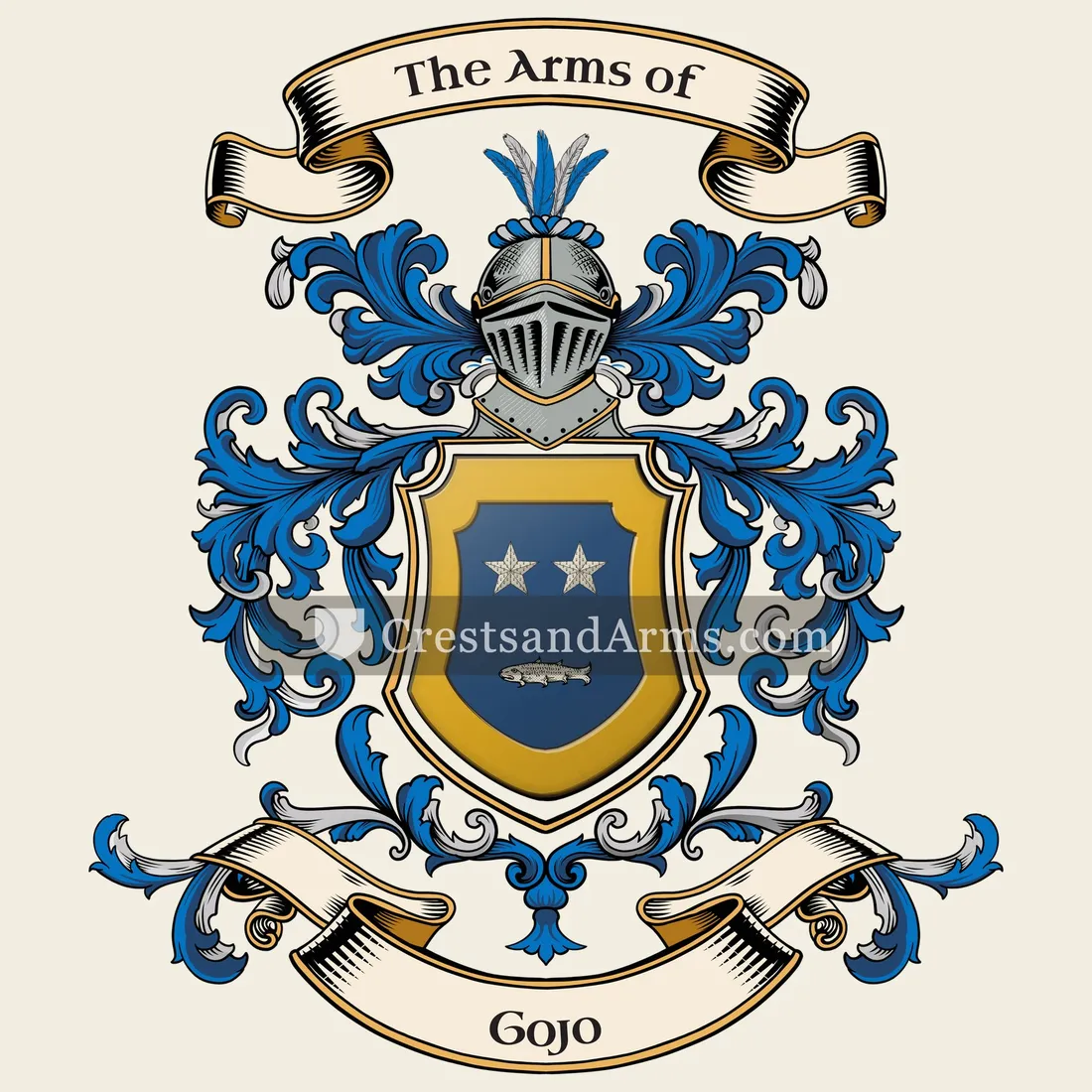
A record of documented arms, meaning and origin, researched for the Gojo family of Sweden.
Reg. 8911 · Swedish, G–I
Meaning of the Gojo family crest colors & symbols
Symbols on this shield
mulletThe third son, and a divine quality from above
fishA true and generous mind, and Christian faith
Colours
Blue (Azure)Means: Loyalty and truth
Gold (Or)Means: Generosity
ErmineMeans: Dignity
Historical info
Source
J. B. Rietstap, Armorial Général, Gouda: G. B. van Goor Zonen, 1884–87
Blazon (the actual original written record)
“D'azur à deux étoiles (5) d'er en chef et un poisson nageant du même en p.; l'écu bordé aussi d'or. C.: une pique d'or, en pal, entre deux guidons d'azur, les hampes d'or.”
Swedenc. 1444
Digital archive packCoat of arms PNG, gold border print PDF, vector SVG and the certificate of authenticity. Sent to your email in minutes.
Map of Sweden showing where the Gojo arms are recorded
The Gojo arms were recorded in Sweden, c. 1444.
Arms such as these were typically recorded in Stockholm.
Stockholm held the Swedish court and the House of Nobility, where every noble family's arms were entered and kept. Families ennobled for service registered there, which is why so many are recorded around the city.
This is where the arms were entered in the register. Families often moved to other parts of the country, so the same name can turn up in more than one region.
The body that granted and recorded arms in Sweden in this period.
Christopher of Bavaria
Sovereign of the period
Christopher of Bavaria
1441–1448
Reigning in Sweden when the Gojo arms are first recorded.
How Arms Worked in Sweden
In Sweden, a coat of arms belonged to a noble family as a whole rather than just one individual. These arms were passed down through the generations to all legitimate descendants. Younger branches of the family used the same shield without needing to change it. This system ensured that the entire lineage shared the same identity and status under the law.
Granting authority
The Riddarhuset, or House of Nobility, regulated all noble coats of arms in Sweden under royal authority.
How they got arms
Families received their coats of arms through royal grants of nobility which were then officially registered with the House.
Where arms were recorded
Coats of arms were officially recorded in the Swedish House of Nobility register starting in the year 1626.
The family's standing
Recorded among the armigerous families of Sweden.
Origin & History of the Gojo Family in Sweden
The history of the Gojo family name traces back to the mid-fifteenth century in Stockholm, where records confirm their presence by the year 1444. During this period, Stockholm was a growing hub of trade and culture under the influence of the Kalmar Union. Families like the Gojos were often integrated into the city’s developing urban structure, likely working as merchants, artisans, or local administrators who helped manage the bustling harbor life. Because the name appears in early municipal documents, it suggests that the family held a stable position within the social hierarchy of the medieval capital. Over time, the name evolved alongside the Swedish language, reflecting the changing customs and linguistic shifts of the Baltic region. By establishing themselves in such a prominent city early on, the family became part of the foundational history of Stockholm’s long-standing urban community.
Gojo Meaning & Related Branches
Root word
Gode
Old Norse term meaning good or capable.
This name
GojoA locational or descriptive surname derived from the Old Norse word for good.
also spelled
Gjoes
Gjoss
Yos
Documented Sources
J. B. Rietstap, Armorial Général, Gouda: G. B. van Goor Zonen, 1884–87
Stockholm City Archives (Stockholms stadsarkiv), Stockholms stads tänkeböcker 1444
Larsson, Lars-Olof, Kalmarunionens tid: Från drottning Margareta till Kristian II, 1997
Digital archive packCoat of arms PNG, gold border print PDF, vector SVG and the certificate of authenticity. Sent to your email in minutes.


 mulletThe third son, and a divine quality from above
 fishA true and generous mind, and Christian faith
 mulletThe third son, and a divine quality from above
 fishA true and generous mind, and Christian faith