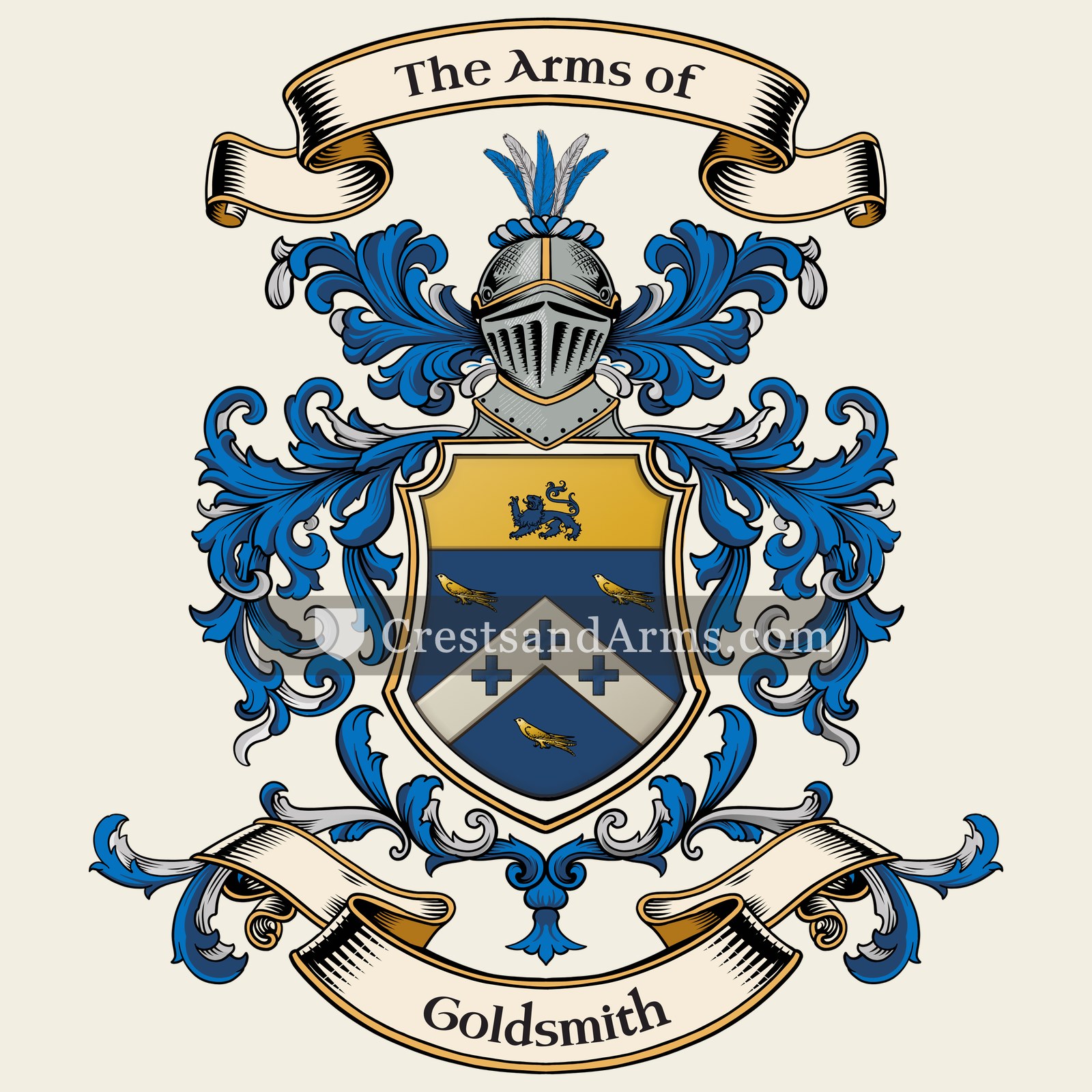
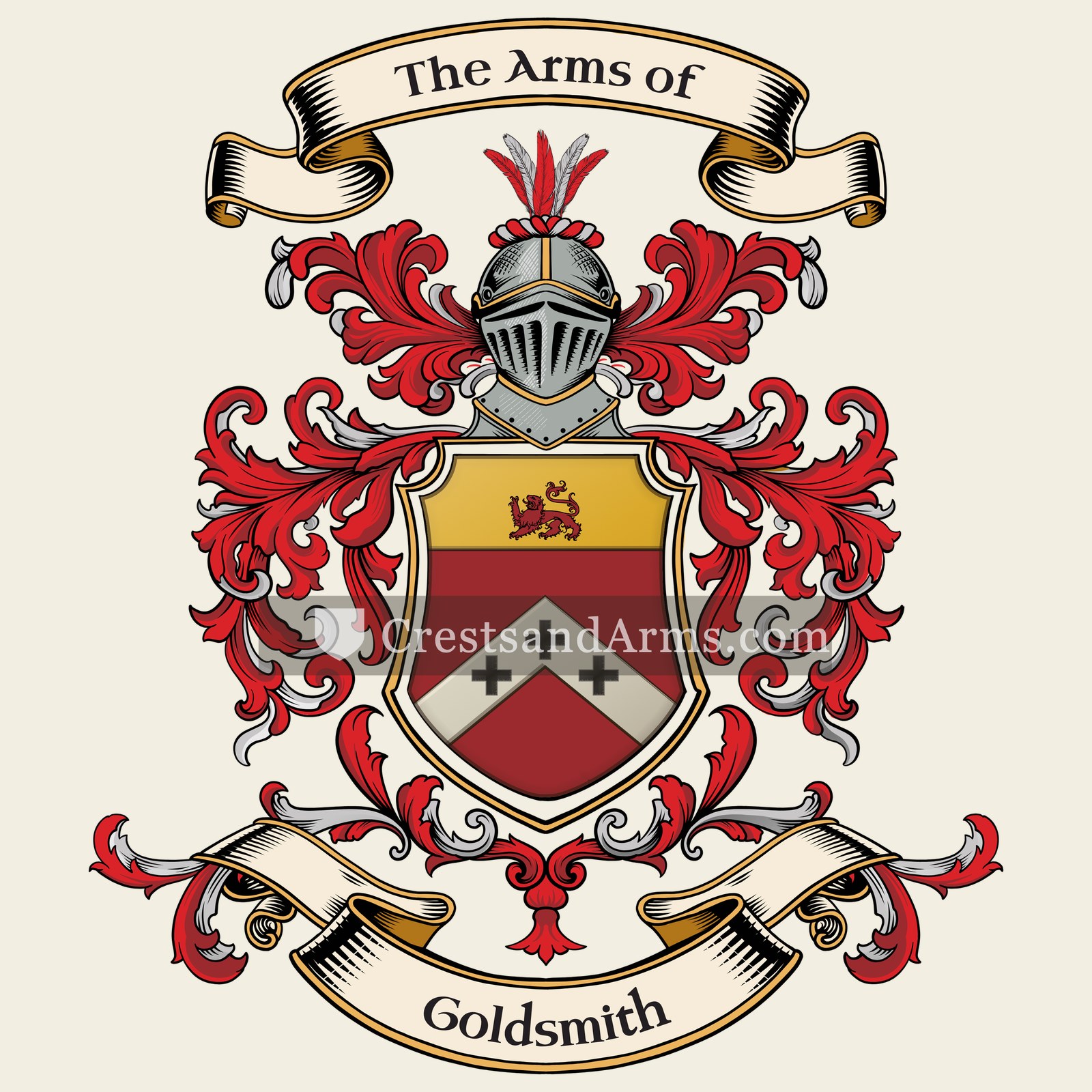
A record of documented arms, meaning and origin, researched for the Goldsmith family lines. Documented in 2 countries.
Reg. 0501 · Irish, G–I
Coat of Arms & Family Crest Details
Symbols on this shield
chevronProtection, and faithful service completed
cross symbolChristian faith and service
chiefAuthority, wisdom and dominion
martletA younger son, who must win his own land
lionCourage, strength and royalty
Colours
Blue (Azure)Means: Loyalty and truth
Silver (Argent)Means: Peace and sincerity
Gold (Or)Means: Generosity
Historical info
Source
Sir Bernard Burke, The General Armory of England, Scotland, Ireland and Wales, London: Harrison & Sons, 1884
Blazon (the actual original written record)
“Az. on a chev. ar. betw. three goldfinches of the last as many crosses crosslet of the first, on a chief or, a lion pass. of the field”
Irelandc. 1679
Where the Goldsmith Arms Were Recorded
Dublin
Map of Ireland showing where the Goldsmith arms are recorded
The Goldsmith arms were recorded in Ireland, c. 1679.
Arms such as these were typically recorded in Dublin.
Dublin was the seat of government in Ireland and the place where grants were sought and recorded. Families with business at the castle or the courts settled nearby, and settling there put their arms on record.
This is where the arms were entered in the register. Families often moved to other parts of the country, so the same name can turn up in more than one region.
The body that granted and recorded arms in Ireland in this period.
Charles II of England
Sovereign of the period
Charles II of England
1660–1685
Reigning in Ireland when the Goldsmith arms are first recorded.
How Arms Worked in Ireland
The Ulster King of Arms granted coats of arms to individuals who proved their social standing and good character. These symbols were typically inherited by all legitimate descendants of the original holder. If a family branch wanted a unique look, they could apply for a specific change to their design through the office to ensure their identity remained distinct.
Granting authority
The Ulster King of Arms acted as the official body that regulated and issued all coats of arms throughout Ireland.
How they got arms
Families obtained their arms through formal grants issued by the office after proving their eligibility and paying the required fees.
Where arms were recorded
All official grants were recorded in the registers held by the Ulster King of Arms starting from the year 1552.
The family's standing
Recorded among the armigerous families of Ireland.
Origin & History of the Goldsmith Family in Ireland
The Goldsmith family name in Ireland is deeply connected to the professional traditions of the seventeenth century. While the name originated as an occupational surname for those who worked with precious metals, its presence in Dublin by 1679 marks a significant chapter in the family’s history. During this period, Dublin was a growing center for trade and craftsmanship, providing a home for skilled artisans who moved across the Irish Sea. These early settlers often integrated into the city’s merchant class, contributing to the local economy through their specialized knowledge of metalwork and finance. As the family established roots in the capital, they became part of the broader social fabric of Ireland, moving from their initial roles as tradesmen toward positions in the church and the arts. This transition helped the name endure through generations as the family expanded beyond Dublin and into the rural landscapes of the Irish countryside.
Coat of Arms & Family Crest Details
Symbols on this shield
chevronProtection, and faithful service completed
cross symbolChristian faith and service
chiefAuthority, wisdom and dominion
lionCourage, strength and royalty
Colours
Red (Gules)Means: Military strength
Silver (Argent)Means: Peace and sincerity
Gold (Or)Means: Generosity
Black (Sable)Means: Constancy
Historical info
Source
Sir Bernard Burke, The General Armory of England, Scotland, Ireland and Wales, London: Harrison & Sons, 1884
Blazon (the actual original written record)
“Gu. on a chev. ar. three crosses crosslet sa. on a chief or, a lion pass. gu”
HantsExton · Hants, c. 1620
Where the Goldsmith Arms Were Recorded
Hants
Map of England showing where the Goldsmith arms are recorded
The Goldsmith arms were recorded in Hants, c. 1620.
Hampshire had the naval dockyards at Portsmouth on one side and good farmland on the other. Sea money and land money both bought estates, and an estate was what brought a family its coat of arms.
This is where the arms were entered in the register. Families often moved to other parts of the country, so the same name can turn up in more than one region.
The body that granted and recorded arms in England in this period.
James VI and I
Sovereign of the period
James VI and I
1603–1625
Reigning in Ireland when the Goldsmith arms are first recorded.
How Arms Worked in England
English heraldry allowed arms to be shared by all legitimate descendants of the original owner. These symbols were treated as personal property that moved through the generations to all children. While the eldest son kept the original design, other family members could use the same shield without needing to change it or register their own unique versions.
Granting authority
The College of Arms in London has regulated the use of coats of arms throughout England and Wales since 1484.
How they got arms
Families typically obtained their coats of arms through a formal grant from the Crown or by proving their ancient right to them.
Where arms were recorded
All official coats of arms are recorded in the registers kept at the College of Arms, which date back to the fifteenth century.
The family's standing
Recorded among the armigerous families of Hants.
Origin & History of the Goldsmith Family in England
The surname Goldsmith originated as an occupational name, identifying individuals who worked with precious metals during the medieval period in England. By the early 17th century, the family had established a notable presence in the county of Hampshire, specifically appearing in records dating back to 1620. During this era, men with this name were often skilled artisans who played a vital role in the local economy by crafting jewelry, coins, and decorative metalwork. Because these craftsmen were trusted with valuable materials, they often held respected positions within their communities. As the family grew, they transitioned from being known simply by their trade to using the term as a permanent hereditary surname passed down through generations. This evolution reflects the broader social history of England, where professional titles gradually transformed into the family names that define our identities today.
Related Branches & Arms
Root word
Goldsmith
Derived from the Old English words for gold and worker.
This name
GoldsmithAn occupational surname for a person who crafted items from gold.
also spelled
Goldsmyth
Related arms
Goldfinch, or Gouldfinchsame arms
Gouldsmithvariant spelling
Dalbyrecorded with Goldsmith, same area
Documented Sources
Sir Bernard Burke, The General Armory of England, Scotland, Ireland and Wales, London: Harrison & Sons, 1884
MacLysaght, Edward. The Surnames of Ireland. 1985
O'Brien, Michael J. The Goldsmiths of Ireland. 1972
National Archives of Ireland, Dublin City Guild Records
Representative Church Body Library, Parish Registers of St. Michan’s, Dublin
Digital archive packCoat of arms PNG, gold border print PDF, vector SVG and the certificate of authenticity. Sent to your email in minutes.


 chevronProtection, and faithful service completed
 cross symbolChristian faith and service
 chiefAuthority, wisdom and dominion
 martletA younger son, who must win his own land
 lionCourage, strength and royalty
 chevronProtection, and faithful service completed
 cross symbolChristian faith and service
 chiefAuthority, wisdom and dominion
 martletA younger son, who must win his own land
 lionCourage, strength and royalty