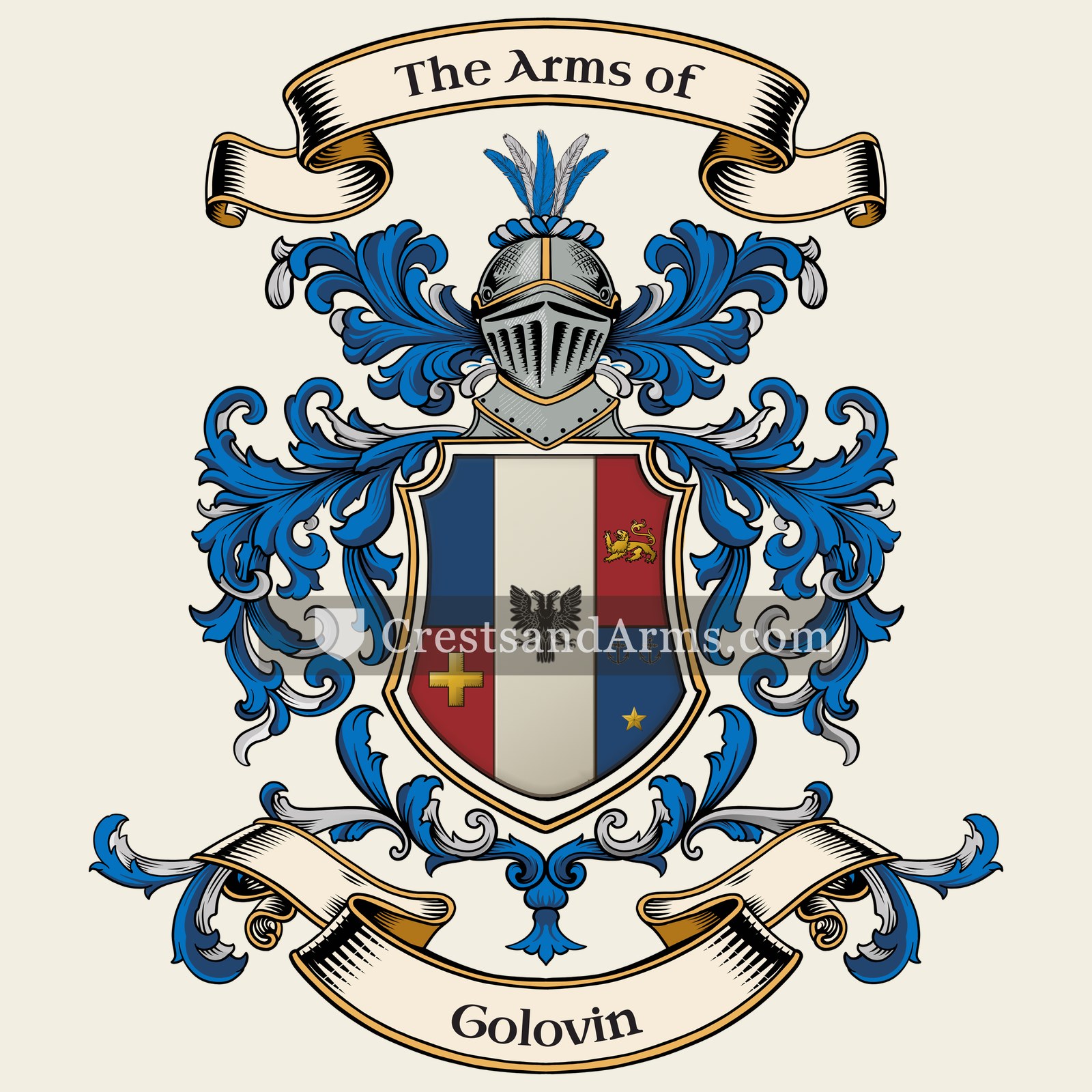
A record of documented arms, meaning and origin, researched for the Golovin family of Poland.
Reg. 5928 · Polish, G–I
Coat of Arms & Family Crest Details
Symbols on this shield
paleMilitary strength, and a fortified defence
fessThe military belt, and readiness to serve
cross symbolChristian faith and service
saltireResolution, and St Andrew's cross
eagleNobility, strength and a keen mind
lionCourage, strength and royalty
anchorHope, and steadfastness in trouble
mulletThe third son, and a divine quality from above
Colours
Blue (Azure)Means: Loyalty and truth
Red (Gules)Means: Military strength
Silver (Argent)Means: Peace and sincerity
Black (Sable)Means: Constancy
Gold (Or)Means: Generosity
Historical info
Source
J. B. Rietstap, Armorial Général, Gouda: G. B. van Goor Zonen, 1884–87
Blazon (the actual original written record)
“Coupé: au 1 parti, d'azur à un centaure cont. d'arg., tenant un voile du même au-dessus de sa tête, et d'azur au lion d'or, cour. du même, brandissant un sabre d'arg.; au pal d'arg., br. sur le parti, et soutenu d'une fasce du même, br. sur le coupé; au 2 d'arg., chapé à dextre de gu. et à sen. d'azur: le gu. ch. d'une croix pattée alésée d'or, l'arg. de deux ancres de sa. passées en saut., surmontées d'une étoile (8) d'or, et l'azur d'un croiss. figuré tourné d'arg. Sur le tout un écusson parti d'or et de gu., à l'aigle ép. de sa. sur l'or et d'arg. sur le gu., chaque tête sommée d'une couronne royale d'or; ledit écusson timbré d'une couronne princière. Cq. cour. C.: deux drapeaux, celui à dextre fascé de gu., d'arg., de sa., d'arg. et de sa., et celui à sen. fascé de sa., d'arg., de gu., d'arg. et de sa., les hampes passées en saut., chaque hampe sommée d'un monde d'or; le tout posé devant deux banderoles flottantes, celle à dextre d'azur et celle à sen. de gu., attachées à des hampes à tête de flèche d'arg., passées en saut.; toutes les hampes soutenues d'un croiss. figuré montant d'arg. L.: à dextre d'or et d'azur, à sen. d'or et de gu. S.: à dextre un lion au nat., cour. d'or, tenant de sa patte dextre un cimeterre d'arg., garni d'or; à sen. un renard au nat., cour. d'or, tenant de sa patte dextre une flèche d'arg., en barre, la pointe en haut.”
LivoniaLivonia, c. 1702
Where the Golovin Arms Were Recorded
Map of Poland showing where the Golovin arms are recorded
The Golovin arms were recorded in Livonia, c. 1702.
Livonia was Baltic country held by a small number of landed families who kept their estates for centuries. Land there passed down whole rather than being divided, and long unbroken tenure is what fills a register.
This is where the arms were entered in the register. Families often moved to other parts of the country, so the same name can turn up in more than one region.
Region
Livonia
First recorded
1702
Granting Authority for the Golovin Arms
Ennoblement by the Sejm
Author: Olek Remesz · CC BY-SA 3.0
The body that granted and recorded arms in Poland in this period.
Augustus II the Strong
Sovereign of the period
Augustus II the Strong
1697–1706
Reigning in Poland when the Golovin arms are first recorded.
How Arms Worked in Poland
Polish noble families shared a single coat of arms across many different surnames, creating large clans rather than individual designs. These symbols were held collectively by all members of the clan regardless of their specific family name. When a new family joined the nobility, they were adopted into an existing clan and began using that group's established shield.
Granting authority
The Sejm, which was the Polish parliament, held the power to grant noble status and the right to bear arms.
How they got arms
Families typically received their coat of arms through a formal act of ennoblement granted by the Sejm for distinguished service.
Where arms were recorded
These grants were officially recorded in the Crown Metrica, which served as the central archive for state documents starting in the sixteenth century.
The family's standing
Recorded among the armigerous families of Livonia.
Origin & History of the Golovin Family in Poland
The surname Golovin originates from the Russian word golova, which translates to head. Historically, this name was often used as a nickname for someone with a large head or perhaps a person who held a position of leadership. By the early 18th century, the family had established a significant presence in the Baltic region, particularly in Livonia. During the year 1702, members of the Golovin family were active in this territory during the Great Northern War. Their presence in Livonia suggests that the family served the Russian state as military officers or administrators during a time of intense territorial expansion. Over time, the family name became associated with high-ranking service to the Russian Empire, marking their transition from local figures to influential members of the nobility.
Related Branches & Arms
Root word
Głowa
The Polish word for head.
This name
GolovinA nickname for a person with a large or distinctive head.
also spelled
Golovin
Documented Sources
J. B. Rietstap, Armorial Général, Gouda: G. B. van Goor Zonen, 1884–87
Veselovsky, Stepan B., Onomastikon: Drevnerusskie imena, prozvishcha i familii, 1974
Unbegaun, Boris O., Russian Surnames, 1972
Bantysh-Kamensky, Dmitry N., Biografii rossiyskikh generalissimusov i general-feldfebelyev, 1840
Russian State Archive of Ancient Acts (RGADA), Fond 210 (Razryadny prikaz)
State Archive of the Russian Federation (GARF), Fond 109 (Third Section of His Imperial Majesty's Own Chancellery)
Digital archive packCoat of arms PNG, gold border print PDF, vector SVG and the certificate of authenticity. Sent to your email in minutes.


 paleMilitary strength, and a fortified defence
 fessThe military belt, and readiness to serve
 cross symbolChristian faith and service
 saltireResolution, and St Andrew's cross
 eagleNobility, strength and a keen mind
 lionCourage, strength and royalty
 anchorHope, and steadfastness in trouble
 mulletThe third son, and a divine quality from above