Map of France showing where the Golson arms are recorded
The Golson arms were recorded in Lorraine, c. 1667.
Lorraine sat on the border between France and the German lands, and border country bred soldiers. Families here held small estates and served in arms, and a fighting man was exactly the sort who carried a shield of his own.
This is where the arms were entered in the register. Families often moved to other parts of the country, so the same name can turn up in more than one region.
The body that granted and recorded arms in France in this period.
Louis XIV of France
Sovereign of the period
Louis XIV of France
1643–1715
Reigning in France when the Golson arms are first recorded.
How Arms Worked in France
In France, a coat of arms was a mark of honor that passed down through the male line to all legitimate descendants. Families often used the same shield without changes to show their shared heritage. If a branch wanted to stand out, they could add a small mark to their shield to show their specific place in the family tree.
Granting authority
The Juge d'armes de France acted as the official authority that regulated and verified coats of arms across the country.
How they got arms
Families typically inherited their arms from ancestors, though they could also receive them through royal grants or by proving their noble status.
Where arms were recorded
Coats of arms were officially recorded in the Armorial Général de France, which began its main collection in the year 1696.
The family's standing
Recorded among the armigerous families of Lorraine.
Origin & History of the Golson Family in France
The history of the Golson family in France is deeply rooted in the historical region of Lorraine. By the year 1667, records confirm that members of the family were established within this territory, which served as a vital crossroads between the French and German cultures. During the seventeenth century, Lorraine was a landscape defined by significant social shifts and the aftermath of regional conflicts, which often influenced how families settled and identified themselves within local communities. The name itself likely evolved from older linguistic patterns common to the borderlands of the Holy Roman Empire and the Kingdom of France. As the family lived in this area, they were part of a society that valued agricultural stability and local trade. Their presence in 1667 suggests that the family was well-integrated into the administrative and social fabric of the province during a time when Lorraine was transitioning toward closer ties with the French crown.
Meaning of the Golson family crest colors & symbols
Symbols on this shield
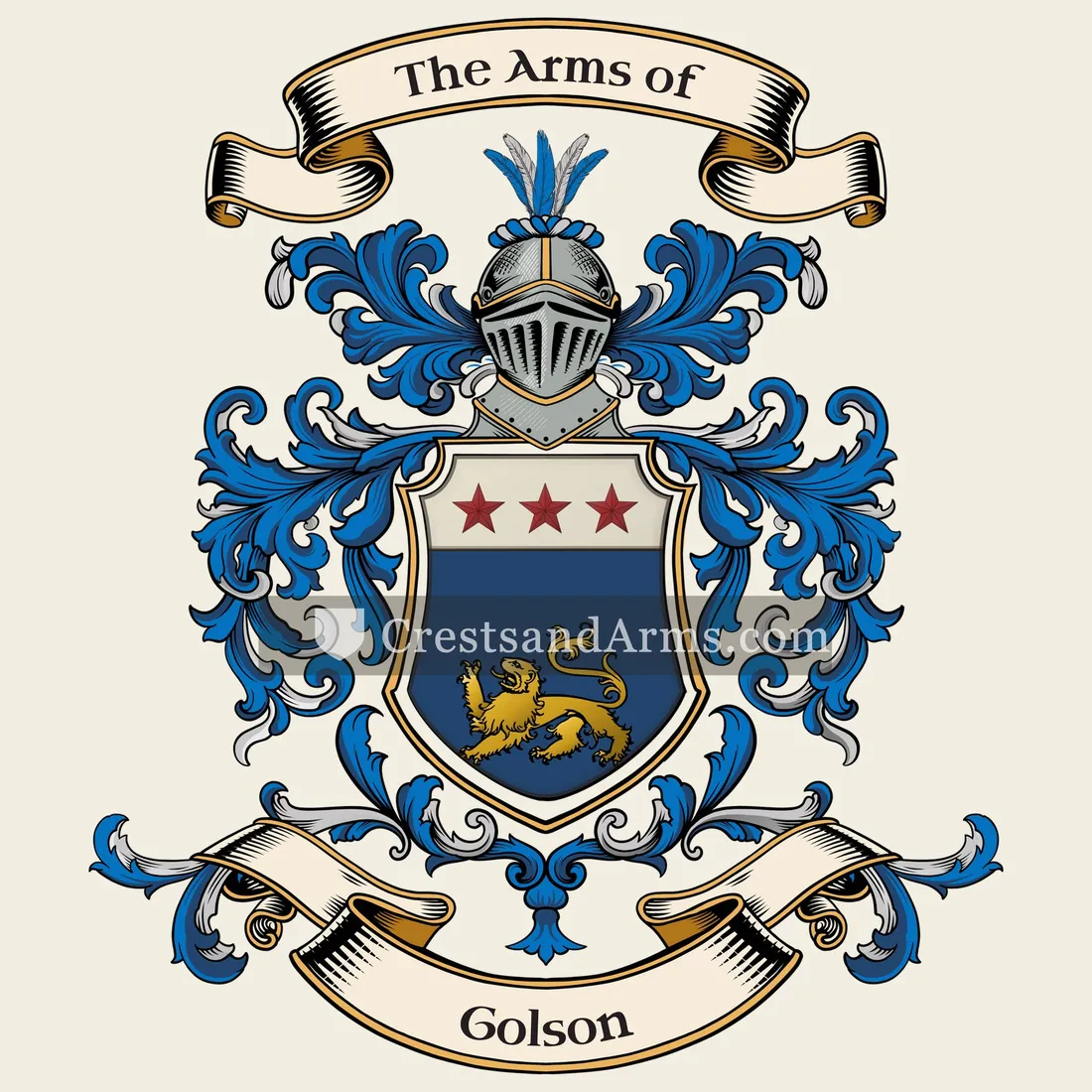
fessThe military belt, and readiness to serve
martletA younger son, who must win his own land
roundelA coin, and one who has been to the crusades
Colours
Silver (Argent)Means: Peace and sincerity
Red (Gules)Means: Military strength
Black (Sable)Means: Constancy
Historical info
Source
J. B. Rietstap, Armorial Général, Gouda: G. B. van Goor Zonen, 1884–87
Blazon (the actual original written record)
“D'arg. à la fasce de gu., acc. en chef de trois merlettes de sa., 2 et 1, et en p. d'une fontaine de deux bassins superposés de sa., jaillissante de plusieurs traits. C.: une merlette de sa.”
Belgiumc. 1737
Digital archive packCoat of arms PNG, gold border print PDF, vector SVG and the certificate of authenticity. Sent to your email in minutes.
Map of Belgium showing where the Golson arms are recorded
The Golson arms were recorded in Belgium, c. 1737.
Arms such as these were typically recorded in Brabant.
Brabant lay at the heart of the Low Countries, where the trade routes met. Its towns were wealthy and its landowners many, and both kinds of family kept arms, which is why the region is so heavily represented.
This is where the arms were entered in the register. Families often moved to other parts of the country, so the same name can turn up in more than one region.
The body that granted and recorded arms in Belgium in this period.
Charles VI, Holy Roman Emperor
Sovereign of the period
Charles VI, Holy Roman Emperor
1711–1740
Reigning in France when the Golson arms are first recorded.
How Arms Worked in Belgium
In Belgium, a coat of arms is considered personal property that is passed down through the male line to legitimate descendants. Families often use the same shield design across generations to show their shared heritage. If a branch of the family wants to change the design, they must apply for an official update to their specific version of the arms.
Granting authority
The Conseil héraldique is the official body that regulates and approves all coats of arms in Belgium.
How they got arms
Families obtain their coats of arms through formal royal grants or by confirming their historical right to use existing designs.
Where arms were recorded
All approved coats of arms are officially recorded in the public registers of the Conseil héraldique since 1844.
The family's standing
Recorded among the armigerous families of Belgium.
Origin & History of the Golson Family in Belgium
The history of the Golson family in Belgium is rooted in the historic Duchy of Brabant, where records confirm their presence by 1737. During the eighteenth century, Brabant was a central hub of trade and agriculture under the rule of the Austrian Netherlands. Families like the Golsons often lived in rural or semi-urban communities where they were deeply connected to the local parish systems. Because surnames were becoming more fixed during this era, the name likely served as a way to identify the family within their specific village or guild. Life in Brabant at this time was defined by a mix of traditional farming practices and the slow growth of local industry. By settling in this region, the early Golsons became part of a complex social landscape that survived through shifting political borders and regional economic changes. Their presence in the official records of 1737 suggests they were established members of the community who participated in the legal and religious life of the province.
Meaning of the Golson family crest colors & symbols
Symbols on this shield
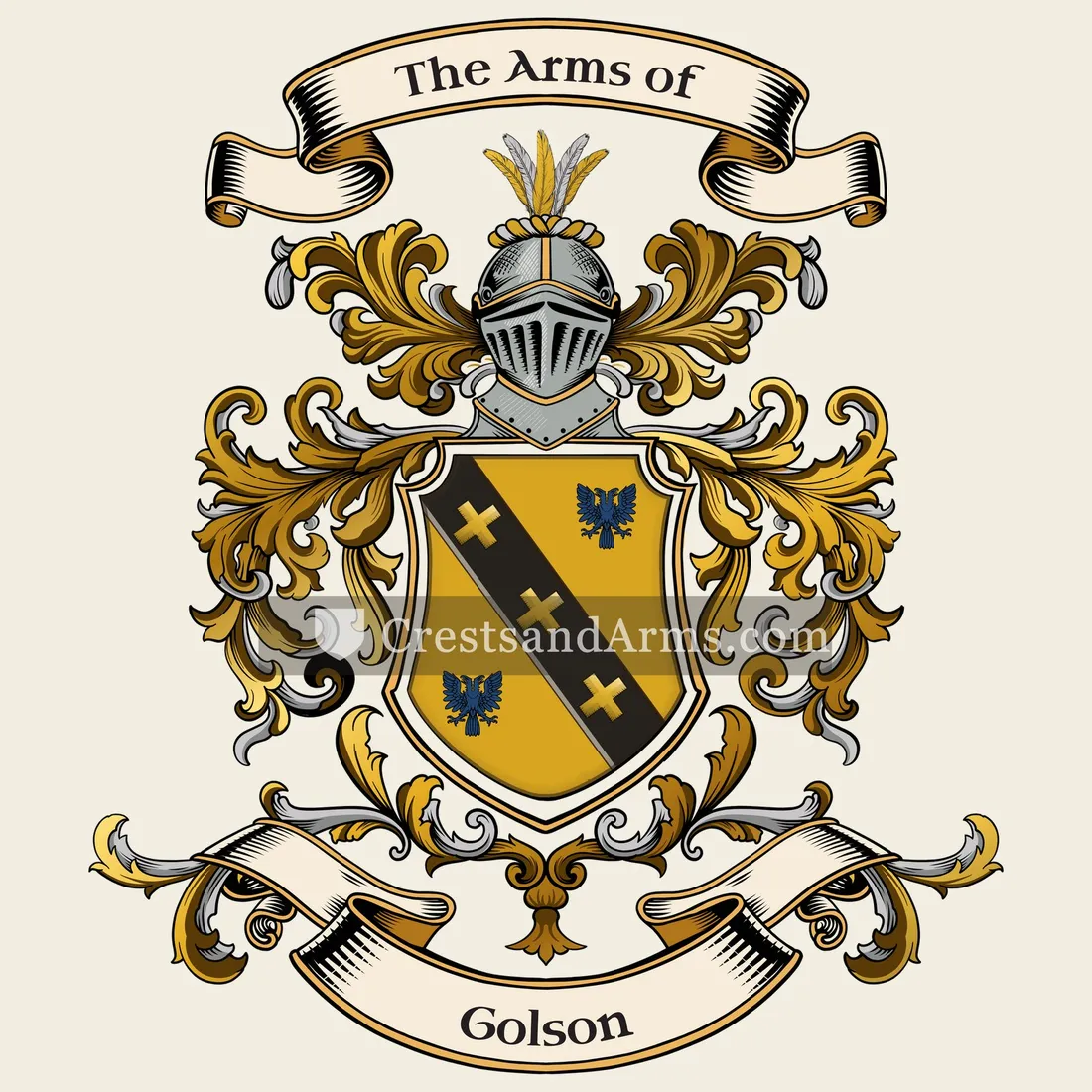
bendDefence, and the scarf of a commander
cross symbolChristian faith and service
eagleNobility, strength and a keen mind
Colours
Gold (Or)Means: Generosity
Black (Sable)Means: Constancy
Blue (Azure)Means: Loyalty and truth
Historical info
Source
Sir Bernard Burke, The General Armory of England, Scotland, Ireland and Wales, London: Harrison & Sons, 1884
Blazon (the actual original written record)
“Or, on a bend sa. betw. two eagles displ. az. armed and langued gu. three crosses crosslet of the first”
Irelandc. 1610
Digital archive packCoat of arms PNG, gold border print PDF, vector SVG and the certificate of authenticity. Sent to your email in minutes.
Map of Ireland showing where the Golson arms are recorded
The Golson arms were recorded in Ireland, c. 1610.
Arms such as these were typically recorded in Dublin.
Dublin was the seat of government in Ireland and the place where grants were sought and recorded. Families with business at the castle or the courts settled nearby, and settling there put their arms on record.
This is where the arms were entered in the register. Families often moved to other parts of the country, so the same name can turn up in more than one region.
The body that granted and recorded arms in Ireland in this period.
James VI and I
Sovereign of the period
James VI and I
1603–1625
Reigning in France when the Golson arms are first recorded.
How Arms Worked in Ireland
The Ulster King of Arms granted coats of arms to individuals who proved their social standing and good character. These symbols were typically inherited by all legitimate descendants of the original holder. If a family branch wanted a unique look, they could apply for a specific change to their design through the office to ensure their identity remained distinct.
Granting authority
The Ulster King of Arms acted as the official body that regulated and issued all coats of arms throughout Ireland.
How they got arms
Families obtained their arms through formal grants issued by the office after proving their eligibility and paying the required fees.
Where arms were recorded
All official grants were recorded in the registers held by the Ulster King of Arms starting from the year 1552.
The family's standing
Recorded among the armigerous families of Ireland.
Origin & History of the Golson Family in Ireland
The history of the Golson family in Ireland begins with their documented presence in Dublin as early as 1610. During this period, Dublin was a rapidly changing city that served as the center of English administration in Ireland. Families like the Golsons often arrived in the capital to participate in the growing trade networks and the professional life of the city. As the seventeenth century progressed, the family became part of the urban fabric of Dublin, living alongside merchants, craftsmen, and government officials. While the name likely originated from roots outside of Ireland, the Golsons established themselves within the local community by taking advantage of the city’s role as a hub for commerce and legal activity. Their early residency in Dublin suggests they were part of a group of settlers who helped shape the economic and social development of the city during a time of significant transition.
Golson Meaning & Related Branches
Root word
Guillaume
Germanic name composed of elements meaning will and helmet or protection.
This name
GolsonA patronymic surname derived from a diminutive form of William, meaning son of little William.
also spelled
Gilsone
Gilsonn
Gilsen
Gylson
Gyllson
Documented Sources
J. B. Rietstap, Armorial Général, Gouda: G. B. van Goor Zonen, 1884–87
Archives départementales de Meurthe-et-Moselle, Série B: Cours et juridictions (Ancien Régime)
Cabourdin, Guy, Terres et hommes en Lorraine 1648-1789, 1977
Lepage, Henri, Les communes de la Meurthe: journal historique des villes, bourgs, villages, hameaux et censes de ce département, 1853
Digital archive packCoat of arms PNG, gold border print PDF, vector SVG and the certificate of authenticity. Sent to your email in minutes.


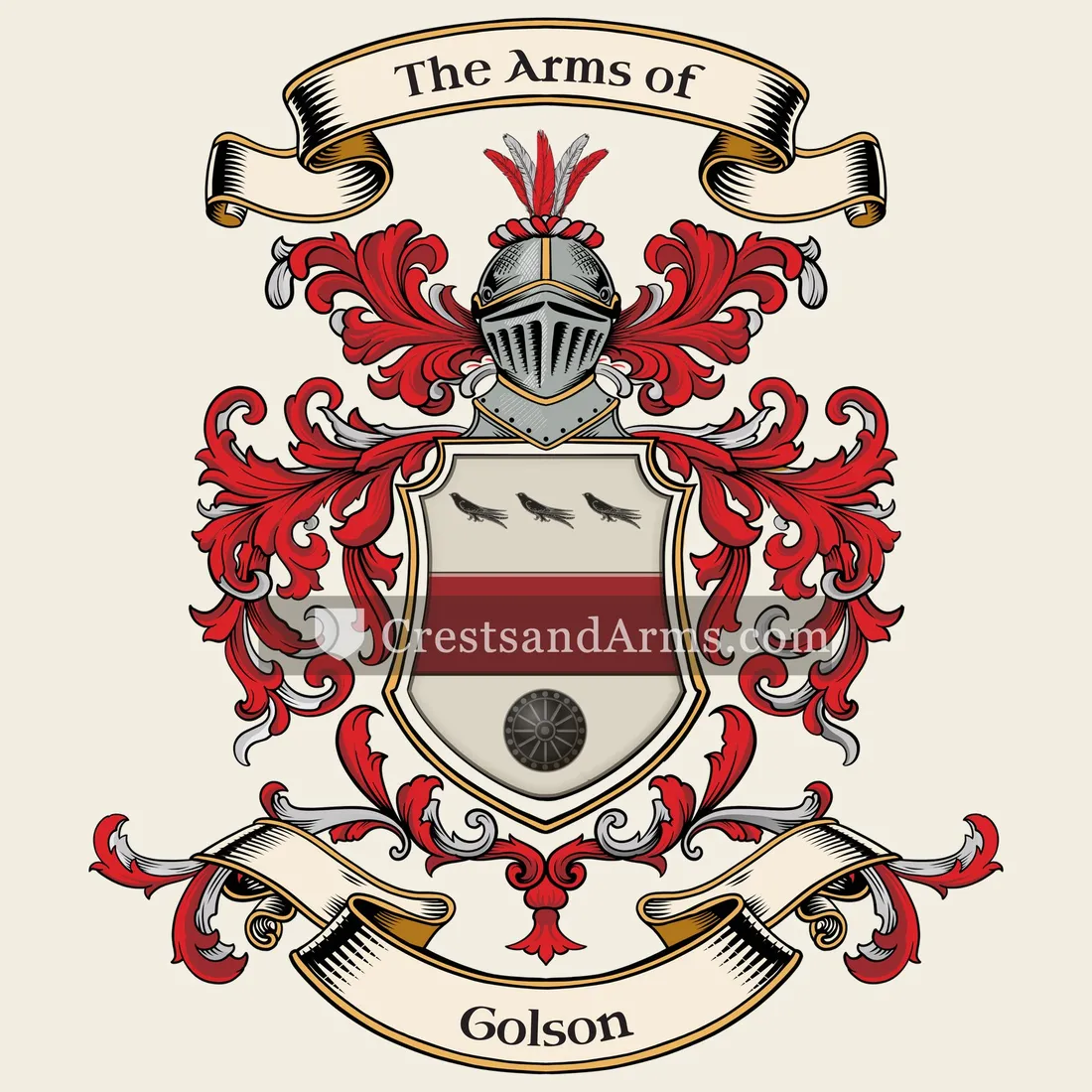
 chiefAuthority, wisdom and dominion
 lionCourage, strength and royalty
 mulletThe third son, and a divine quality from above
 chiefAuthority, wisdom and dominion
 lionCourage, strength and royalty
 mulletThe third son, and a divine quality from above


 fessThe military belt, and readiness to serve
 martletA younger son, who must win his own land
 roundelA coin, and one who has been to the crusades


 bendDefence, and the scarf of a commander
 cross symbolChristian faith and service
 eagleNobility, strength and a keen mind