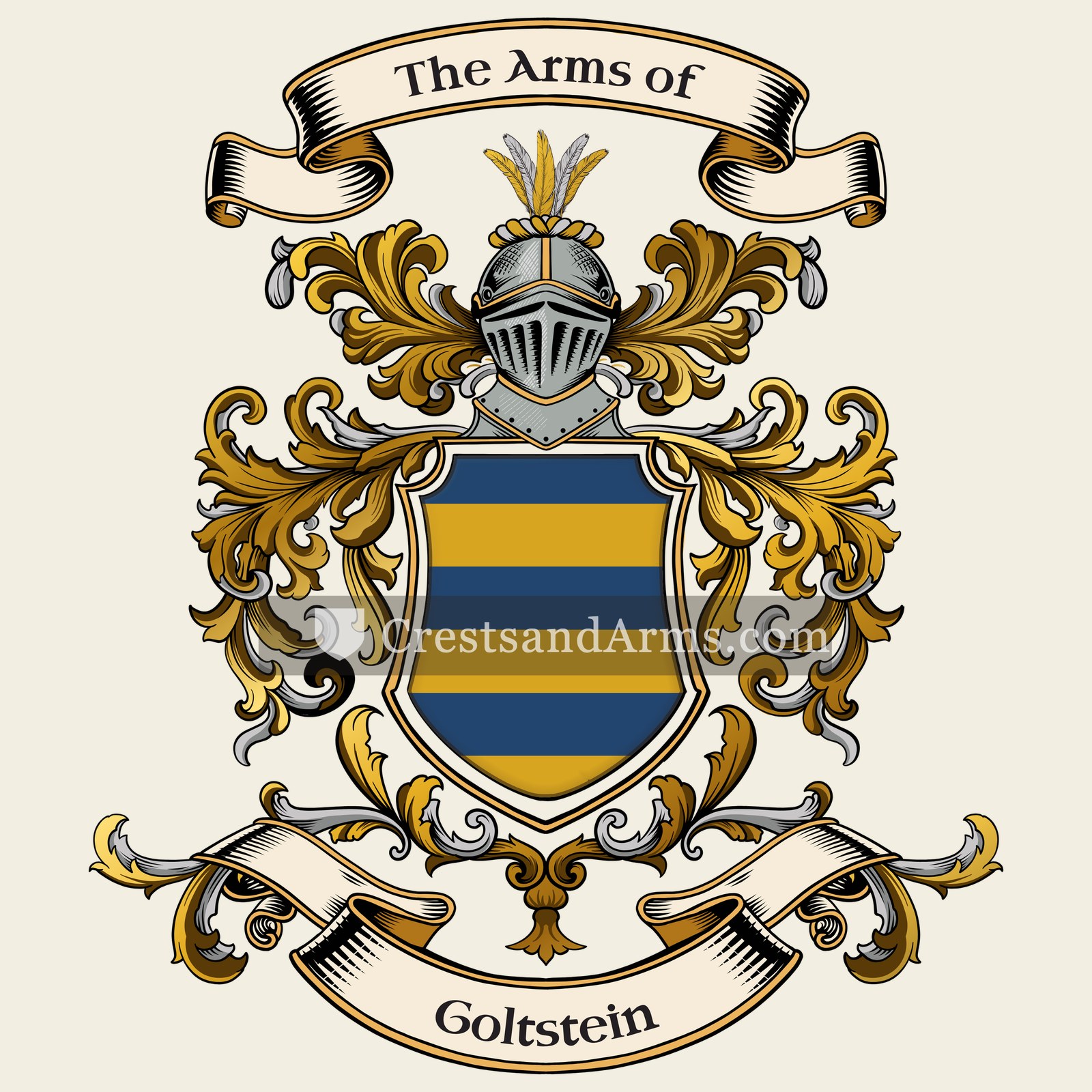
A record of documented arms, meaning and origin, researched for the Goltstein family lines. Documented in 2 countries.
Reg. 3104 · German, G–I
Coat of Arms & Family Crest Details
Symbols on this shield
fessThe military belt, and readiness to serve
Colours
Gold (Or)Means: Generosity
Blue (Azure)Means: Loyalty and truth
Historical info
Source
J. B. Rietstap, Armorial Général, Gouda: G. B. van Goor Zonen, 1884–87
Blazon (the actual original written record)
“Fascé d'or et d'azur, de huit pièces. Cq. cour. C.: une aigle de gu., entre deux prob. aux armes de l'écu. S.: deux éléphants ramp. au nat.”
Germanyc. 1694
Where the Goltstein Arms Were Recorded
Bavaria
Map of Germany showing where the Goltstein arms are recorded
The Goltstein arms were recorded in Germany, c. 1694.
Arms such as these were typically recorded in Bavaria.
Bavaria was a country of old landed families and walled market towns. Estates passed down the same line for centuries, and both the landowners and the leading townsmen kept arms, which is why so many Bavarian names sit in the registers.
This is where the arms were entered in the register. Families often moved to other parts of the country, so the same name can turn up in more than one region.
The body that granted and recorded arms in Germany in this period.
Leopold I, Holy Roman Emperor
Sovereign of the period
Leopold I, Holy Roman Emperor
1658–1705
Reigning in Germany when the Goltstein arms are first recorded.
How Arms Worked in Germany
In the Holy Roman Empire, coats of arms were often granted to individuals by the Emperor or his representatives. These arms were then passed down through the generations to all legitimate descendants of the original holder. Younger branches of a family usually kept the same shield design without needing to change it, as the arms belonged to the entire lineage.
Granting authority
The Holy Roman Emperor held the sole power to grant new coats of arms throughout his vast imperial territories.
How they got arms
Families typically obtained their coats of arms through a formal imperial grant or by proving their noble status to the authorities.
Where arms were recorded
These grants were officially recorded in the Imperial Chancery registers, which began keeping formal records of such honors during the Middle Ages.
The family's standing
Recorded among the armigerous families of Germany.
Origin & History of the Goltstein Family in Germany
The family name Goltstein traces its roots to the German-speaking regions of Central Europe, where it emerged as a descriptive surname during the late Middle Ages. By the year 1694, historical records confirm that members of the family were firmly established in Bavaria. During this period, the name was often associated with families living in or near areas known for gold mining or trade, as the prefix suggests a connection to gold. Life in 17th-century Bavaria was defined by the aftermath of major regional conflicts, which forced many families to settle in specific agricultural or administrative hubs to ensure stability. As the family grew, they integrated into the local social structures of the Bavarian landscape, transitioning from their earlier origins into a recognized part of the regional population. This early presence in Bavaria highlights the family's role in the development of local communities during a time of significant cultural and economic rebuilding in Germany.
Coat of Arms & Family Crest Details
Symbols on this shield
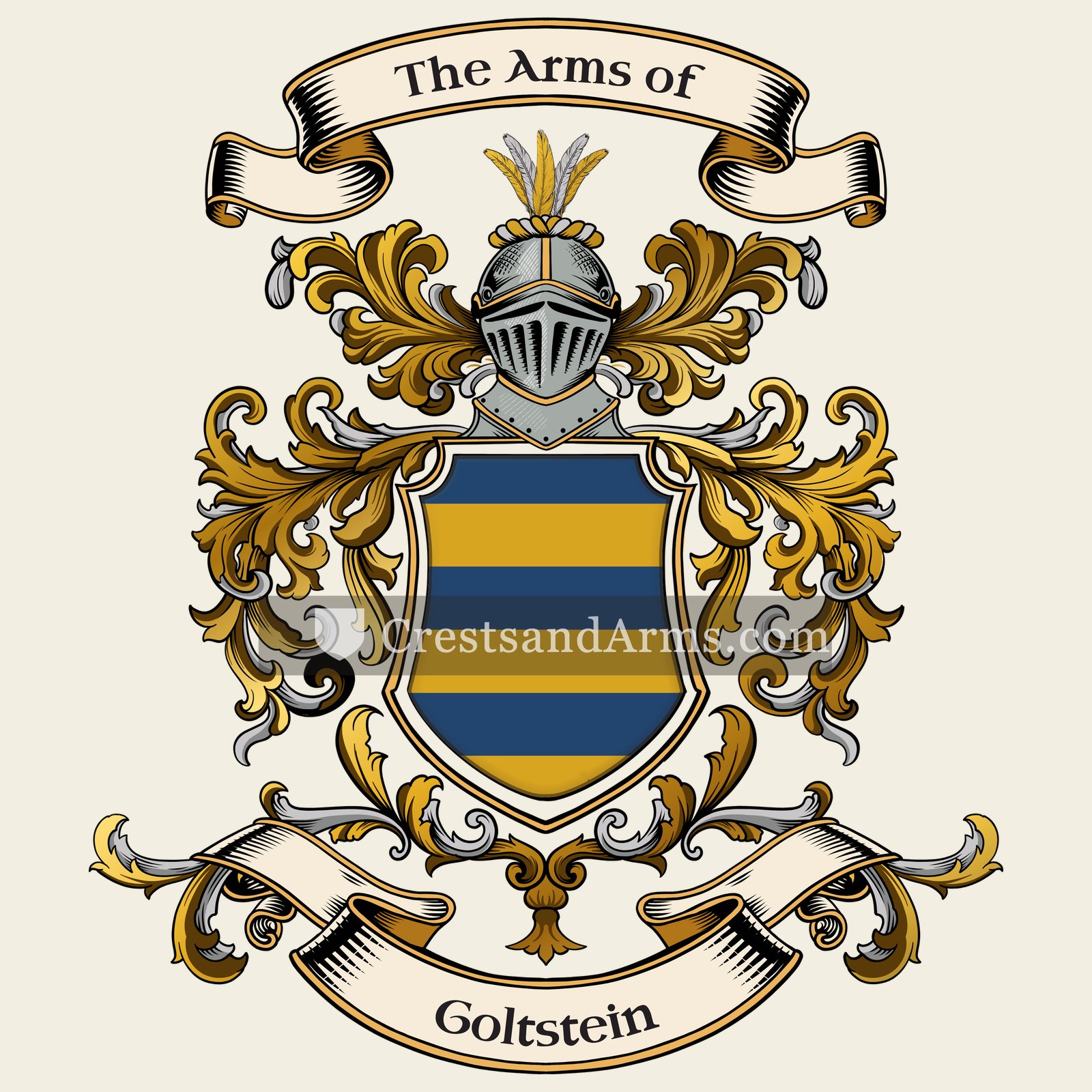
fessThe military belt, and readiness to serve
Colours
Gold (Or)Means: Generosity
Blue (Azure)Means: Loyalty and truth
Historical info
Source
J. B. Rietstap, Armorial Général, Gouda: G. B. van Goor Zonen, 1884–87
Blazon (the actual original written record)
“Fascé d'or et d'azur, de huit pièces. Cq. cour. C.: deux prob. d'or, ch. chacune de quatre fasces d'azur. S.: deux léopards lionnés d'or.”
UtrechtUtrecht, c. 1820
Where the Goltstein Arms Were Recorded
Utrecht
Map of Netherlands showing where the Goltstein arms are recorded
The Goltstein arms were recorded in Utrecht, c. 1820.
Utrecht was an old church town with rich farming country around it. Both the church and the land produced families of standing, and families of standing kept arms to seal their documents with.
This is where the arms were entered in the register. Families often moved to other parts of the country, so the same name can turn up in more than one region.
Region
Utrecht
First recorded
1820
Granting Authority for the Goltstein Arms
Hoge Raad van Adel
Photograph made by me · CC BY-SA 3.0
The body that granted and recorded arms in Netherlands in this period.
William I of the Netherlands
Sovereign of the period
William I of the Netherlands
1815–1840
Reigning in Germany when the Goltstein arms are first recorded.
How Arms Worked in Netherlands
In the Netherlands, coats of arms were often used by noble families and those who held specific public offices. These arms were passed down through the generations to legitimate descendants. Younger branches of a family usually kept the original design without needing to add special marks. This system ensured that the family identity remained clear and consistent over many years.
Granting authority
The Hoge Raad van Adel is the official body that regulates and manages noble titles and coats of arms in the Netherlands.
How they got arms
Families typically obtained their coats of arms through official royal grants or by proving their long-standing historical use of the symbols.
Where arms were recorded
Coats of arms are officially recorded in the registers held by the Hoge Raad van Adel, which began its work in 1814.
The family's standing
Recorded among the armigerous families of Utrecht.
Origin & History of the Goltstein Family in Netherlands
The family name Goltstein traces its roots in the Netherlands back to the early nineteenth century, with documented evidence placing members of the family in the historic city of Utrecht by 1820. During this period, Utrecht served as a vital cultural and economic hub, attracting families who were often involved in the city's growing trade and civil administration sectors. The name itself suggests a connection to the German word for gold, which was a common way for families in that era to adopt surnames based on physical descriptions, locations, or occupations. As the family established their presence in Utrecht, they became part of the local social fabric during a time when the Netherlands was transitioning into a modern kingdom. Their residency in the city during the early 1800s reflects the broader movement of families seeking stability and opportunity in the heart of the Dutch provinces.
Related Branches & Arms
Root word
Goldstein
Derived from the German words for gold and stone.
This name
GoltsteinA topographic name for someone living near a prominent gold-colored rock or stone.
also spelled
Goltstein
Goltsteyn
von Goltstine
Documented Sources
J. B. Rietstap, Armorial Général, Gouda: G. B. van Goor Zonen, 1884–87


 fessThe military belt, and readiness to serve
 fessThe military belt, and readiness to serve