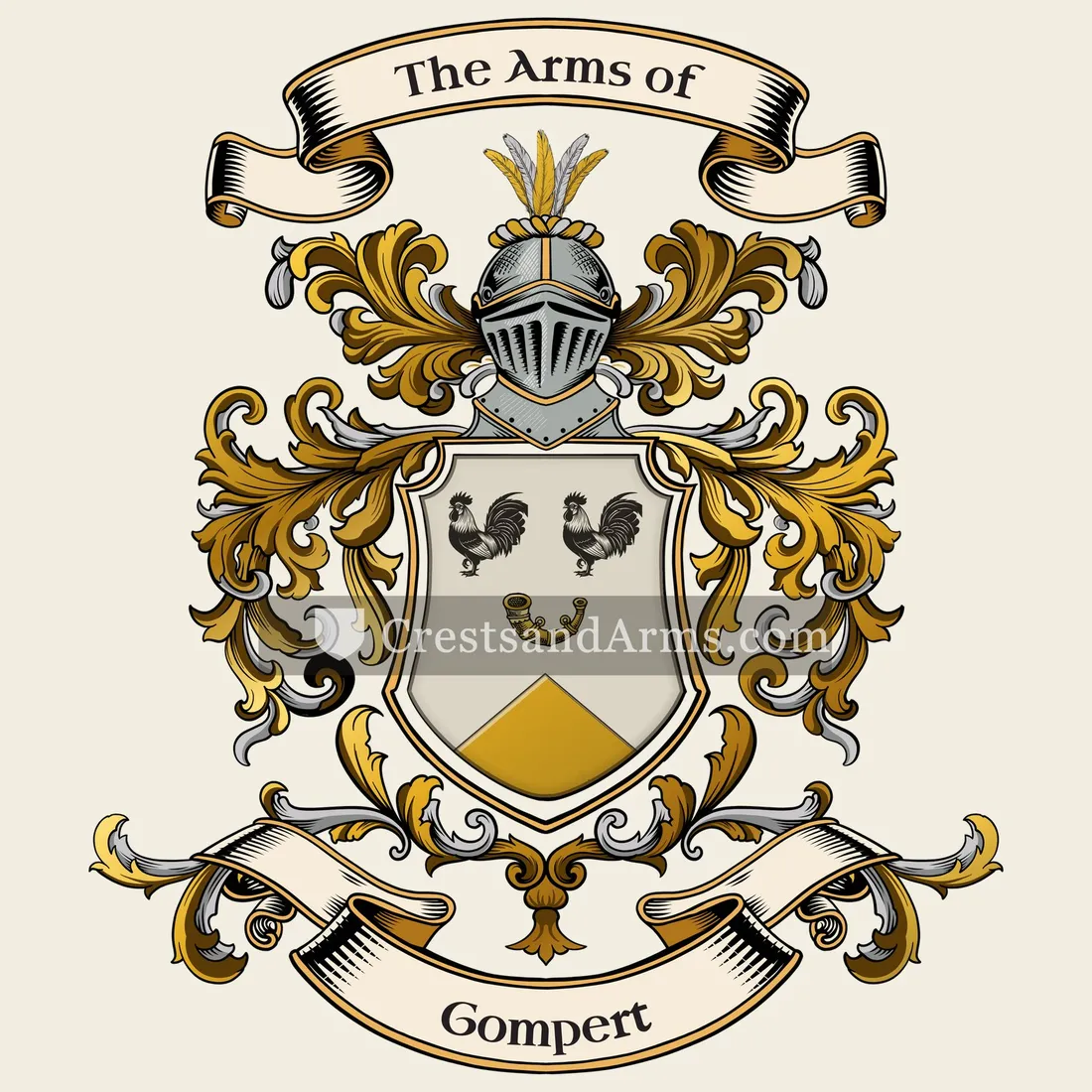
A record of documented arms, meaning and origin, researched for the Gompert family of Germany.
Reg. 9429 · German, G–I
Meaning of the Gompert family crest colors & symbols
Symbols on this shield
hunting horn stringedOne who delights in the chase
cockCourage, vigilance and readiness for battle
Colours
Silver (Argent)Means: Peace and sincerity
Gold (Or)Means: Generosity
Black (Sable)Means: Constancy
Historical info
Source
J. B. Rietstap, Armorial Général, Gouda: G. B. van Goor Zonen, 1884–87
Blazon (the actual original written record)
“D'arg. à un huchet d'or, l'embouchure à dextre; le champ chapé-ployé de gu., à deux coqs de sa. Cq. cour. C.: trois pl. d'aut. d'arg., entre un vol de sa. L.: d'arg. et de gu.”
Germanyc. 1810
Digital archive packCoat of arms PNG, gold border print PDF, vector SVG and the certificate of authenticity. Sent to your email in minutes.
Map of Germany showing where the Gompert arms are recorded
The Gompert arms were recorded in Germany, c. 1810.
Arms such as these were typically recorded in Bavaria.
Bavaria was a country of old landed families and walled market towns. Estates passed down the same line for centuries, and both the landowners and the leading townsmen kept arms, which is why so many Bavarian names sit in the registers.
This is where the arms were entered in the register. Families often moved to other parts of the country, so the same name can turn up in more than one region.
The body that granted and recorded arms in Germany in this period.
Frederick William III of Prussia
Sovereign of the period
Frederick William III of Prussia
1797–1840
Reigning in Germany when the Gompert arms are first recorded.
How Arms Worked in Germany
Prussian heraldry was strictly tied to social rank and noble status rather than being a free choice for every citizen. These symbols were treated as permanent family property that moved through the generations to all legitimate heirs. If a family branch wanted to change their design to stand out, they had to apply for official permission to alter their specific version of the shield.
Granting authority
The Prussian Heroldsamt acted as the central state office that managed and strictly controlled all noble titles and coats of arms.
How they got arms
Families usually obtained their arms through formal royal grants or by proving their long-standing noble status to the state authorities.
Where arms were recorded
All official coats of arms were kept in the rolls of the Prussian Heroldsamt, which functioned from 1706 until 1918.
The family's standing
Recorded among the armigerous families of Germany.
Origin & History of the Gompert Family in Germany
The surname Gompert has deep roots in the German-speaking regions of Europe, with historical records placing family members in the Bavarian region by the early 19th century. The name itself is derived from the Old High German name Gundbert, which combines the elements for battle and bright or famous. During the 1800s, families with this name were often integrated into the local social fabric of southern Germany, where they worked as tradespeople, farmers, or craftsmen. As the Napoleonic era reshaped the borders and laws of the Bavarian Kingdom, many families began to formalize their surnames in official civil registries for the first time. This transition helped solidify the name Gompert as a distinct family identity that was passed down through generations. By the mid-1800s, the name was well-established within the local communities, reflecting a history tied to the agricultural and industrial growth of the region.
Gompert Meaning & Related Branches
Root word
Gundbert
Derived from Germanic elements meaning battle and bright or famous.
This name
GompertA patronymic surname signifying a descendant of someone named Gundbert, meaning bright in battle.
Documented Sources
J. B. Rietstap, Armorial Général, Gouda: G. B. van Goor Zonen, 1884–87
Bahlow, Hans, Deutsches Namenlexikon: Familien- und Vornamen nach Ursprung und Sinn erklärt, 1967
Heintze, Albert, Die deutschen Familien-Namen: geschichtlich, geographisch, sprachlich, 1903


 hunting horn stringedOne who delights in the chase
 cockCourage, vigilance and readiness for battle
 hunting horn stringedOne who delights in the chase
 cockCourage, vigilance and readiness for battle