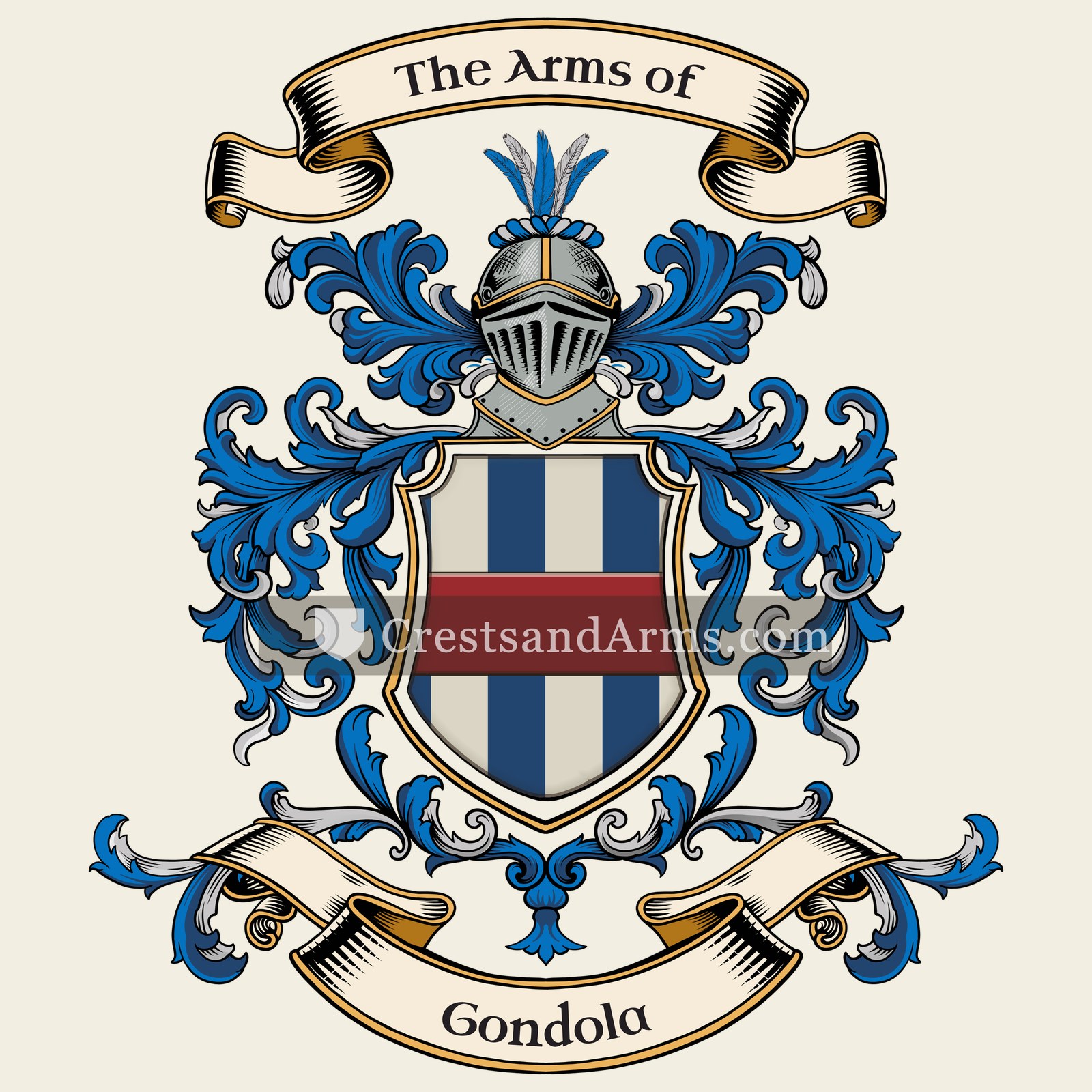
A record of documented arms, meaning and origin, researched for the Gondola family of Italy.
Reg. 6170 · Italian, G–I
Coat of Arms & Family Crest Details
Symbols on this shield
paleMilitary strength, and a fortified defence
fessThe military belt, and readiness to serve
Colours
Silver (Argent)Means: Peace and sincerity
Red (Gules)Means: Military strength
Blue (Azure)Means: Loyalty and truth
Historical info
Source
J. B. Rietstap, Armorial Général, Gouda: G. B. van Goor Zonen, 1884–87
Blazon (the actual original written record)
“Palé d'arg. et d'azur; à la fasce de gu., br. sur le tout. Cq. cour. C.: un vol aux armes de l'écu. L.: à dextre d'arg. et d'azur, à sen. d'arg. et de gu. [Comp. Ghetaldi-Gondola.]”
ItalyRaguse, c. 1775
Where the Gondola Arms Were Recorded
Raguse
Map of Italy showing where the Gondola arms are recorded
The Gondola arms were recorded in Raguse, c. 1775.
This is where the arms were entered in the register. Families often moved to other parts of the country, so the same name can turn up in more than one region.
The body that granted and recorded arms in Italy in this period.
Alvise Giovanni Mocenigo
Sovereign of the period
Alvise Giovanni Mocenigo
1763–1778
Reigning in Italy when the Gondola arms are first recorded.
How Arms Worked in Italy
In the Italian states, coats of arms were often used by noble families to show their status and history. These symbols were passed down through the generations to all legitimate male descendants. Younger branches of a family usually kept the original design but sometimes added small changes to distinguish their specific line from the main branch.
Granting authority
Various local rulers and city governments controlled the use of coats of arms across the different Italian states.
How they got arms
Families often assumed their own arms or received them as official grants from local lords, popes, or city councils.
Where arms were recorded
Arms were recorded in local city archives or private family books rather than in one single national register.
The family's standing
Recorded among the armigerous families of Italy.
Origin & History of the Gondola Family in Italy
The Gondola family, historically known in its native language as the Gundulić family, was a prominent noble house based in the Republic of Ragusa, which is modern-day Dubrovnik. By the late 18th century, the family had established a long-standing reputation as influential members of the Ragusan patriciate, a group that held significant political and economic power in the Adriatic region. The name itself is deeply connected to the maritime and diplomatic history of this independent city-state, where family members frequently served as government officials and diplomats. By 1775, the family was well-entrenched in the social and administrative fabric of Ragusa, maintaining their status through strategic marriages and involvement in the city's extensive Mediterranean trade networks. Their history reflects the broader evolution of the Ragusan aristocracy, which navigated complex political relationships between the Ottoman Empire and various European powers to maintain the autonomy of their republic.
Related Branches & Arms
Root word
gondula
A small boat or vessel used for transport.
This name
GondolaDerived from a Venetian boatman or a nickname for someone associated with water transport.
also spelled
Gondolla
Gondolah
Gondol
Documented Sources
J. B. Rietstap, Armorial Général, Gouda: G. B. van Goor Zonen, 1884–87
Fisković, Cvito. Dubrovački patriciji u umjetnosti. 1987
Harris, Robin. Dubrovnik: A History. 2003
Krekic, Bariša. Dubrovnik in the 14th and 15th Centuries: A City Between Two Worlds. 1972
State Archives in Dubrovnik (Državni arhiv u Dubrovniku), Acta Consilii Maioris
Digital archive packCoat of arms PNG, gold border print PDF, vector SVG and the certificate of authenticity. Sent to your email in minutes.


 paleMilitary strength, and a fortified defence
 fessThe military belt, and readiness to serve
 paleMilitary strength, and a fortified defence
 fessThe military belt, and readiness to serve