A record of documented arms, meaning and origin, researched for the Goodmon family lines. Documented in 3 countries.
Reg. 3571 · English, G–I
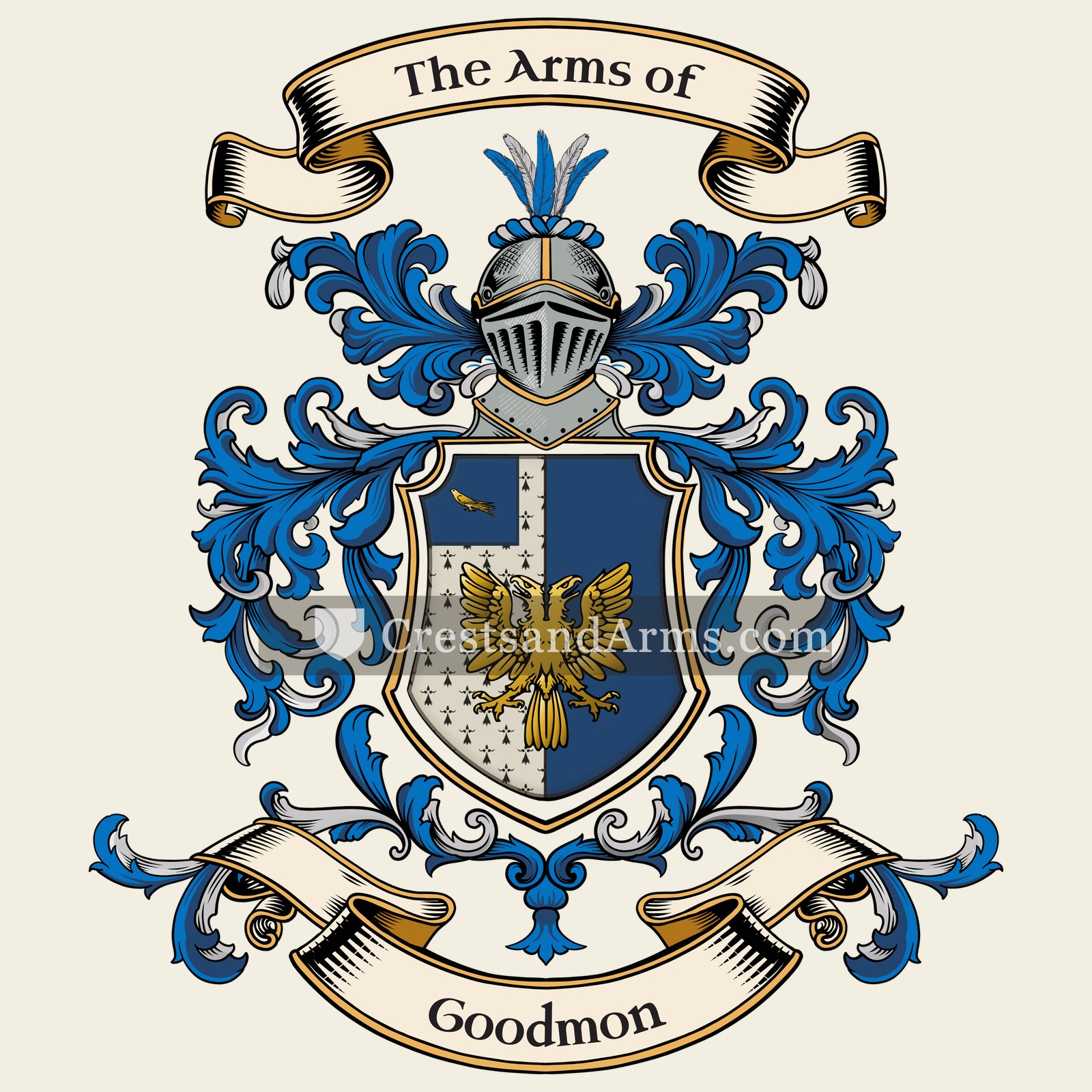
Coat of Arms & Family Crest Details
Symbols on this shield
paleMilitary strength, and a fortified defence
cantonA mark of honour granted by the sovereign
eagleNobility, strength and a keen mind
martletA younger son, who must win his own land
Colours
ErmineMeans: Dignity
Blue (Azure)Means: Loyalty and truth
Gold (Or)Means: Generosity
Historical info
Source
Sir Bernard Burke, The General Armory of England, Scotland, Ireland and Wales, London: Harrison & Sons, 1884
Blazon (the actual original written record)
“Per pale erm. and az. an eagle displ. with two heads or, on a canton of the second a martlet of the third”
EnglandWestminster, c. 1601
Where the Goodmon Arms Were Recorded
Westminster
Map of England showing where the Goodmon arms are recorded
The Goodmon arms were recorded in Westminster, c. 1601.
This is where the arms were entered in the register. Families often moved to other parts of the country, so the same name can turn up in more than one region.
The body that granted and recorded arms in England in this period.
Elizabeth I of England
Sovereign of the period
Elizabeth I of England
1558–1603
Reigning in England when the Goodmon arms are first recorded.
How Arms Worked in England
English heraldry allowed arms to be shared by all legitimate descendants of the original owner. These symbols were treated as personal property that moved through the generations to all children. While the eldest son kept the original design, other family members could use the same shield without needing to change it or register their own unique versions.
Granting authority
The College of Arms in London has regulated the use of coats of arms throughout England and Wales since 1484.
How they got arms
Families typically obtained their coats of arms through a formal grant from the Crown or by proving their ancient right to them.
Where arms were recorded
All official coats of arms are recorded in the registers kept at the College of Arms, which date back to the fifteenth century.
The family's standing
Recorded among the armigerous families of England.
Origin & History of the Goodmon Family in England
The surname Goodmon originated in medieval England as a descriptive name, likely used to identify a person of respectable character or a householder of good standing. By the dawn of the seventeenth century, the family had established a notable presence in the heart of London, specifically within the district of Westminster. Records from 1601 confirm that members of the Goodmon family were active in this area during the final years of Queen Elizabeth I’s reign. At that time, Westminster was a bustling center of political and religious life, serving as the seat of the royal court and the national government. Living in such a prominent location suggests that these early ancestors were likely involved in the trades, legal services, or administrative roles that supported the daily operations of the city. As the family moved through the generations, their name remained a marker of their English roots and their integration into the social fabric of the capital.
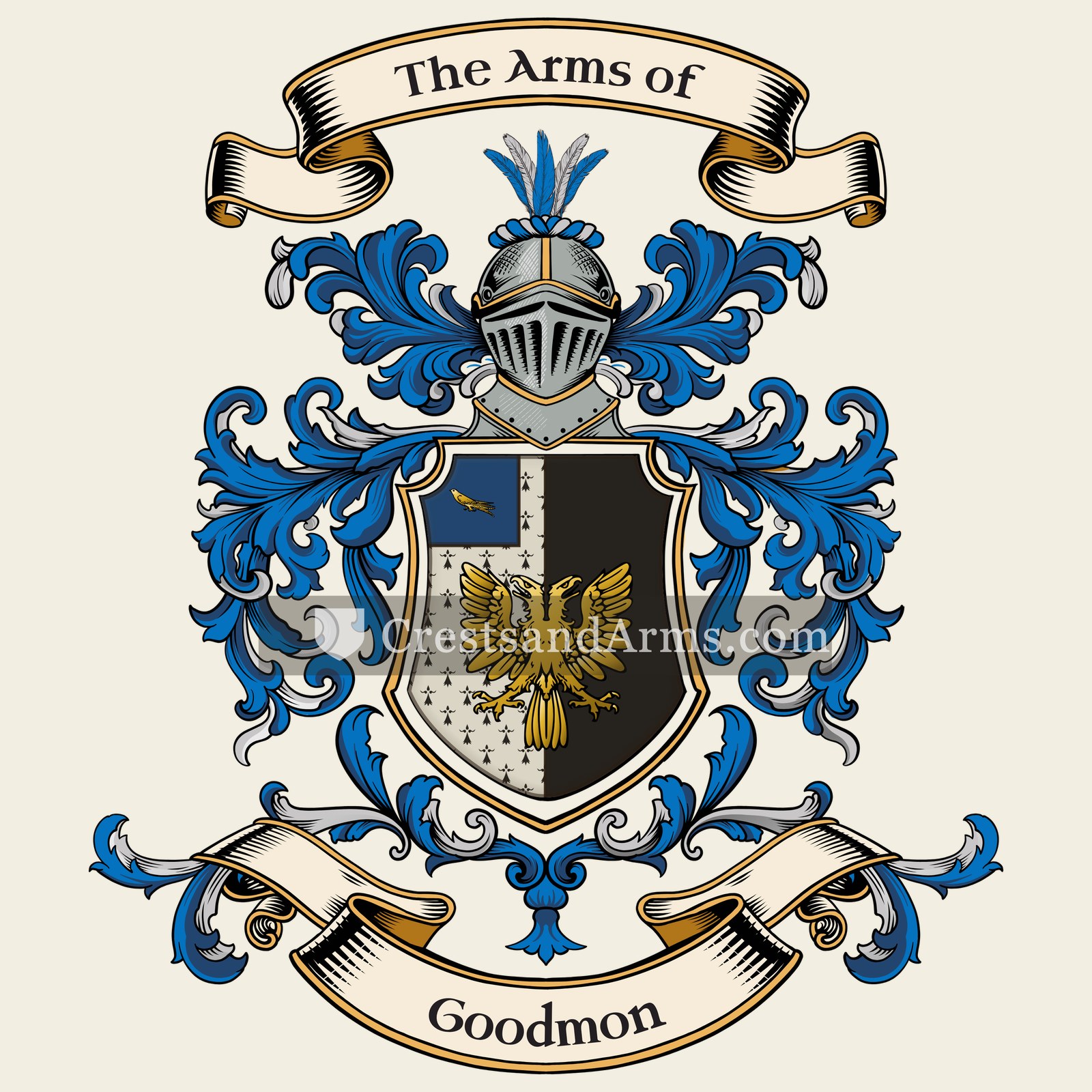
Coat of Arms & Family Crest Details
Symbols on this shield
paleMilitary strength, and a fortified defence
cantonA mark of honour granted by the sovereign
eagleNobility, strength and a keen mind
martletA younger son, who must win his own land
Colours
ErmineMeans: Dignity
Black (Sable)Means: Constancy
Blue (Azure)Means: Loyalty and truth
Gold (Or)Means: Generosity
Historical info
Source
Sir Bernard Burke, The General Armory of England, Scotland, Ireland and Wales, London: Harrison & Sons, 1884
Blazon (the actual original written record)
“Per pale erm. and sa. an eagle displ. with two heads or, on a canton az. a martlet of the third”
DenbighRuthyn · Denbigh, c. 1572
Where the Goodmon Arms Were Recorded
Denbigh
Map of Wales showing where the Goodmon arms are recorded
The Goodmon arms were recorded in Denbigh, c. 1572.
Denbighshire was north Welsh country of hills and small estates. Land was held by a great many families rather than a few, and each holding brought its own claim to a coat of arms.
This is where the arms were entered in the register. Families often moved to other parts of the country, so the same name can turn up in more than one region.
The body that granted and recorded arms in Wales in this period.
Elizabeth I of England
Sovereign of the period
Elizabeth I of England
1558–1603
Reigning in England when the Goodmon arms are first recorded.
How Arms Worked in Wales
English heraldry allowed arms to be shared by all legitimate descendants of the original owner. These symbols were treated as personal property that moved through the generations to all children. While the eldest son kept the original design, other family members could use the same shield without needing to change it or register their own unique versions.
Granting authority
The College of Arms in London has regulated the use of coats of arms throughout England and Wales since 1484.
How they got arms
Families typically obtained their coats of arms through a formal grant from the Crown or by proving their ancient right to them.
Where arms were recorded
All official coats of arms are recorded in the registers kept at the College of Arms, which date back to the fifteenth century.
The family's standing
Recorded among the armigerous families of Denbigh.
Origin & History of the Goodmon Family in Wales
The Goodmon family name finds its early roots in the rugged landscape of Denbigh, Wales, where records confirm their presence as early as 1572. During this period, the name likely emerged as a descriptive identifier within the local community, reflecting the social standing or personal character of those who first carried it. Life in Denbigh during the late sixteenth century was shaped by the influence of the town’s historic castle and its position as a center for trade and administration in North Wales. Families like the Goodmons were often deeply integrated into the local economy, living through a time of significant cultural transition as Wales became more closely tied to the English legal and administrative systems. By establishing themselves in this region, the early members of the family became part of the enduring fabric of Welsh history, contributing to the growth and development of their community long before the name spread to other parts of the world.
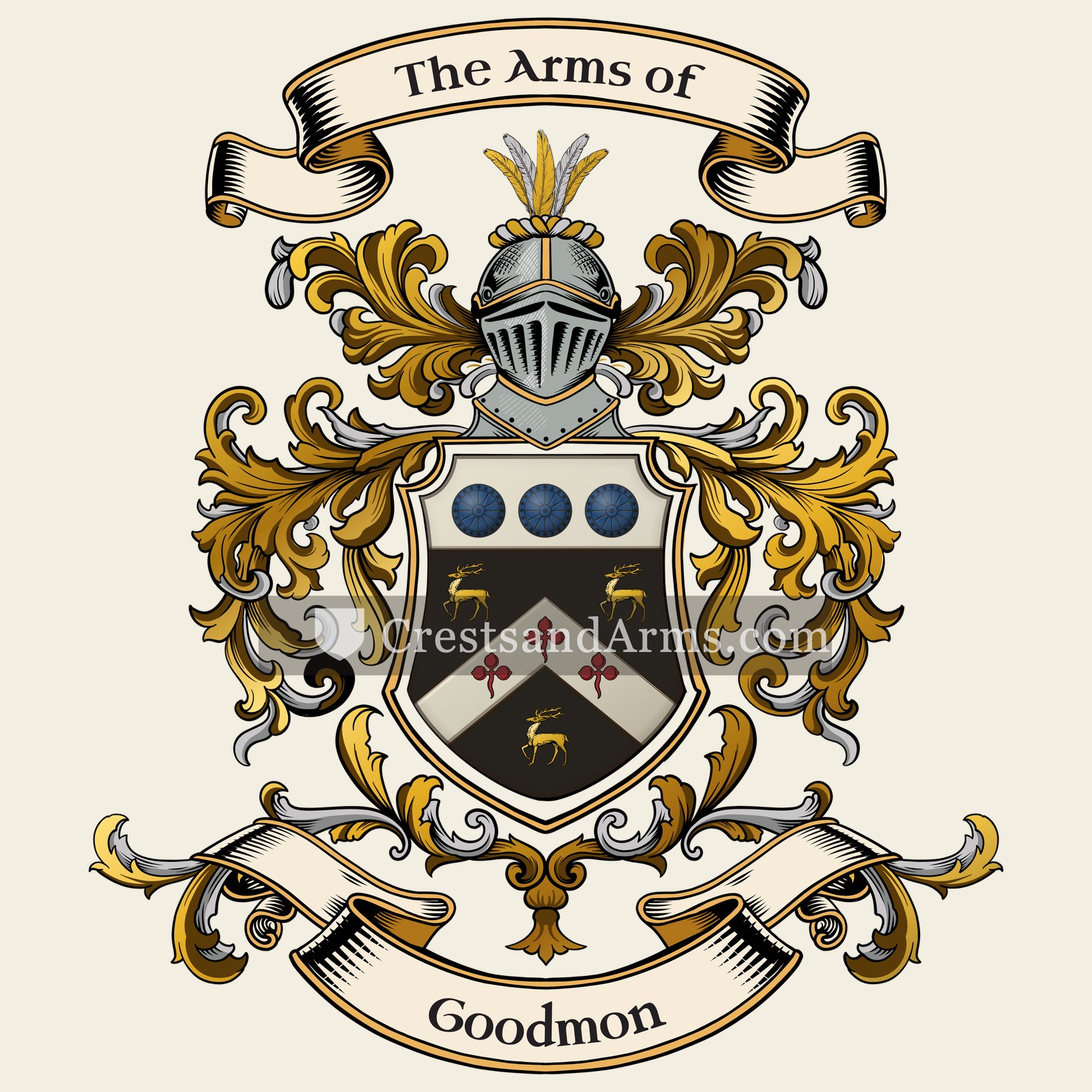
Coat of Arms & Family Crest Details
Symbols on this shield
chevronProtection, and faithful service completed
chiefAuthority, wisdom and dominion
stagPeace and harmony, and one who will not fight unprovoked
trefoilPerpetuity, and the Trinity
roundelA coin, and one who has been to the crusades
Colours
Black (Sable)Means: Constancy
Silver (Argent)Means: Peace and sincerity
Gold (Or)Means: Generosity
Red (Gules)Means: Military strength
Blue (Azure)Means: Loyalty and truth
Historical info
Source
Sir Bernard Burke, The General Armory of England, Scotland, Ireland and Wales, London: Harrison & Sons, 1884
Blazon (the actual original written record)
“Sa. on a chev. ar. betw. three bucks' heads cabossed or, as many trefoils slipped gu. on a chief dancettée of the second three hurts”
DublinLoughlinstown · Dublin, c. 1609
Where the Goodmon Arms Were Recorded
Dublin
Map of Ireland showing where the Goodmon arms are recorded
The Goodmon arms were recorded in Dublin, c. 1609.
Dublin was the seat of government in Ireland and the place where grants were sought and recorded. Families with business at the castle or the courts settled nearby, and settling there put their arms on record.
This is where the arms were entered in the register. Families often moved to other parts of the country, so the same name can turn up in more than one region.
The body that granted and recorded arms in Ireland in this period.
James VI and I
Sovereign of the period
James VI and I
1603–1625
Reigning in England when the Goodmon arms are first recorded.
How Arms Worked in Ireland
The Ulster King of Arms granted coats of arms to individuals who proved their social standing and good character. These symbols were typically inherited by all legitimate descendants of the original holder. If a family branch wanted a unique look, they could apply for a specific change to their design through the office to ensure their identity remained distinct.
Granting authority
The Ulster King of Arms acted as the official body that regulated and issued all coats of arms throughout Ireland.
How they got arms
Families obtained their arms through formal grants issued by the office after proving their eligibility and paying the required fees.
Where arms were recorded
All official grants were recorded in the registers held by the Ulster King of Arms starting from the year 1552.
The family's standing
Recorded among the armigerous families of Dublin.
Origin & History of the Goodmon Family in Ireland
The history of the Goodmon family in Ireland begins with documented evidence of their presence in Dublin as early as 1609. During this period, Dublin was a rapidly changing city that served as the primary hub for administrative and commercial life under English rule. Families like the Goodmons likely arrived in the capital to participate in the growing trade networks or to serve in the professional classes that supported the city government. Because the name appears in official records during the early seventeenth century, it suggests that the family was integrated into the urban fabric of Dublin during a time of significant migration and social restructuring. These early settlers lived through a transformative era in Irish history, navigating the complexities of a city that acted as the bridge between Ireland and the wider Atlantic world. By establishing themselves in Dublin, the Goodmons became part of the long-standing tradition of families who helped shape the civic and economic identity of Ireland’s capital city.
Related Branches & Arms
Root word
Godman
Derived from the Old English words for god and man.
This name
GoodmonA descriptive surname for a pious or virtuous individual.
also spelled
Goodmanne
Gudman
Goodmon
Documented Sources
Sir Bernard Burke, The General Armory of England, Scotland, Ireland and Wales, London: Harrison & Sons, 1884
The National Archives, State Papers Domestic, Elizabeth I
Westminster City Archives, Westminster Parish Registers
Reaney, P.H., A Dictionary of English Surnames, 1958
Ekwall, Eilert, The Concise Oxford Dictionary of English Place-names, 1960
Digital archive packCoat of arms PNG, gold border print PDF, vector SVG and the certificate of authenticity. Sent to your email in minutes.


 paleMilitary strength, and a fortified defence
 cantonA mark of honour granted by the sovereign
 eagleNobility, strength and a keen mind
 martletA younger son, who must win his own land
 paleMilitary strength, and a fortified defence
 cantonA mark of honour granted by the sovereign
 eagleNobility, strength and a keen mind
 martletA younger son, who must win his own land

 chevronProtection, and faithful service completed
 chiefAuthority, wisdom and dominion
 stagPeace and harmony, and one who will not fight unprovoked
 trefoilPerpetuity, and the Trinity
 roundelA coin, and one who has been to the crusades