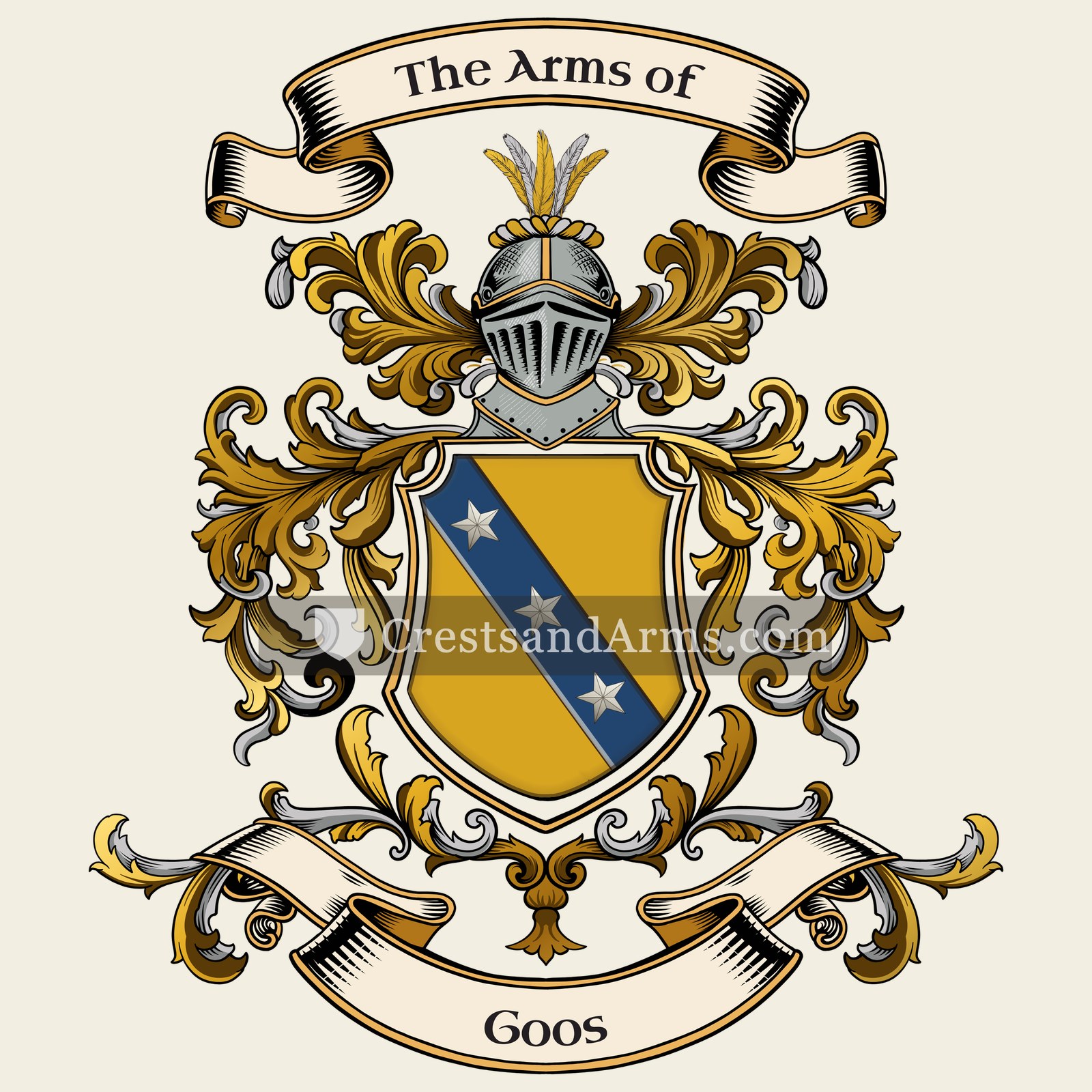
A record of documented arms, meaning and origin, researched for the Goos family of Belgium.
Reg. 9633 · Belgian, G–I
Coat of Arms & Family Crest Details
Symbols on this shield
bendDefence, and the scarf of a commander
mulletThe third son, and a divine quality from above
Colours
Gold (Or)Means: Generosity
Blue (Azure)Means: Loyalty and truth
Silver (Argent)Means: Peace and sincerity
Historical info
Source
J. B. Rietstap, Armorial Général, Gouda: G. B. van Goor Zonen, 1884–87
Blazon (the actual original written record)
“D'or à la bande d'azur, ch. de trois étoiles d'arg. C.: une étoile d'or, entre un vol d'azur. L. d'or et d'azur. T.: deux sauvages de carn., ceints et cour. de lierre, tenant chacun une bannière, celle à dextre aux armes de l'écu, celle à sen. aux armes de Vecquemans, qui sont d'or à une barrière des champs de sa.”
BelgiumAnvers, c. 1676
Digital archive packCoat of arms PNG, gold border print PDF, vector SVG and the certificate of authenticity. Sent to your email in minutes.
Map of Belgium showing where the Goos arms are recorded
The Goos arms were recorded in Anvers, c. 1676.
This is where the arms were entered in the register. Families often moved to other parts of the country, so the same name can turn up in more than one region.
The body that granted and recorded arms in Belgium in this period.
Charles II of Spain
Sovereign of the period
Charles II of Spain
1665–1700
Reigning in Belgium when the Goos arms are first recorded.
How Arms Worked in Belgium
In Belgium, a coat of arms is considered personal property that is passed down through the male line to legitimate descendants. Families often use the same shield design across generations to show their shared heritage. If a branch of the family wants to change the design, they must apply for an official update to their specific version of the arms.
Granting authority
The Conseil héraldique is the official body that regulates and approves all coats of arms in Belgium.
How they got arms
Families obtain their coats of arms through formal royal grants or by confirming their historical right to use existing designs.
Where arms were recorded
All approved coats of arms are officially recorded in the public registers of the Conseil héraldique since 1844.
The family's standing
Recorded among the armigerous families of Belgium.
Origin & History of the Goos Family in Belgium
The surname Goos has deep roots in the Low Countries, with historical records confirming that members of the family were established in the city of Antwerp by 1676. The name itself is likely derived from the Middle Dutch word for a goose, which was often used as a descriptive nickname for a person who possessed certain traits associated with the bird or perhaps as a reference to a professional goose herder. During the seventeenth century, Antwerp was a major center for trade and culture, and families like the Goos clan were often integrated into the bustling urban life of the region. As the family grew, they became part of the local social fabric, contributing to the development of the city through their various trades and civic duties. By tracing these early residents, we can see how the name evolved from a simple descriptive term into a lasting family identity that persisted through generations of life in the Flemish territories.
Goos Meaning & Related Branches
Root word
Godefridus
Derived from Germanic elements meaning god and peace or protection.
This name
GoosA patronymic surname originating as a short form of names like Godfrey.
also spelled
Goos de Ghyseghe
Goos de Ghysegheme
Goos de Gisehem
Goos
Documented Sources
J. B. Rietstap, Armorial Général, Gouda: G. B. van Goor Zonen, 1884–87
Stadsarchief Antwerpen, Doopregisters van de Sint-Jacobskerk (1676)
Stadsarchief Antwerpen, Poortersboeken (1676)
Debrabandere, Frans, Woordenboek van de familienamen in België en Noord-Frankrijk, 2003
Leys, O., De familienamen in de Nederlanden, 1987
Digital archive packCoat of arms PNG, gold border print PDF, vector SVG and the certificate of authenticity. Sent to your email in minutes.


 bendDefence, and the scarf of a commander
 mulletThe third son, and a divine quality from above
 bendDefence, and the scarf of a commander
 mulletThe third son, and a divine quality from above