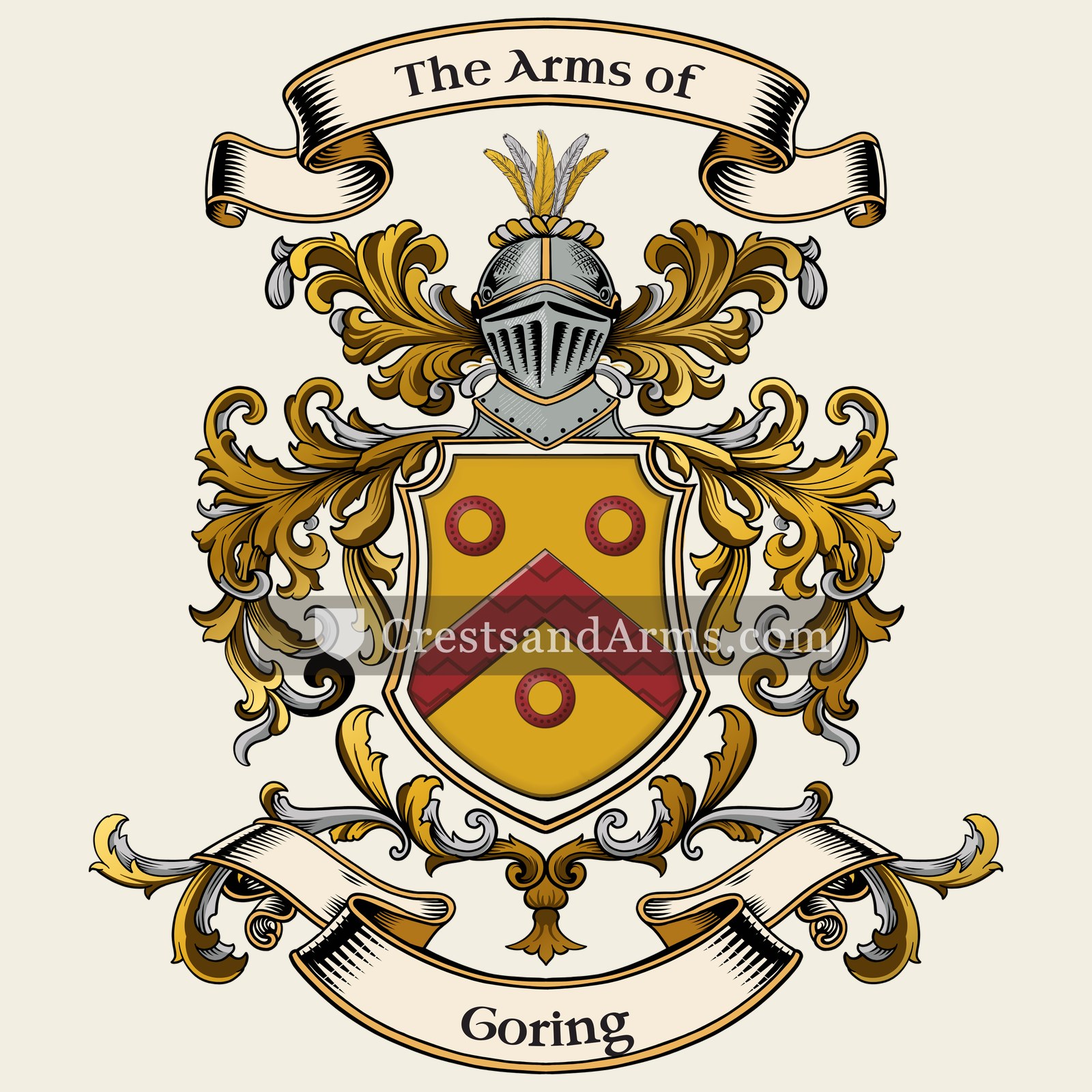
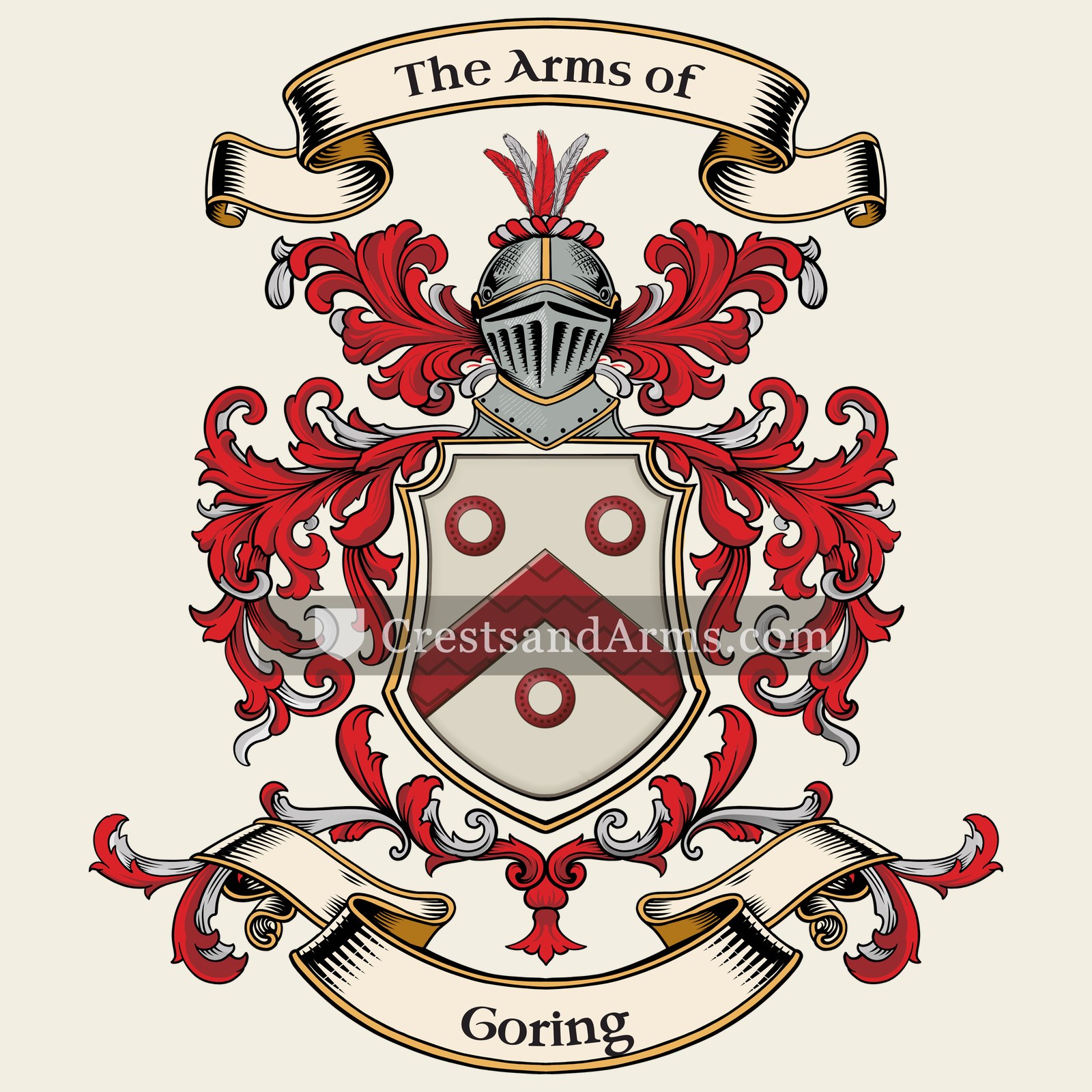
A record of documented arms, meaning and origin, researched for the Goring family lines. Documented in 2 countries.
Reg. 9476 · German, G–I
Coat of Arms & Family Crest Details
Symbols on this shield
chevronProtection, and faithful service completed
ringFidelity, and a promise kept
Colours
Gold (Or)Means: Generosity
Red (Gules)Means: Military strength
Historical info
Source
J. B. Rietstap, Armorial Général, Gouda: G. B. van Goor Zonen, 1884–87
Blazon (the actual original written record)
“D'or au chev. de gu., acc. de trois annelets du même. C.: un léopard lionné de sa.”
Germanyc. 1646
Where the Goring Arms Were Recorded
Bavaria
Map of Germany showing where the Goring arms are recorded
The Goring arms were recorded in Germany, c. 1646.
Arms such as these were typically recorded in Bavaria.
Bavaria was a country of old landed families and walled market towns. Estates passed down the same line for centuries, and both the landowners and the leading townsmen kept arms, which is why so many Bavarian names sit in the registers.
This is where the arms were entered in the register. Families often moved to other parts of the country, so the same name can turn up in more than one region.
The body that granted and recorded arms in Germany in this period.
Ferdinand III, Holy Roman Emperor
Sovereign of the period
Ferdinand III, Holy Roman Emperor
1637–1657
Reigning in Germany when the Goring arms are first recorded.
How Arms Worked in Germany
In the Holy Roman Empire, coats of arms were often granted to individuals by the Emperor or his representatives. These arms were then passed down through the generations to all legitimate descendants of the original holder. Younger branches of a family usually kept the same shield design without needing to change it, as the arms belonged to the entire lineage.
Granting authority
The Holy Roman Emperor held the sole power to grant new coats of arms throughout his vast imperial territories.
How they got arms
Families typically obtained their coats of arms through a formal imperial grant or by proving their noble status to the authorities.
Where arms were recorded
These grants were officially recorded in the Imperial Chancery registers, which began keeping formal records of such honors during the Middle Ages.
The family's standing
Recorded among the armigerous families of Germany.
Origin & History of the Goring Family in Germany
The family name Goring traces its roots to the southern regions of Germany, where early ancestors established a presence in Bavaria by the middle of the seventeenth century. During this period, the name was closely tied to the social and agricultural structures of the Bavarian countryside. Families with this surname often lived in small, rural communities where they contributed to the local economy through farming or trade. As the region recovered from the long conflicts of the Thirty Years' War, the Goring family became part of the local fabric of village life. They were typically recorded in parish registers as members of the community who participated in the religious and civic activities of their home towns. By 1646, the family had already integrated into the local culture, reflecting a history of stability and regional belonging that defined the lives of many common families in the Holy Roman Empire.
Coat of Arms & Family Crest Details
Symbols on this shield
chevronProtection, and faithful service completed
ringFidelity, and a promise kept
Colours
Silver (Argent)Means: Peace and sincerity
Red (Gules)Means: Military strength
Historical info
Source
Sir Bernard Burke, The General Armory of England, Scotland, Ireland and Wales, London: Harrison & Sons, 1884
Blazon (the actual original written record)
“Ar. a chev. betw. three annulets gu”
SussexHighden · Sussex, c. 1620
Where the Goring Arms Were Recorded
Sussex
Map of England showing where the Goring arms are recorded
The Goring arms were recorded in Sussex, c. 1620.
Sussex had ironworks in its woods and good farmland on its downs. Both made money, and families who made it bought manors, which is what put their names in the heraldic records.
This is where the arms were entered in the register. Families often moved to other parts of the country, so the same name can turn up in more than one region.
The body that granted and recorded arms in England in this period.
James VI and I
Sovereign of the period
James VI and I
1603–1625
Reigning in Germany when the Goring arms are first recorded.
How Arms Worked in England
English heraldry allowed arms to be shared by all legitimate descendants of the original owner. These symbols were treated as personal property that moved through the generations to all children. While the eldest son kept the original design, other family members could use the same shield without needing to change it or register their own unique versions.
Granting authority
The College of Arms in London has regulated the use of coats of arms throughout England and Wales since 1484.
How they got arms
Families typically obtained their coats of arms through a formal grant from the Crown or by proving their ancient right to them.
Where arms were recorded
All official coats of arms are recorded in the registers kept at the College of Arms, which date back to the fifteenth century.
The family's standing
Recorded among the armigerous families of Sussex.
Origin & History of the Goring Family in England
The Goring family name is deeply rooted in the landscape of Sussex, where members of the family established a prominent presence by the early seventeenth century. The name itself is locative, meaning it likely originated from a specific place called Goring located along the southern coast of England. During the medieval period, families often took their surnames from the villages or manors where they held land or lived. By 1620, the Gorings were well-entrenched in the social and political life of Sussex, serving as influential landowners who played significant roles in local administration. Their history is closely tied to the development of the English countryside, as they managed estates and participated in the regional governance that defined life in the county during the Stuart era. This long-standing connection to the soil of Sussex helped the family maintain their status and influence across several generations.
Related Branches & Arms
Root word
Goro
A Germanic personal name derived from the element meaning spear.
This name
GoringA patronymic surname indicating descent from a person named Goro or Goring.
also spelled
Goryng
Gorynge
Related arms
Bulbeckrecorded with Goring, same area
Cheekerecorded with Goring, same area
Dorerecorded with Goring, same area
Fotherbyrecorded with Goring, same area
Documented Sources
J. B. Rietstap, Armorial Général, Gouda: G. B. van Goor Zonen, 1884–87


 chevronProtection, and faithful service completed
 ringFidelity, and a promise kept
 chevronProtection, and faithful service completed
 ringFidelity, and a promise kept