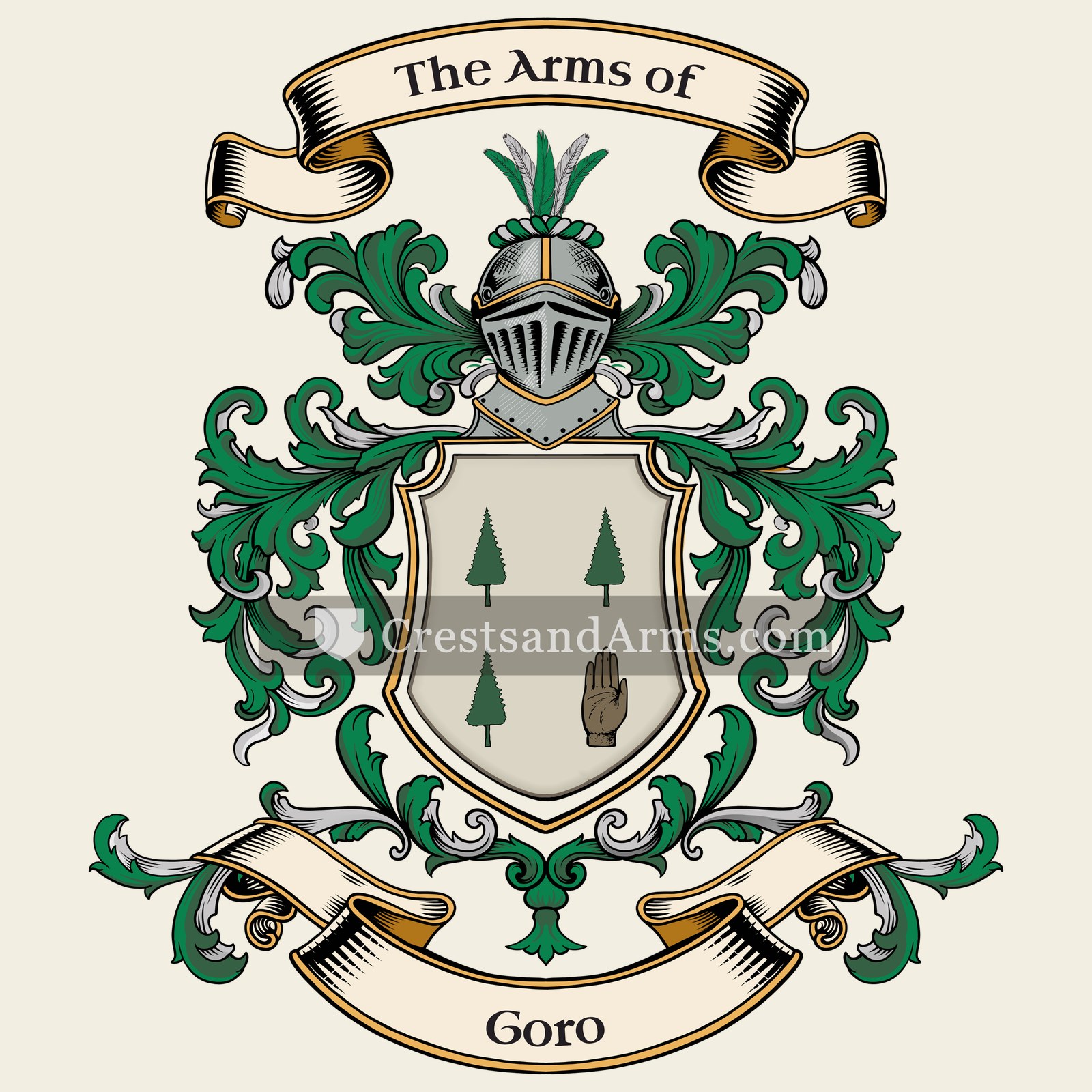
A record of documented arms, meaning and origin, researched for the Goro family of France.
Reg. 5429 · French, G–I
Coat of Arms & Family Crest Details
Symbols on this shield
pine treeSteadfastness through every season
handFaith, sincerity and justice
Colours
Silver (Argent)Means: Peace and sincerity
Green (Vert)Means: Hope
Historical info
Source
J. B. Rietstap, Armorial Général, Gouda: G. B. van Goor Zonen, 1884–87
Blazon (the actual original written record)
“D'arg. à trois pins mal-ordonnés de sin., le premier soutenu d'une Foi de carn., mouv. de deux nuées aux flancs de l'écu.”
OrleanaisOrleanais, c. 1663
Where the Goro Arms Were Recorded
Orleanais
Map of France showing where the Goro arms are recorded
The Goro arms were recorded in Orleanais, c. 1663.
Orleanais lay on the Loire around Orleans, close enough to Paris for court money to reach it. Officials and lawyers who did well bought estates there, and an estate brought a coat of arms with it.
This is where the arms were entered in the register. Families often moved to other parts of the country, so the same name can turn up in more than one region.
The body that granted and recorded arms in France in this period.
Louis XIV of France
Sovereign of the period
Louis XIV of France
1643–1715
Reigning in France when the Goro arms are first recorded.
How Arms Worked in France
In France, a coat of arms was a mark of honor that passed down through the male line to all legitimate descendants. Families often used the same shield without changes to show their shared heritage. If a branch wanted to stand out, they could add a small mark to their shield to show their specific place in the family tree.
Granting authority
The Juge d'armes de France acted as the official authority that regulated and verified coats of arms across the country.
How they got arms
Families typically inherited their arms from ancestors, though they could also receive them through royal grants or by proving their noble status.
Where arms were recorded
Coats of arms were officially recorded in the Armorial Général de France, which began its main collection in the year 1696.
The family's standing
Recorded among the armigerous families of Orleanais.
Origin & History of the Goro Family in France
The family name Goro has deep roots in the Orleanais region of France, where records confirm members of the family were established by 1663. During the seventeenth century, this area was a vital center for agriculture and trade along the Loire River, suggesting that early ancestors likely worked as skilled laborers, merchants, or farmers who contributed to the local economy. The name itself may have originated as a descriptive nickname or a shortened form of a longer given name common to the region at the time. Families in this part of France often lived in close-knit rural communities, and the presence of the Goro name in official documents from this period indicates that they were recognized members of their parish. Over generations, the family helped shape the social fabric of the Orleanais landscape through their daily work and their connections to the neighboring towns.
Related Branches & Arms
Root word
Gora
Derived from the Germanic word for a mountain or peak.
This name
GoroA locational surname referring to someone who lived near a mountain or elevated terrain.
also spelled
Goraut
Gorraud
Goro
Documented Sources
J. B. Rietstap, Armorial Général, Gouda: G. B. van Goor Zonen, 1884–87
Archives départementales du Loiret, Registres paroissiaux et d'état civil de l'Orléanais, 1663
Bouchard, Gérard, Quelques arpents d'Amérique: Population et économie du peuplement, 1996
Goubert, Pierre, The French Peasantry in the Seventeenth Century, 1986
Digital archive packCoat of arms PNG, gold border print PDF, vector SVG and the certificate of authenticity. Sent to your email in minutes.


 pine treeSteadfastness through every season
 handFaith, sincerity and justice
 pine treeSteadfastness through every season
 handFaith, sincerity and justice