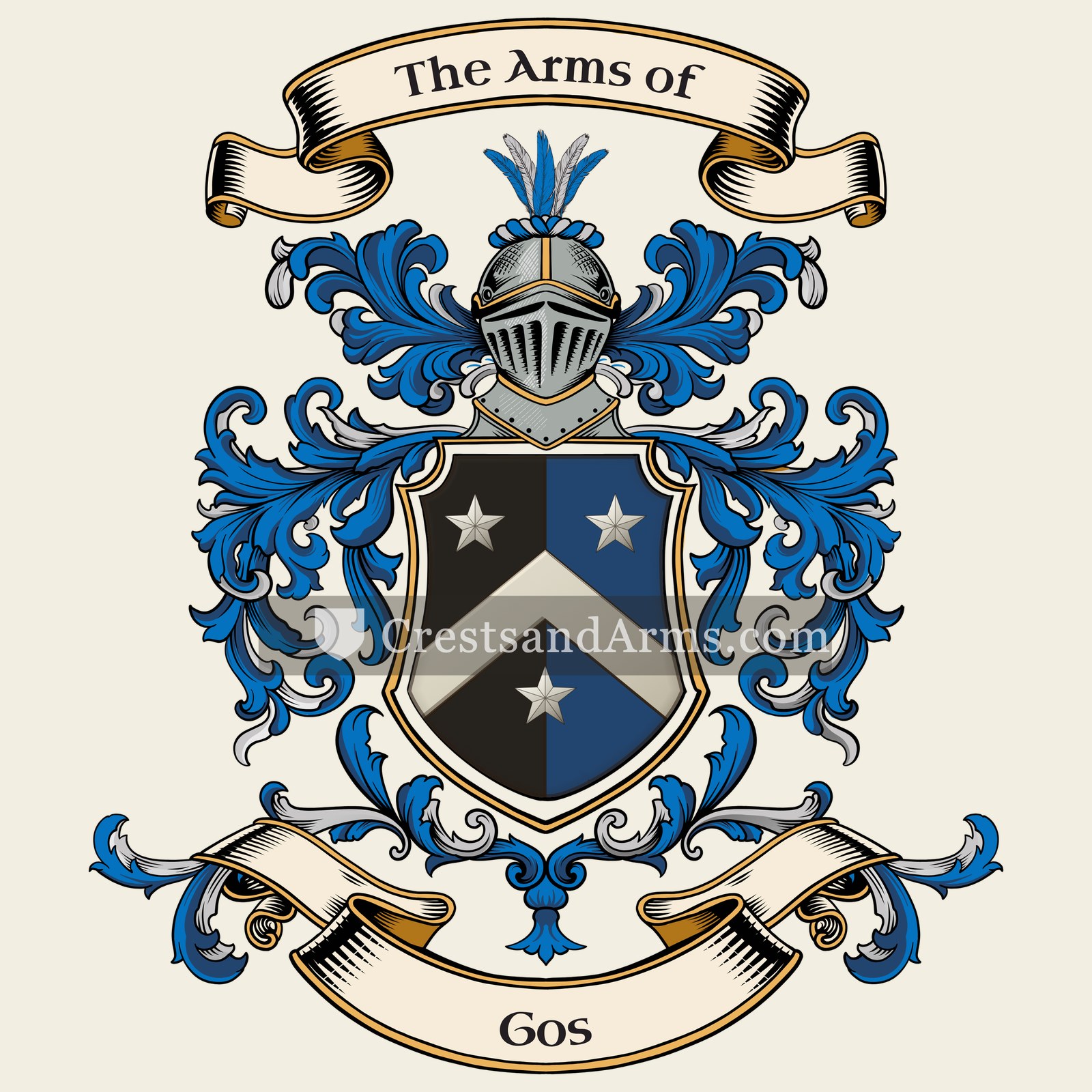
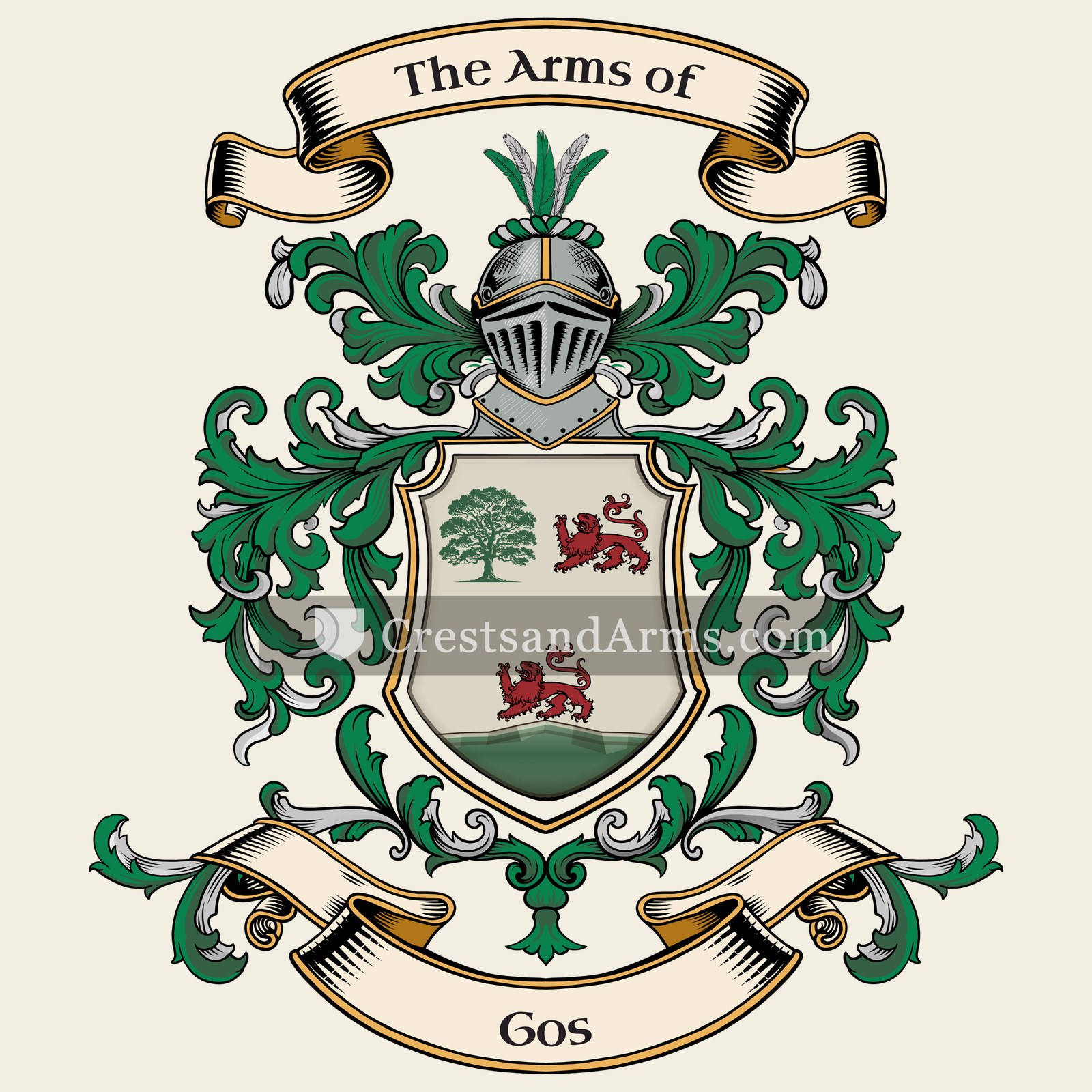
A record of documented arms, meaning and origin, researched for the Gos family lines. Documented in 2 countries.
Reg. 7433 · Dutch, G–I
Coat of Arms & Family Crest Details
Symbols on this shield
chevronProtection, and faithful service completed
mulletThe third son, and a divine quality from above
Colours
Black (Sable)Means: Constancy
Blue (Azure)Means: Loyalty and truth
Silver (Argent)Means: Peace and sincerity
Historical info
Source
J. B. Rietstap, Armorial Général, Gouda: G. B. van Goor Zonen, 1884–87
Blazon (the actual original written record)
“Parti de sa. et d'azur (quelquefois d'azur et de sa.); au chev. d'arg., br. sur le parti, et acc. de trois étoiles du même.”
NetherlandsLeyde, c. 1815
Where the Gos Arms Were Recorded
Leyde
Map of Netherlands showing where the Gos arms are recorded
The Gos arms were recorded in Leyde, c. 1815.
This is where the arms were entered in the register. Families often moved to other parts of the country, so the same name can turn up in more than one region.
Region
Leyde
Town
Leyde
First recorded
1815
Granting Authority for the Gos Arms
Hoge Raad van Adel
Photograph made by me · CC BY-SA 3.0
The body that granted and recorded arms in Netherlands in this period.
William I of the Netherlands
Sovereign of the period
William I of the Netherlands
1815–1840
Reigning in Netherlands when the Gos arms are first recorded.
How Arms Worked in Netherlands
In the Netherlands, coats of arms were often used by noble families and those who held specific public offices. These arms were passed down through the generations to legitimate descendants. Younger branches of a family usually kept the original design without needing to add special marks. This system ensured that the family identity remained clear and consistent over many years.
Granting authority
The Hoge Raad van Adel is the official body that regulates and manages noble titles and coats of arms in the Netherlands.
How they got arms
Families typically obtained their coats of arms through official royal grants or by proving their long-standing historical use of the symbols.
Where arms were recorded
Coats of arms are officially recorded in the registers held by the Hoge Raad van Adel, which began its work in 1814.
The family's standing
Recorded among the armigerous families of Netherlands.
Origin & History of the Gos Family in Netherlands
The surname Gos has deep roots in the Netherlands, with historical records confirming the presence of the family in the city of Leiden by the early nineteenth century. During this period, Leiden was a bustling center of trade and industry, which often drew families seeking new opportunities in urban life. The name itself is likely a shortened form of Germanic names that began with the element "god," meaning good or divine, or it may have evolved from local nicknames used in medieval Dutch communities. As the family established itself in Leiden around 1815, they became part of the city’s evolving social fabric during a time of significant national transition following the Napoleonic era. By tracing these early residents, we gain insight into how families settled into Dutch urban centers and maintained their identity through generations of local history.
Coat of Arms & Family Crest Details
Symbols on this shield
mountThe ground held, and steadfastness upon it
treeLife, endurance and deep roots
lionCourage, strength and royalty
Colours
Silver (Argent)Means: Peace and sincerity
Green (Vert)Means: Hope
Red (Gules)Means: Military strength
Historical info
Source
J. B. Rietstap, Armorial Général, Gouda: G. B. van Goor Zonen, 1884–87
Blazon (the actual original written record)
“D'arg. à un arbre de sin., accosté de deux lions affr. de gu., ramp. contre le fût; le tout soutenu d'une terrasse de sin. C.: un arbre de sin.”
Belgiumc. 1737
Where the Gos Arms Were Recorded
Brabant
Map of Belgium showing where the Gos arms are recorded
The Gos arms were recorded in Belgium, c. 1737.
Arms such as these were typically recorded in Brabant.
Brabant lay at the heart of the Low Countries, where the trade routes met. Its towns were wealthy and its landowners many, and both kinds of family kept arms, which is why the region is so heavily represented.
This is where the arms were entered in the register. Families often moved to other parts of the country, so the same name can turn up in more than one region.
The body that granted and recorded arms in Belgium in this period.
Charles VI, Holy Roman Emperor
Sovereign of the period
Charles VI, Holy Roman Emperor
1711–1740
Reigning in Netherlands when the Gos arms are first recorded.
How Arms Worked in Belgium
In Belgium, a coat of arms is considered personal property that is passed down through the male line to legitimate descendants. Families often use the same shield design across generations to show their shared heritage. If a branch of the family wants to change the design, they must apply for an official update to their specific version of the arms.
Granting authority
The Conseil héraldique is the official body that regulates and approves all coats of arms in Belgium.
How they got arms
Families obtain their coats of arms through formal royal grants or by confirming their historical right to use existing designs.
Where arms were recorded
All approved coats of arms are officially recorded in the public registers of the Conseil héraldique since 1844.
The family's standing
Recorded among the armigerous families of Belgium.
Origin & History of the Gos Family in Belgium
The family name Gos has deep roots in the historical region of Brabant, where records confirm members of the family were established by 1737. During the eighteenth century, Brabant was a bustling center of trade and agriculture under the rule of the Austrian Netherlands. Families like the Gos clan often lived in rural or semi-urban communities where they contributed to the local economy through farming, skilled craftsmanship, or trade. The name itself likely evolved from older Germanic naming traditions, which were common in the Low Countries during the Middle Ages and the early modern period. As the family grew, they became part of the social fabric of the region, navigating the political shifts and cultural changes that defined life in what is now modern-day Belgium. By maintaining a presence in Brabant for generations, the family helped shape the local history of their community through their daily work and their connections to neighboring households.
Related Branches & Arms
Root word
Godizo
An ancient Germanic short form derived from the element god meaning god.
This name
GosA patronymic or nickname derived from a shortened form of Germanic names containing the element god.
also spelled
Gose
Gos
Documented Sources
J. B. Rietstap, Armorial Général, Gouda: G. B. van Goor Zonen, 1884–87
Erfgoed Leiden en Omstreken, Bevolkingsregister van Leiden (1815)
Van der Aa, A. J., Biographisch woordenboek der Nederlanden (1852)
Centraal Bureau voor Genealogie, Nederland's Patriciaat (1910)
Digital archive packCoat of arms PNG, gold border print PDF, vector SVG and the certificate of authenticity. Sent to your email in minutes.


 chevronProtection, and faithful service completed
 mulletThe third son, and a divine quality from above
 chevronProtection, and faithful service completed
 mulletThe third son, and a divine quality from above

 mountThe ground held, and steadfastness upon it
 treeLife, endurance and deep roots
 lionCourage, strength and royalty