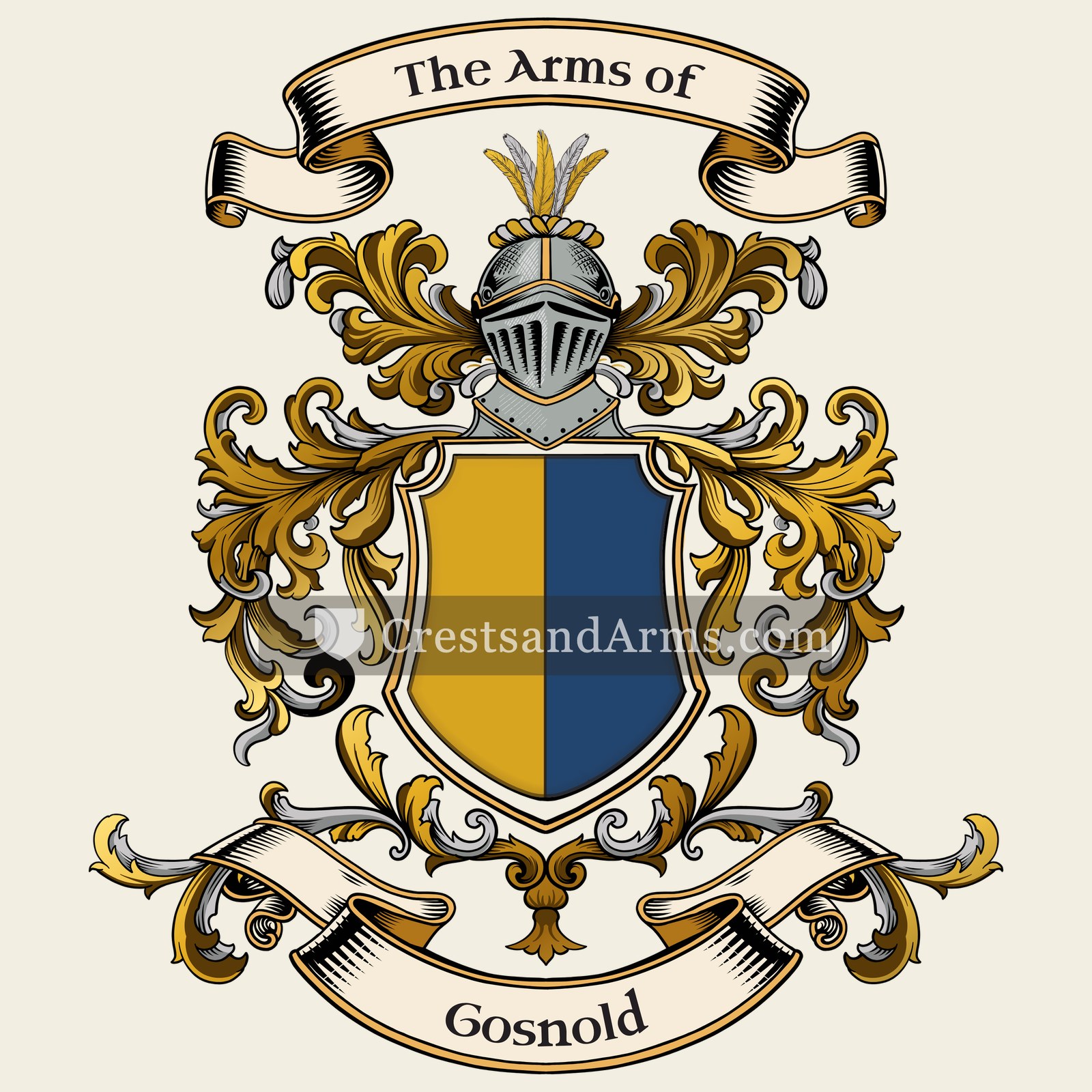
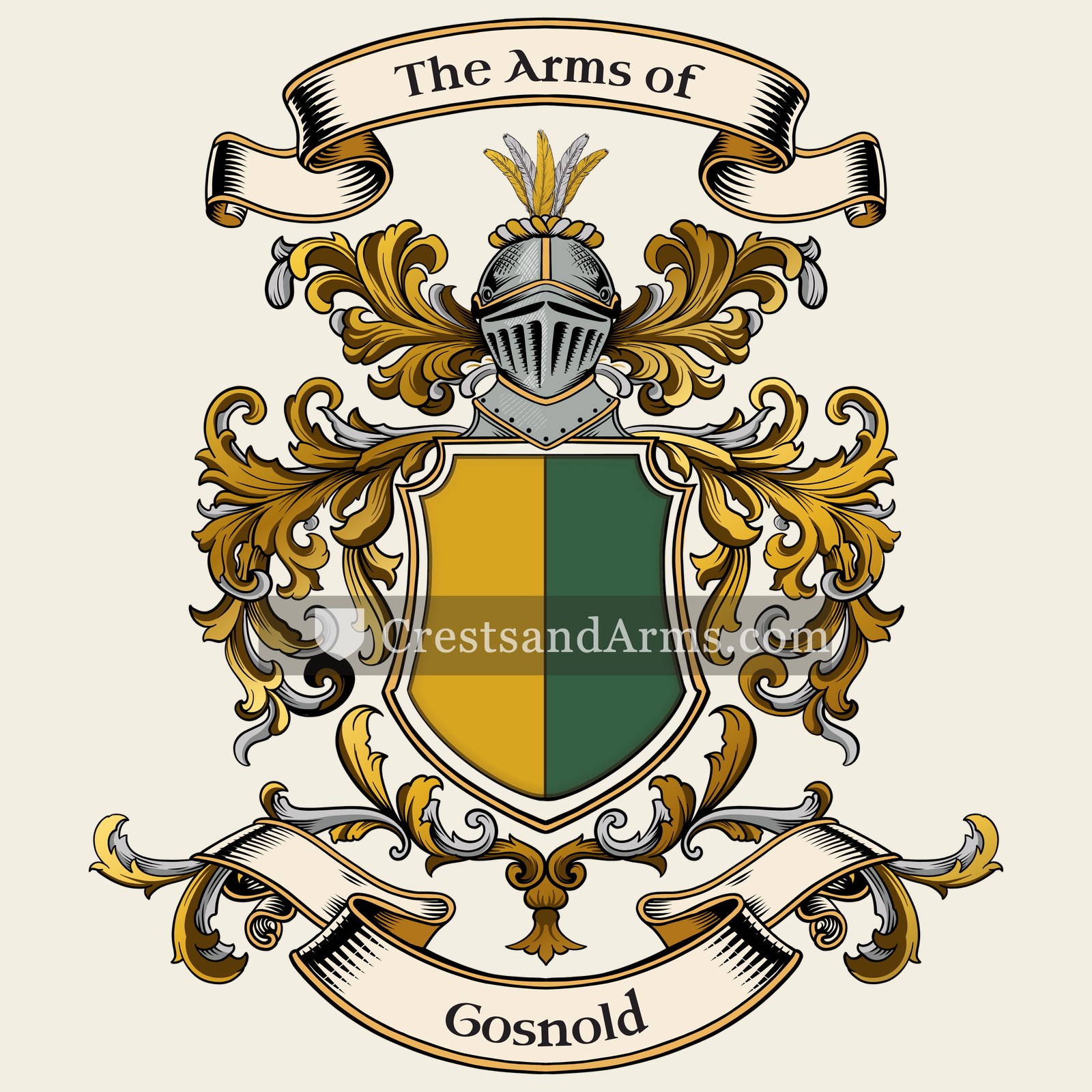
A record of documented arms, meaning and origin, researched for the Gosnold family lines. Documented in 2 countries.
Reg. 8662 · Irish, G–I
Coat of Arms & Family Crest Details
Symbols on this shield
paleMilitary strength, and a fortified defence
Colours
Gold (Or)Means: Generosity
Blue (Azure)Means: Loyalty and truth
Historical info
Source
Sir Bernard Burke, The General Armory of England, Scotland, Ireland and Wales, London: Harrison & Sons, 1884
Blazon (the actual original written record)
“Per pale crenellée or and az”
IrelandMunster, c. 1645
Where the Gosnold Arms Were Recorded
Munster
Map of Ireland showing where the Gosnold arms are recorded
The Gosnold arms were recorded in Munster, c. 1645.
This is where the arms were entered in the register. Families often moved to other parts of the country, so the same name can turn up in more than one region.
The body that granted and recorded arms in Ireland in this period.
Charles I of England
Sovereign of the period
Charles I of England
1625–1649
Reigning in Ireland when the Gosnold arms are first recorded.
How Arms Worked in Ireland
The Ulster King of Arms granted coats of arms to individuals who proved their social standing and good character. These symbols were typically inherited by all legitimate descendants of the original holder. If a family branch wanted a unique look, they could apply for a specific change to their design through the office to ensure their identity remained distinct.
Granting authority
The Ulster King of Arms acted as the official body that regulated and issued all coats of arms throughout Ireland.
How they got arms
Families obtained their arms through formal grants issued by the office after proving their eligibility and paying the required fees.
Where arms were recorded
All official grants were recorded in the registers held by the Ulster King of Arms starting from the year 1552.
The family's standing
Recorded among the armigerous families of Ireland.
Origin & History of the Gosnold Family in Ireland
The Gosnold family name arrived in Ireland during a time of great political upheaval and land redistribution. By 1645, members of the family were established in the province of Munster, a region that served as a central hub for English settlers during the seventeenth century. These early settlers often moved to Ireland to manage land grants or to serve in the military forces stationed there to maintain order. Because the name is of English origin, its presence in Munster reflects the broader movement of families across the Irish Sea during the mid-1600s. These individuals integrated into the local colonial administration and helped shape the social landscape of the region as they established farms and estates. Their presence in the historical record of Munster provides a clear link to the complex migration patterns that defined Ireland during this period.
Coat of Arms & Family Crest Details
Symbols on this shield
paleMilitary strength, and a fortified defence
Colours
Gold (Or)Means: Generosity
Green (Vert)Means: Hope
Historical info
Source
Sir Bernard Burke, The General Armory of England, Scotland, Ireland and Wales, London: Harrison & Sons, 1884
Blazon (the actual original written record)
“Per pale crenellée or and vert”
BuckinghamBeaconsfield · Buckingham, c. 1620
Where the Gosnold Arms Were Recorded
Buckingham
Map of England showing where the Gosnold arms are recorded
The Gosnold arms were recorded in Buckingham, c. 1620.
Buckinghamshire was quiet farming country on the road out of London. Court officials and lawyers bought manors there within easy reach of the capital, and a manor was the usual reason to take arms.
This is where the arms were entered in the register. Families often moved to other parts of the country, so the same name can turn up in more than one region.
The body that granted and recorded arms in England in this period.
James VI and I
Sovereign of the period
James VI and I
1603–1625
Reigning in Ireland when the Gosnold arms are first recorded.
How Arms Worked in England
English heraldry allowed arms to be shared by all legitimate descendants of the original owner. These symbols were treated as personal property that moved through the generations to all children. While the eldest son kept the original design, other family members could use the same shield without needing to change it or register their own unique versions.
Granting authority
The College of Arms in London has regulated the use of coats of arms throughout England and Wales since 1484.
How they got arms
Families typically obtained their coats of arms through a formal grant from the Crown or by proving their ancient right to them.
Where arms were recorded
All official coats of arms are recorded in the registers kept at the College of Arms, which date back to the fifteenth century.
The family's standing
Recorded among the armigerous families of Buckingham.
Origin & History of the Gosnold Family in England
The Gosnold family name traces its roots to the rural landscapes of East Anglia, particularly within the county of Suffolk, where the name appears in local records as early as the fourteenth century. The family established themselves as members of the landed gentry, often managing estates and serving in local administrative roles that allowed them to build influence over several generations. By the early seventeenth century, the family had expanded their reach into other parts of England, including Buckingham, where records confirm their presence by 1620. This period was marked by a shift toward exploration and public service, as members of the family became notable figures in the maritime and political life of the nation. Their movement across the English countryside reflects the broader social mobility of the era, as families of modest standing sought to secure their legacy through land ownership and participation in the growing English state.
Related Branches & Arms
Root word
Gaus-wald
Derived from Germanic elements meaning Goth and forest or ruler.
This name
GosnoldRefers to a dweller near a forest associated with the Goth people.
also spelled
Gosnoll
Gosnald
Gosnould
Related arms
Brownerecorded with Gosnold, same area
Carrrecorded with Gosnold, same area
Cassrecorded with Gosnold, same area
Disraelirecorded with Gosnold, same area
Documented Sources
Sir Bernard Burke, The General Armory of England, Scotland, Ireland and Wales, London: Harrison & Sons, 1884
Canny, Nicholas, Making Ireland British, 1580-1650, 2001
Prendergast, John P., The Cromwellian Settlement of Ireland, 1865
National Archives of Ireland, Civil Survey of the County of Cork, 1654-1656
Digital archive packCoat of arms PNG, gold border print PDF, vector SVG and the certificate of authenticity. Sent to your email in minutes.


 paleMilitary strength, and a fortified defence
 paleMilitary strength, and a fortified defence