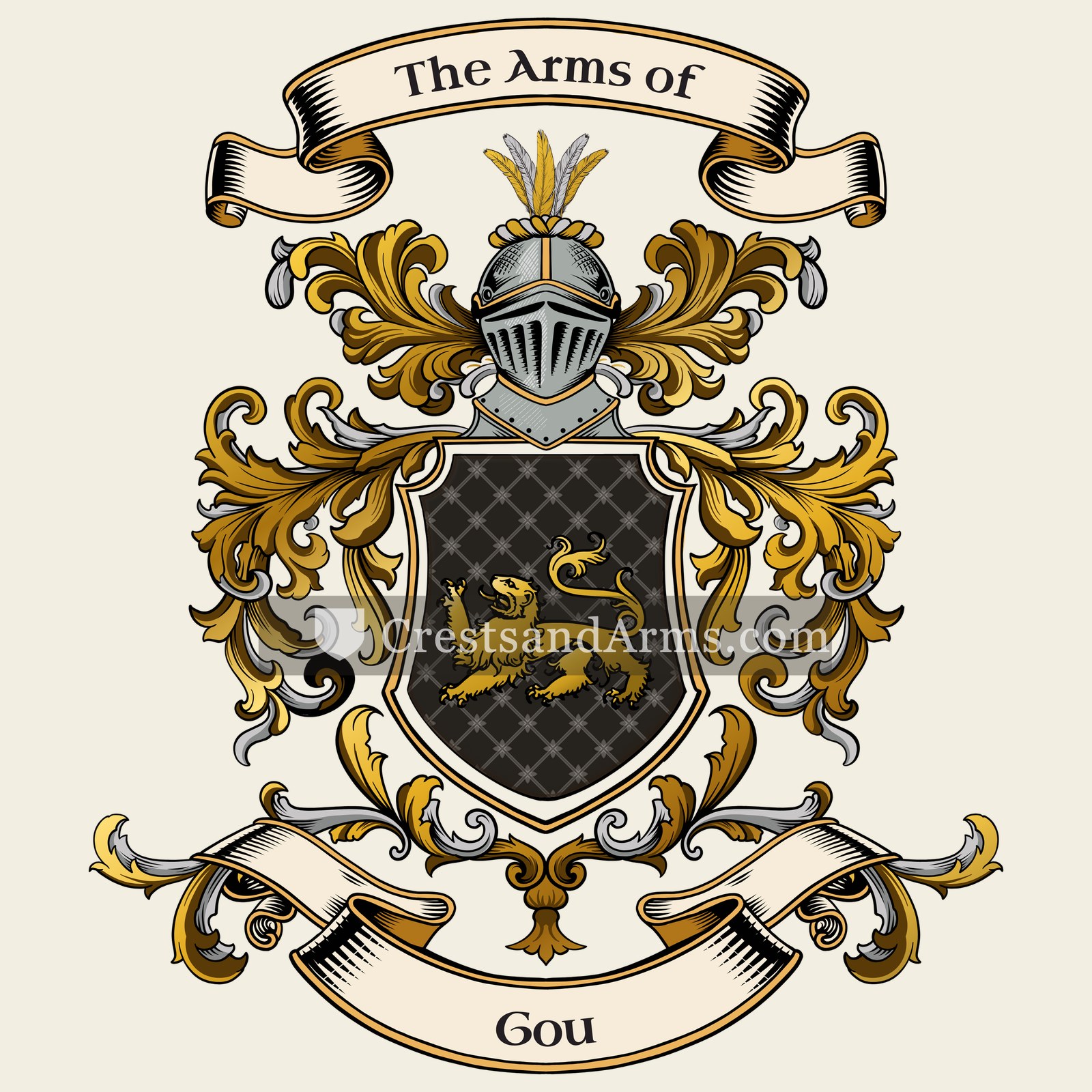
A record of documented arms, meaning and origin, researched for the Gou family of France.
Reg. 8210 · French, G–I
Coat of Arms & Family Crest Details
Symbols on this shield
lionCourage, strength and royalty
Colours
Black (Sable)Means: Constancy
Gold (Or)Means: Generosity
Historical info
Source
J. B. Rietstap, Armorial Général, Gouda: G. B. van Goor Zonen, 1884–87
Blazon (the actual original written record)
“De sa. au lion d'or, arm. et lamp. de gu. D.: SANS DÉFALLOIR.”
Franche-ComteFranche-Comte, c. 1663
Where the Gou Arms Were Recorded
Franche-Comte
Map of France showing where the Gou arms are recorded
The Gou arms were recorded in Franche-Comte, c. 1663.
Franche-Comte sat between France and the Empire and changed hands more than once. Border families held their land under arms and expected to defend it, so a shield was a practical thing rather than an ornament.
This is where the arms were entered in the register. Families often moved to other parts of the country, so the same name can turn up in more than one region.
The body that granted and recorded arms in France in this period.
Louis XIV of France
Sovereign of the period
Louis XIV of France
1643–1715
Reigning in France when the Gou arms are first recorded.
How Arms Worked in France
In France, a coat of arms was a mark of honor that passed down through the male line to all legitimate descendants. Families often used the same shield without changes to show their shared heritage. If a branch wanted to stand out, they could add a small mark to their shield to show their specific place in the family tree.
Granting authority
The Juge d'armes de France acted as the official authority that regulated and verified coats of arms across the country.
How they got arms
Families typically inherited their arms from ancestors, though they could also receive them through royal grants or by proving their noble status.
Where arms were recorded
Coats of arms were officially recorded in the Armorial Général de France, which began its main collection in the year 1696.
The family's standing
Recorded among the armigerous families of Franche-Comte.
Origin & History of the Gou Family in France
The history of the Gou family in the Franche-Comté region of eastern France is deeply rooted in the social landscape of the seventeenth century. By 1663, records confirm that members of the family were established residents in this mountainous area near the border of Switzerland. During this period, the region was transitioning between different political powers, which often meant that families had to be resilient and adaptable to survive. The name Gou likely originated as a descriptive nickname or a shortened form of a longer occupational title common to the rural communities of the Jura Mountains. Families in this area often worked in agriculture, forestry, or local crafts, and they maintained strong ties to their parish churches for record-keeping. Because the Franche-Comté was a crossroads for trade and migration, the Gou family would have been part of a close-knit society that valued land ownership and local community bonds. These early ancestors helped shape the cultural identity of the region long before the modern borders of France were fully solidified.
Related Branches & Arms
Root word
Gode
Old Germanic term meaning god or good.
This name
GouA locative or occupational name derived from a shortened form of Germanic names containing the element god.
also spelled
Gou
Goux
Gouxe
de Gu
Documented Sources
J. B. Rietstap, Armorial Général, Gouda: G. B. van Goor Zonen, 1884–87
Bavoux, François. Histoire de la Franche-Comté. 1957
Fohlen, Claude. Histoire de la Franche-Comté. 1981
Archives départementales du Doubs, Série E, État civil et registres paroissiaux
Digital archive packCoat of arms PNG, gold border print PDF, vector SVG and the certificate of authenticity. Sent to your email in minutes.


 lionCourage, strength and royalty
 lionCourage, strength and royalty