A record of documented arms, meaning and origin, researched for the Gough family lines. Documented in 3 countries.
Reg. 3991 · French, G–I
Coat of Arms & Family Crest Details
Symbols on this shield
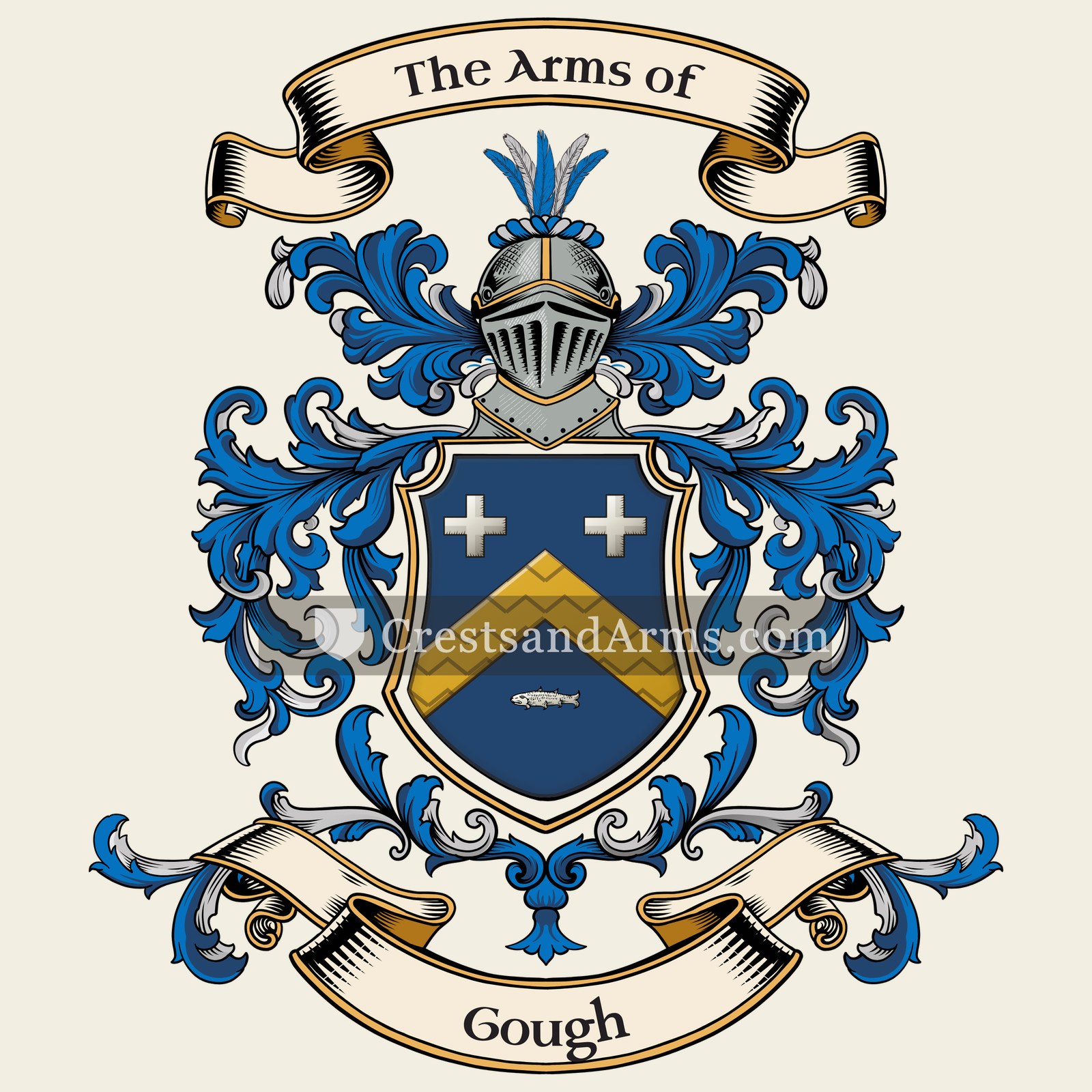
chevronProtection, and faithful service completed
cross symbolChristian faith and service
fishA true and generous mind, and Christian faith
Colours
Blue (Azure)Means: Loyalty and truth
Gold (Or)Means: Generosity
Silver (Argent)Means: Peace and sincerity
Historical info
Source
J. B. Rietstap, Armorial Général, Gouda: G. B. van Goor Zonen, 1884–87
Blazon (the actual original written record)
“D'azur au chev. d'or, acc. en chef de deux croix ancrées d'arg. et en p. d'un poisson du même, nageant dans une rivière aussi d'arg.”
Francec. 1725
Where the Gough Arms Were Recorded
Bretagne
Map of France showing where the Gough arms are recorded
The Gough arms were recorded in France, c. 1725.
Arms such as these were typically recorded in Bretagne.
More families held coats of arms in Bretagne than anywhere else in France. The land was divided into many small estates rather than a few large ones, so far more households counted as gentry, and each needed a shield of its own to be told apart.
This is where the arms were entered in the register. Families often moved to other parts of the country, so the same name can turn up in more than one region.
The body that granted and recorded arms in France in this period.
Louis XV of France
Sovereign of the period
Louis XV of France
1715–1774
Reigning in France when the Gough arms are first recorded.
How Arms Worked in France
In France, a coat of arms was a mark of honor that passed down through the male line to all legitimate descendants. Families often used the same shield without changes to show their shared heritage. If a branch wanted to stand out, they could add a small mark to their shield to show their specific place in the family tree.
Granting authority
The Juge d'armes de France acted as the official authority that regulated and verified coats of arms across the country.
How they got arms
Families typically inherited their arms from ancestors, though they could also receive them through royal grants or by proving their noble status.
Where arms were recorded
Coats of arms were officially recorded in the Armorial Général de France, which began its main collection in the year 1696.
The family's standing
Recorded among the armigerous families of France.
Origin & History of the Gough Family in France
The family name Gough has deep roots that connect to the rugged landscapes of Brittany in northwestern France. By the year 1725, records confirm that members of the family were well-established within this region, which was then a distinct province with its own unique language and customs. The name itself is often linked to the Old Breton word goff, which translates to smith. This suggests that the earliest ancestors of the family were likely skilled metalworkers who played an essential role in their local communities. Because Brittany served as a vital maritime hub, these early family members lived in a society shaped by trade, seafaring, and strong local traditions. Their presence in the region during the early eighteenth century reflects a long history of craftsmanship and deep ties to the cultural identity of the Breton people.
Coat of Arms & Family Crest Details
Symbols on this shield
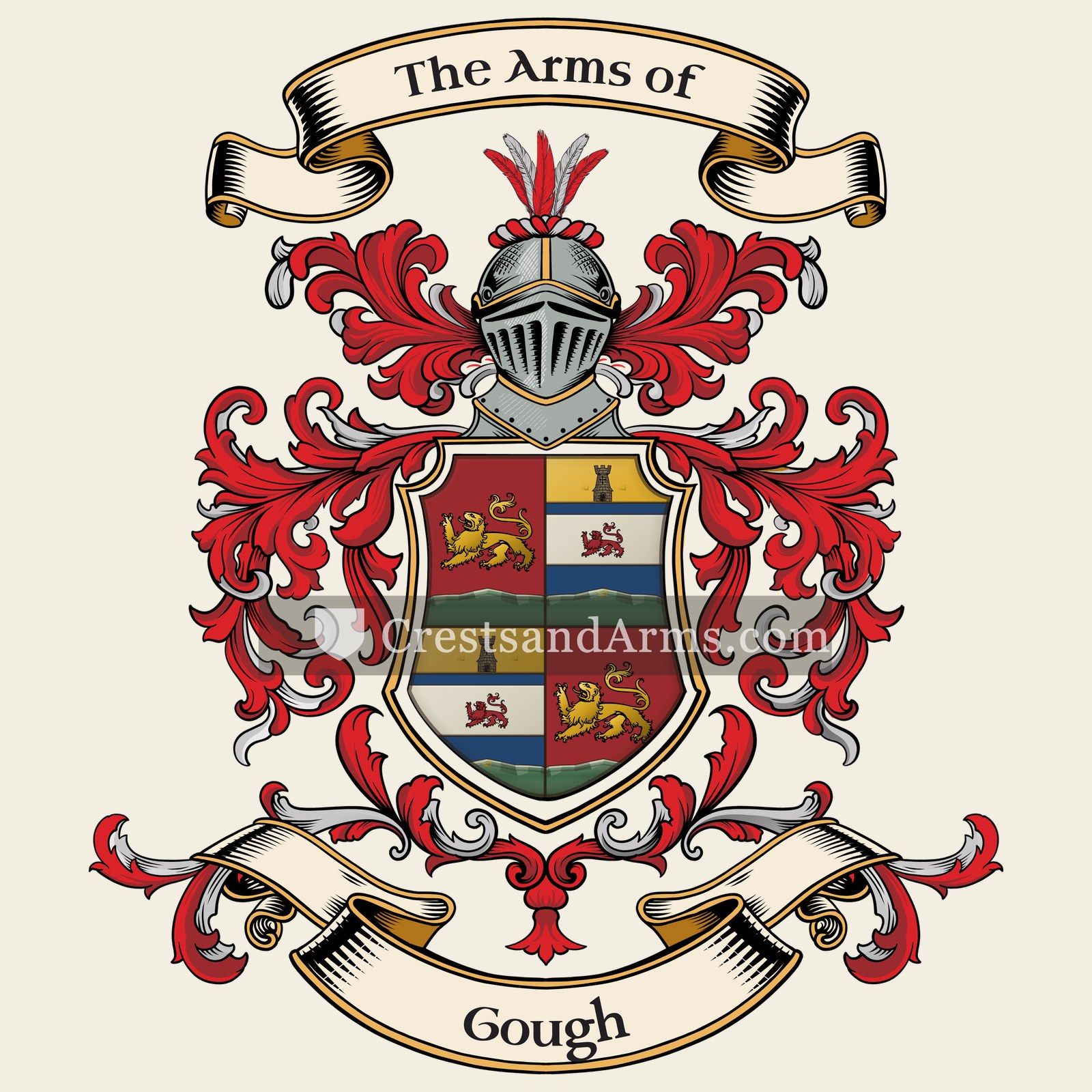
mountThe ground held, and steadfastness upon it
fessThe military belt, and readiness to serve
chiefAuthority, wisdom and dominion
lionCourage, strength and royalty
boars headA fierce fighter who battles to the end
towerGrandeur and solidity, and a stronghold defended
Colours
Red (Gules)Means: Military strength
Blue (Azure)Means: Loyalty and truth
Green (Vert)Means: Hope
Silver (Argent)Means: Peace and sincerity
Gold (Or)Means: Generosity
Historical info
Source
Sir Bernard Burke, The General Armory of England, Scotland, Ireland and Wales, London: Harrison & Sons, 1884
Blazon (the actual original written record)
“Quarterly, 1st and 4th, gu. on a mount vert a lion pass. guard. or, supporting with the dexter paw the union flag ppr. and over the same, in chief, the words "China, India," in letters of gold; 2nd and 3rd, az. on a fesse ar. betw. three boars' heads couped or, a lion pass. gu. (being his family arms), in the centre chief point, pendent from a riband ar. fimbriated az. a representation of the badge of the Spanish Order of Charles III. ppr. and on a chief a representation of the east wall of the fortress of Tarifa, with a breach betw. two turrets, and on the dexter turret the British flag flying also ppr”
Irelandc. 1645
Where the Gough Arms Were Recorded
Dublin
Map of Ireland showing where the Gough arms are recorded
The Gough arms were recorded in Ireland, c. 1645.
Arms such as these were typically recorded in Dublin.
Dublin was the seat of government in Ireland and the place where grants were sought and recorded. Families with business at the castle or the courts settled nearby, and settling there put their arms on record.
This is where the arms were entered in the register. Families often moved to other parts of the country, so the same name can turn up in more than one region.
The body that granted and recorded arms in Ireland in this period.
Charles I of England
Sovereign of the period
Charles I of England
1625–1649
Reigning in France when the Gough arms are first recorded.
How Arms Worked in Ireland
The Ulster King of Arms granted coats of arms to individuals who proved their social standing and good character. These symbols were typically inherited by all legitimate descendants of the original holder. If a family branch wanted a unique look, they could apply for a specific change to their design through the office to ensure their identity remained distinct.
Granting authority
The Ulster King of Arms acted as the official body that regulated and issued all coats of arms throughout Ireland.
How they got arms
Families obtained their arms through formal grants issued by the office after proving their eligibility and paying the required fees.
Where arms were recorded
All official grants were recorded in the registers held by the Ulster King of Arms starting from the year 1552.
The family's standing
Recorded among the armigerous families of Ireland.
Origin & History of the Gough Family in Ireland
The surname Gough has deep roots in Ireland that trace back to the mid-seventeenth century. By 1645, members of the family were already established residents of Dublin, a city that served as a major hub for trade and politics at the time. The name itself is thought to be a variation of the Welsh word coch, which translates to red. It is likely that the family arrived in Ireland during periods of migration from Wales or England, eventually integrating into the social and economic life of the Irish capital. Over the following decades, the family became part of the urban middle class, participating in the city's growth as it transitioned through a turbulent era of Irish history. Their presence in Dublin records from this period suggests they were well-integrated into the local community long before the name spread further across the country.
Coat of Arms & Family Crest Details
Symbols on this shield
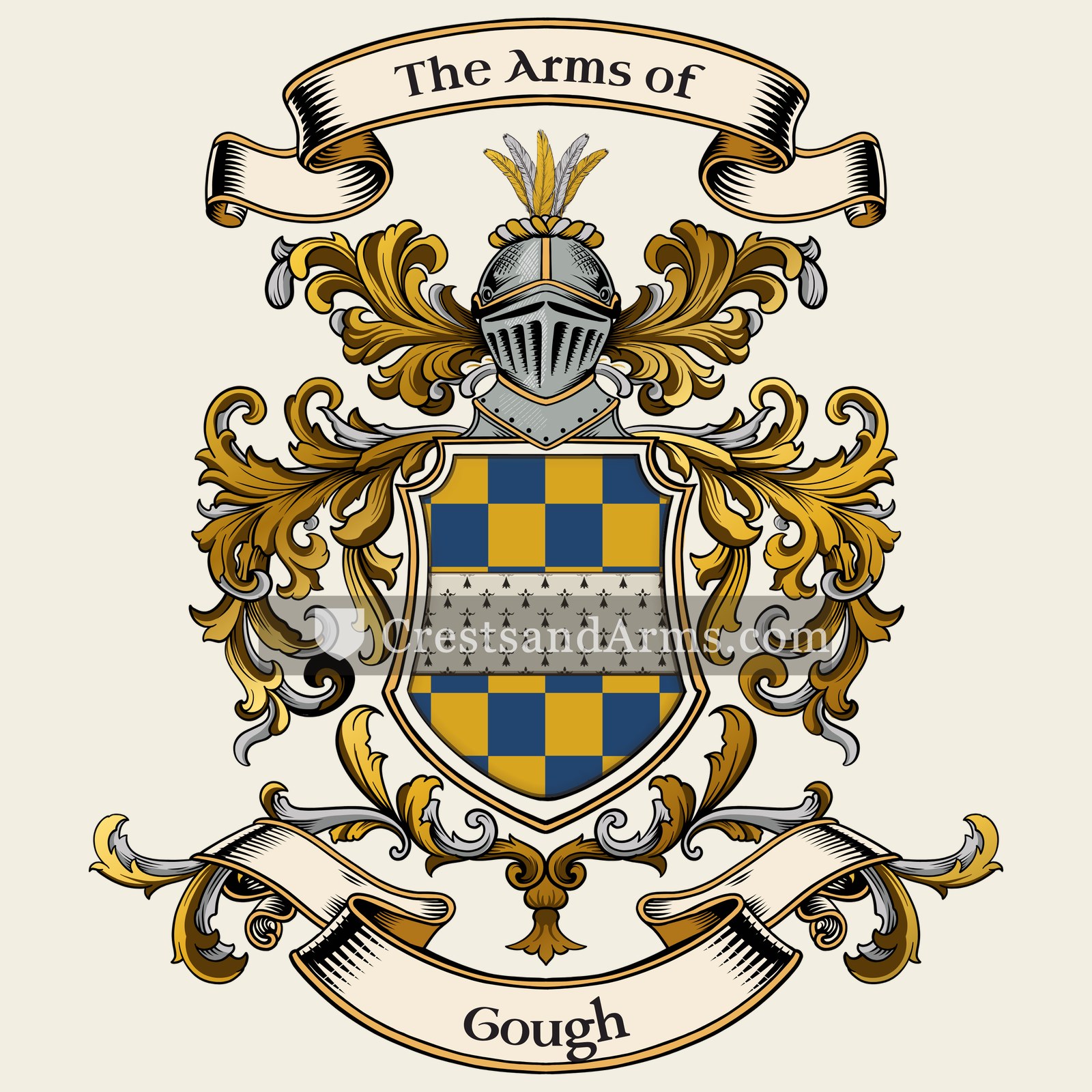
chequyConstancy, and the counting-board
fessThe military belt, and readiness to serve
Colours
Gold (Or)Means: Generosity
ErmineMeans: Dignity
Blue (Azure)Means: Loyalty and truth
Historical info
Source
Sir Bernard Burke, The General Armory of England, Scotland, Ireland and Wales, London: Harrison & Sons, 1884
Blazon (the actual original written record)
“Chequy or and az. a fesse erm”
WarwickWarwick, c. 1620
Where the Gough Arms Were Recorded
Warwick
Map of England showing where the Gough arms are recorded
The Gough arms were recorded in Warwick, c. 1620.
Warwickshire lay in the middle of England, and its landed families were spread evenly across it rather than gathered in one corner. A great many held a single manor each, and each of those holdings brought its own claim to arms.
This is where the arms were entered in the register. Families often moved to other parts of the country, so the same name can turn up in more than one region.
The body that granted and recorded arms in England in this period.
James VI and I
Sovereign of the period
James VI and I
1603–1625
Reigning in France when the Gough arms are first recorded.
How Arms Worked in England
English heraldry allowed arms to be shared by all legitimate descendants of the original owner. These symbols were treated as personal property that moved through the generations to all children. While the eldest son kept the original design, other family members could use the same shield without needing to change it or register their own unique versions.
Granting authority
The College of Arms in London has regulated the use of coats of arms throughout England and Wales since 1484.
How they got arms
Families typically obtained their coats of arms through a formal grant from the Crown or by proving their ancient right to them.
Where arms were recorded
All official coats of arms are recorded in the registers kept at the College of Arms, which date back to the fifteenth century.
The family's standing
Recorded among the armigerous families of Warwick.
Origin & History of the Gough Family in England
The surname Gough is rooted in the Middle Welsh word *coch*, which translates to red. This name likely began as a descriptive nickname for an ancestor who had red hair or a ruddy complexion. As surnames became more common in England, families began to adopt these identifiers to distinguish themselves within their local communities. By the time members of the Gough family were documented in Warwick in 1620, the name had already transitioned from a personal descriptor into a stable family identifier. During this era, families in the English Midlands were often tied to the land and local trade, and the presence of the Goughs in Warwick suggests they were part of the growing social fabric of the town during the early seventeenth century. This period was a time of significant record-keeping, allowing historians to trace how such names moved across regional borders and became firmly established in English society.
Related Branches & Arms
Root word
Goch
A Welsh term meaning red or reddish in color.
This name
GoughA descriptive nickname for a person with red hair or a ruddy complexion.
also spelled
Goughe
Goughh
Goff
Goffe
Related arms
Goffsame arms
Goghesame arms
Goffevariant spelling
Googh, or Googevariant spelling
Documented Sources
J. B. Rietstap, Armorial Général, Gouda: G. B. van Goor Zonen, 1884–87
Deshayes, Albert. Dictionnaire des noms de famille bretons. 1995
Archives départementales du Morbihan. Registres paroissiaux et d'état civil. 1725
Digital archive packCoat of arms PNG, gold border print PDF, vector SVG and the certificate of authenticity. Sent to your email in minutes.


 chevronProtection, and faithful service completed
 cross symbolChristian faith and service
 fishA true and generous mind, and Christian faith
 chevronProtection, and faithful service completed
 cross symbolChristian faith and service
 fishA true and generous mind, and Christian faith

 mountThe ground held, and steadfastness upon it
 fessThe military belt, and readiness to serve
 chiefAuthority, wisdom and dominion
 lionCourage, strength and royalty
 boars headA fierce fighter who battles to the end
 towerGrandeur and solidity, and a stronghold defended

 chequyConstancy, and the counting-board