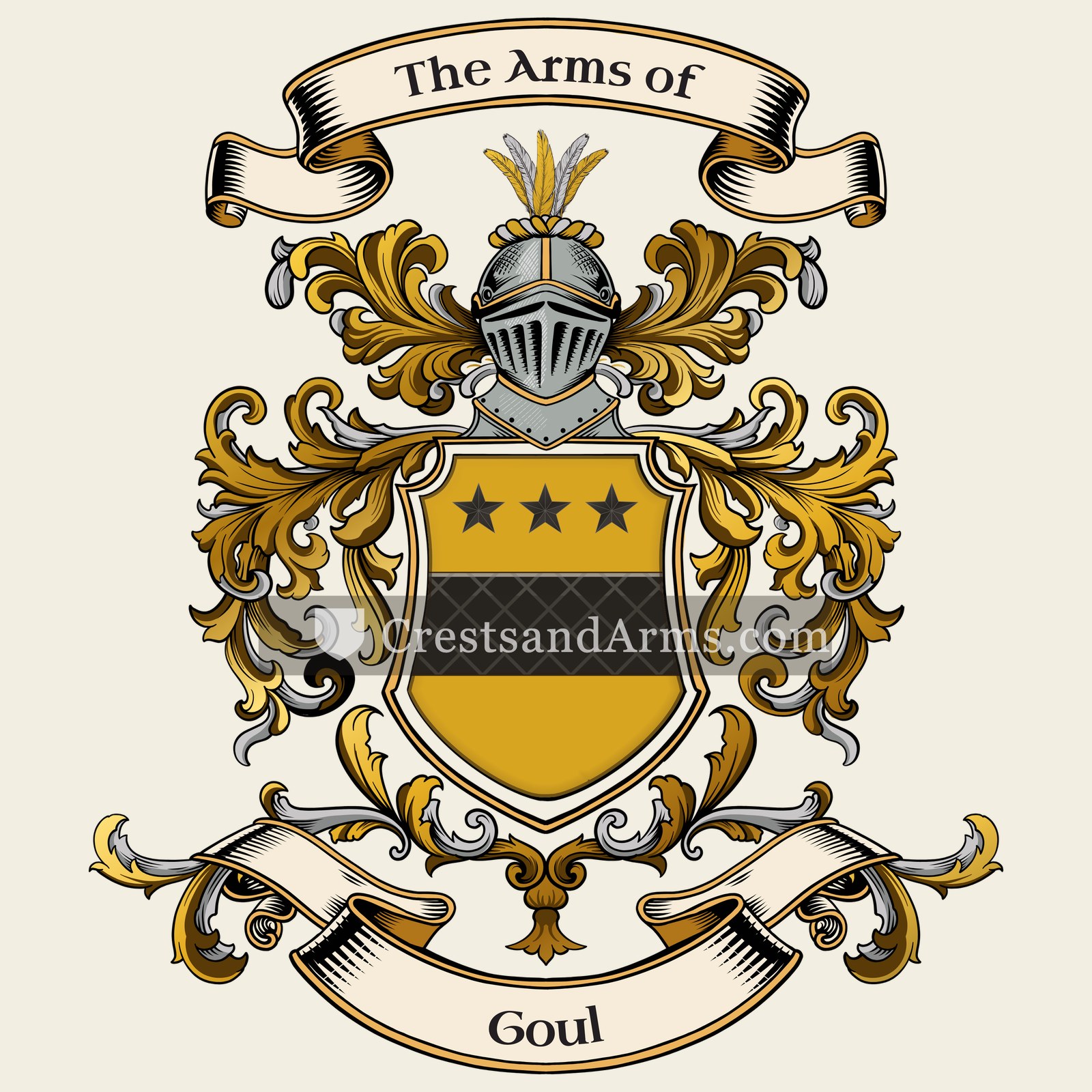
A record of documented arms, meaning and origin, researched for the Goul family of France.
Reg. 0917 · French, G–I
Coat of Arms & Family Crest Details
Symbols on this shield
fessThe military belt, and readiness to serve
mulletThe third son, and a divine quality from above
Colours
Gold (Or)Means: Generosity
Black (Sable)Means: Constancy
Historical info
Source
J. B. Rietstap, Armorial Général, Gouda: G. B. van Goor Zonen, 1884–87
Blazon (the actual original written record)
“D'or à la fasce de sa., acc. de trois molettes du même, rangées en chef.”
FranceBeauvoisis, c. 1663
Where the Goul Arms Were Recorded
Beauvoisis
Map of France showing where the Goul arms are recorded
The Goul arms were recorded in Beauvoisis, c. 1663.
This is where the arms were entered in the register. Families often moved to other parts of the country, so the same name can turn up in more than one region.
The body that granted and recorded arms in France in this period.
Louis XIV of France
Sovereign of the period
Louis XIV of France
1643–1715
Reigning in France when the Goul arms are first recorded.
How Arms Worked in France
In France, a coat of arms was a mark of honor that passed down through the male line to all legitimate descendants. Families often used the same shield without changes to show their shared heritage. If a branch wanted to stand out, they could add a small mark to their shield to show their specific place in the family tree.
Granting authority
The Juge d'armes de France acted as the official authority that regulated and verified coats of arms across the country.
How they got arms
Families typically inherited their arms from ancestors, though they could also receive them through royal grants or by proving their noble status.
Where arms were recorded
Coats of arms were officially recorded in the Armorial Général de France, which began its main collection in the year 1696.
The family's standing
Recorded among the armigerous families of France.
Origin & History of the Goul Family in France
The family name Goul has deep roots in the Beauvoisis region of northern France, where records confirm members of the family were firmly established by 1663. During the seventeenth century, this area was a center for agricultural production and textile manufacturing, which likely shaped the daily lives and occupations of early family members. The name itself is thought to be a variation of older regional terms, potentially linked to local nicknames or geographical markers common in the Picardy dialect of that era. As residents of the Beauvoisis, the Goul family lived through a period of significant social change under the reign of King Louis XIV, when the French state began to exert more control over rural provinces. By maintaining their presence in this specific territory, the early Goul family helped contribute to the long-standing cultural and social identity of the region.
Related Branches & Arms
Root word
Gudwald
Derived from Germanic elements meaning good and ruler or power.
This name
GoulA French habitational or patronymic surname likely originating from a shortened form of Germanic personal names.
also spelled
Goul
Goullee
Gool
Documented Sources
J. B. Rietstap, Armorial Général, Gouda: G. B. van Goor Zonen, 1884–87
Archives départementales de l'Oise, Registres paroissiaux et d'état civil du Beauvaisis, 1663
Léopold Delisle, Études sur la condition de la classe agricole et l'état de l'agriculture en Normandie au Moyen Âge, 1903
Pierre Goubert, Beauvais et le Beauvaisis de 1600 à 1730, 1960
Digital archive packCoat of arms PNG, gold border print PDF, vector SVG and the certificate of authenticity. Sent to your email in minutes.


 fessThe military belt, and readiness to serve
 mulletThe third son, and a divine quality from above
 fessThe military belt, and readiness to serve
 mulletThe third son, and a divine quality from above