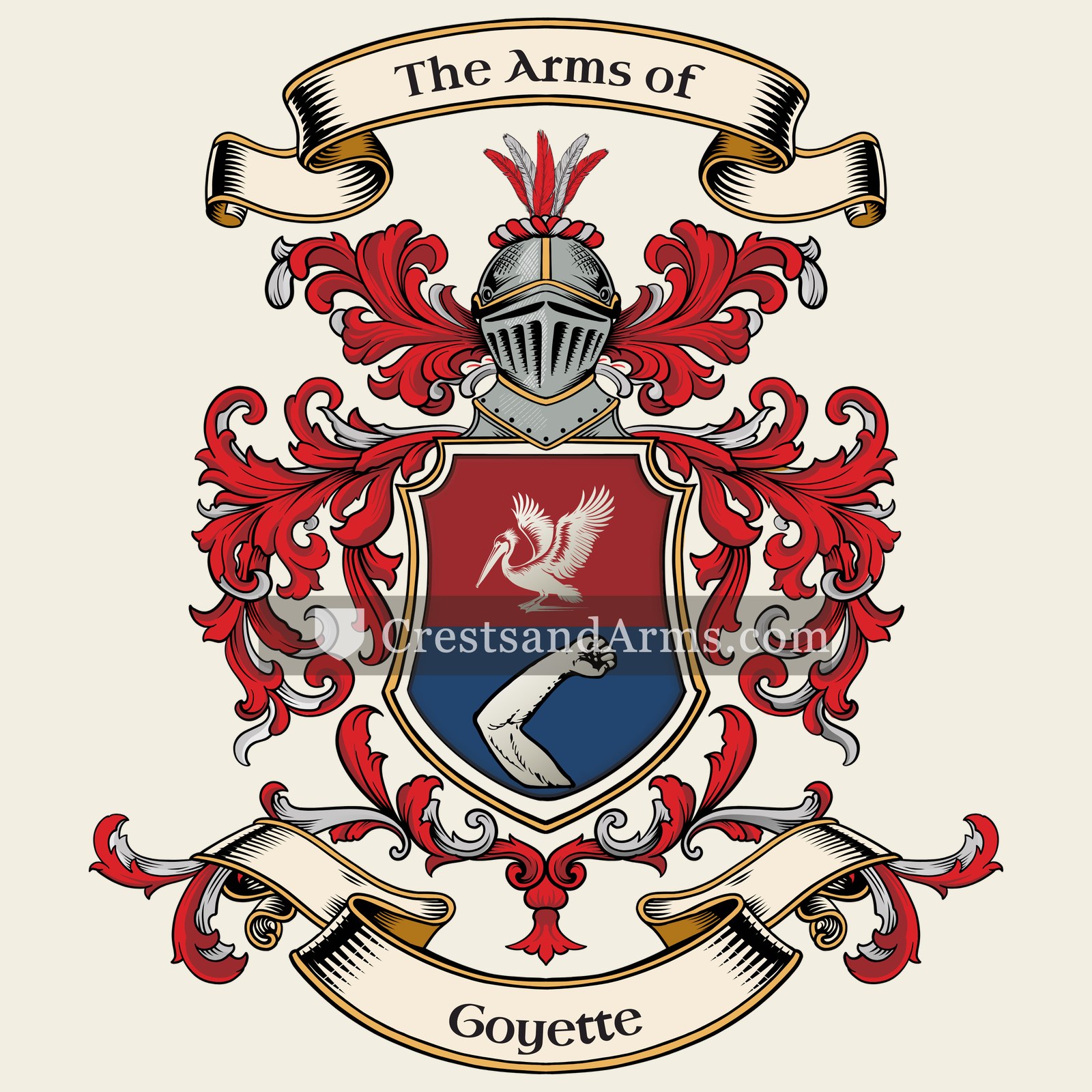
A record of documented arms, meaning and origin, researched for the Goyette family of Germany.
Reg. 2856 · German, G–I
Coat of Arms & Family Crest Details
Symbols on this shield
pelicanSelf-sacrifice and devotion to one's children
armA person of action, industrious and laborious
Colours
Red (Gules)Means: Military strength
Blue (Azure)Means: Loyalty and truth
Silver (Argent)Means: Peace and sincerity
Historical info
Source
J. B. Rietstap, Armorial Général, Gouda: G. B. van Goor Zonen, 1884–87
Blazon (the actual original written record)
“Coupé: au 1 de gu. à un pélican avec ses petits dans son aire, le tout d'arg. (Gayette); au 2 d'azur à un senestrochère, arm. d'arg., tenant une épée et sortant d'une nuée d'arg., mouv. du flanc.”
Germanyc. 1765
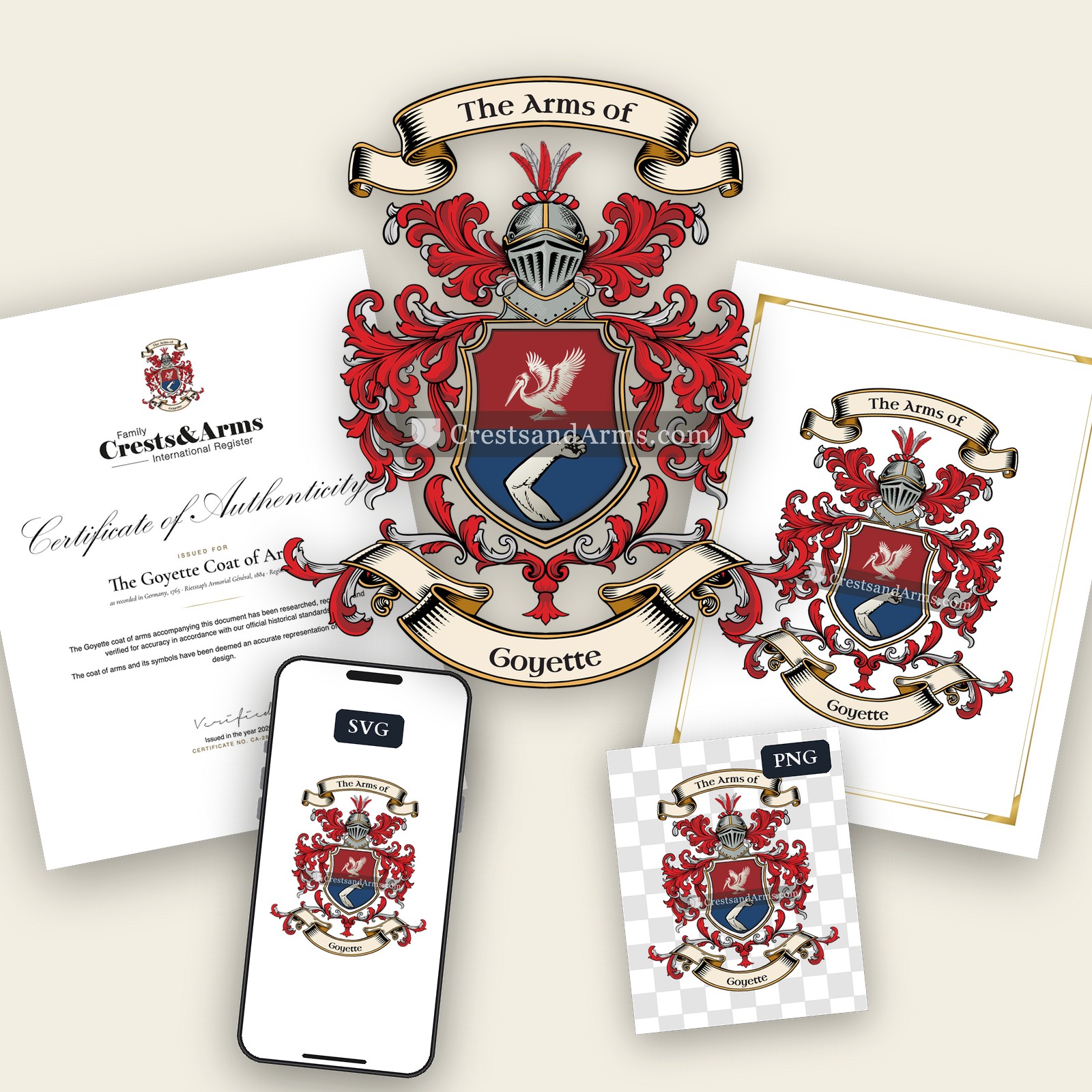
Digital archive packCoat of arms PNG, gold border print PDF, vector SVG and the certificate of authenticity. Sent to your email in minutes.
Map of Germany showing where the Goyette arms are recorded
The Goyette arms were recorded in Germany, c. 1765.
Arms such as these were typically recorded in Bavaria.
Bavaria was a country of old landed families and walled market towns. Estates passed down the same line for centuries, and both the landowners and the leading townsmen kept arms, which is why so many Bavarian names sit in the registers.
This is where the arms were entered in the register. Families often moved to other parts of the country, so the same name can turn up in more than one region.
The body that granted and recorded arms in Germany in this period.
Francis I, Holy Roman Emperor
Sovereign of the period
Francis I, Holy Roman Emperor
1745–1765
Reigning in Germany when the Goyette arms are first recorded.
How Arms Worked in Germany
In the Holy Roman Empire, coats of arms were often granted to individuals by the Emperor or his representatives. These arms were then passed down through the generations to all legitimate descendants of the original holder. Younger branches of a family usually kept the same shield design without needing to change it, as the arms belonged to the entire lineage.
Granting authority
The Holy Roman Emperor held the sole power to grant new coats of arms throughout his vast imperial territories.
How they got arms
Families typically obtained their coats of arms through a formal imperial grant or by proving their noble status to the authorities.
Where arms were recorded
These grants were officially recorded in the Imperial Chancery registers, which began keeping formal records of such honors during the Middle Ages.
The family's standing
Recorded among the armigerous families of Germany.
Origin & History of the Goyette Family in Germany
The family name Goyette has deep roots in the historical region of Bavaria, where records confirm members of the family were established by 1765. During this period, Bavaria was a collection of territories known for its strong agricultural traditions and distinct local dialects. Families with this surname often lived in rural communities where they contributed to the local economy through farming or skilled trade work. As the region underwent political and social changes during the late 18th century, many families began to move toward larger towns to seek new opportunities. The name itself likely evolved from older Germanic linguistic roots, reflecting the naming customs common to the southern German states at the time. Over the generations, the family maintained its presence in these central European lands before some branches eventually migrated to other parts of the world.
Goyette Meaning & Related Branches
Root word
Gode
Derived from the Germanic element god meaning good or god.
This name
GoyetteA diminutive form indicating a descendant of someone named with the root element for good.
also spelled
Gayet
Gayettes
Gayett
Documented Sources
J. B. Rietstap, Armorial Général, Gouda: G. B. van Goor Zonen, 1884–87


 pelicanSelf-sacrifice and devotion to one's children
 armA person of action, industrious and laborious
 pelicanSelf-sacrifice and devotion to one's children
 armA person of action, industrious and laborious