A record of documented arms, meaning and origin, researched for the Goz family lines. Documented in 2 countries.
Reg. 4919 · German, G–I
Coat of Arms & Family Crest Details
Symbols on this shield
bendDefence, and the scarf of a commander
lionCourage, strength and royalty
eagleNobility, strength and a keen mind
hunting horn stringedOne who delights in the chase
pillowRest earned, and authority at ease
treeLife, endurance and deep roots
Colours
Gold (Or)Means: Generosity
Black (Sable)Means: Constancy
Silver (Argent)Means: Peace and sincerity
Red (Gules)Means: Military strength
Historical info
Source
J. B. Rietstap, Armorial Général, Gouda: G. B. van Goor Zonen, 1884–87
Blazon (the actual original written record)
“Tiercé en fasce: au 1 parti: a. d'or à l'aigle cont. de sa., bq., m. et cour. du champ, b. de sa. au lion d'or; au 2 parti: a. de sa. au lion cont. d'or; b. d'or à l'aigle de sa., bq., m. et cour. du champ; au 3 tiercé en pal: a. d'arg. à deux barres de gu.; b. coupé, d'arg. à une corne de bouquetin de gu., en fasce, sur or à un coussin de gu., houppé du même; c. d'arg. à deux bandes de gu. Sur le tout d'arg. à un tronc de tilleul d'or, en bande, feuillé au côté sen. de deux feuilles de sin. Trois cq. cour. C.: 1° un tronc d'arg., en pal, entre deux prob. de sa.; à un billet d'arg., br. en barre sur le haut du chicot et des prob.; 2° l'aigle du 2; 3° six bannières de gu. L.: des deux premiers cq., d'or et de sa.; du troisième, d'arg. et de gu.”
Germanyc. 1765
Digital archive packCoat of arms PNG, gold border print PDF, vector SVG and the certificate of authenticity. Sent to your email in minutes.
Map of Germany showing where the Goz arms are recorded
The Goz arms were recorded in Germany, c. 1765.
Arms such as these were typically recorded in Bavaria.
Bavaria was a country of old landed families and walled market towns. Estates passed down the same line for centuries, and both the landowners and the leading townsmen kept arms, which is why so many Bavarian names sit in the registers.
This is where the arms were entered in the register. Families often moved to other parts of the country, so the same name can turn up in more than one region.
The body that granted and recorded arms in Germany in this period.
Francis I, Holy Roman Emperor
Sovereign of the period
Francis I, Holy Roman Emperor
1745–1765
Reigning in Germany when the Goz arms are first recorded.
How Arms Worked in Germany
In the Holy Roman Empire, coats of arms were often granted to individuals by the Emperor or his representatives. These arms were then passed down through the generations to all legitimate descendants of the original holder. Younger branches of a family usually kept the same shield design without needing to change it, as the arms belonged to the entire lineage.
Granting authority
The Holy Roman Emperor held the sole power to grant new coats of arms throughout his vast imperial territories.
How they got arms
Families typically obtained their coats of arms through a formal imperial grant or by proving their noble status to the authorities.
Where arms were recorded
These grants were officially recorded in the Imperial Chancery registers, which began keeping formal records of such honors during the Middle Ages.
The family's standing
Recorded among the armigerous families of Germany.
Origin & History of the Goz Family in Germany
The surname Goz traces its roots back to the southern regions of Germany, particularly within the historic lands of Bavaria. By the mid-eighteenth century, the family was well-established in this area, as evidenced by records confirming their presence in 1765. The name itself is thought to be a shortened form of ancient Germanic personal names that began with the element "Godo," which relates to the concept of a god or a divine being. During this period, families often lived in small, rural communities where they worked as farmers or skilled tradespeople. Life in eighteenth-century Bavaria was defined by local traditions and the influence of the church, which kept detailed registers of births, marriages, and deaths. These documents show that the Goz family was part of a stable social structure that had occupied the region for generations. As they moved through the late 1700s, members of the family contributed to the local economy and helped shape the small villages that defined the Bavarian landscape.
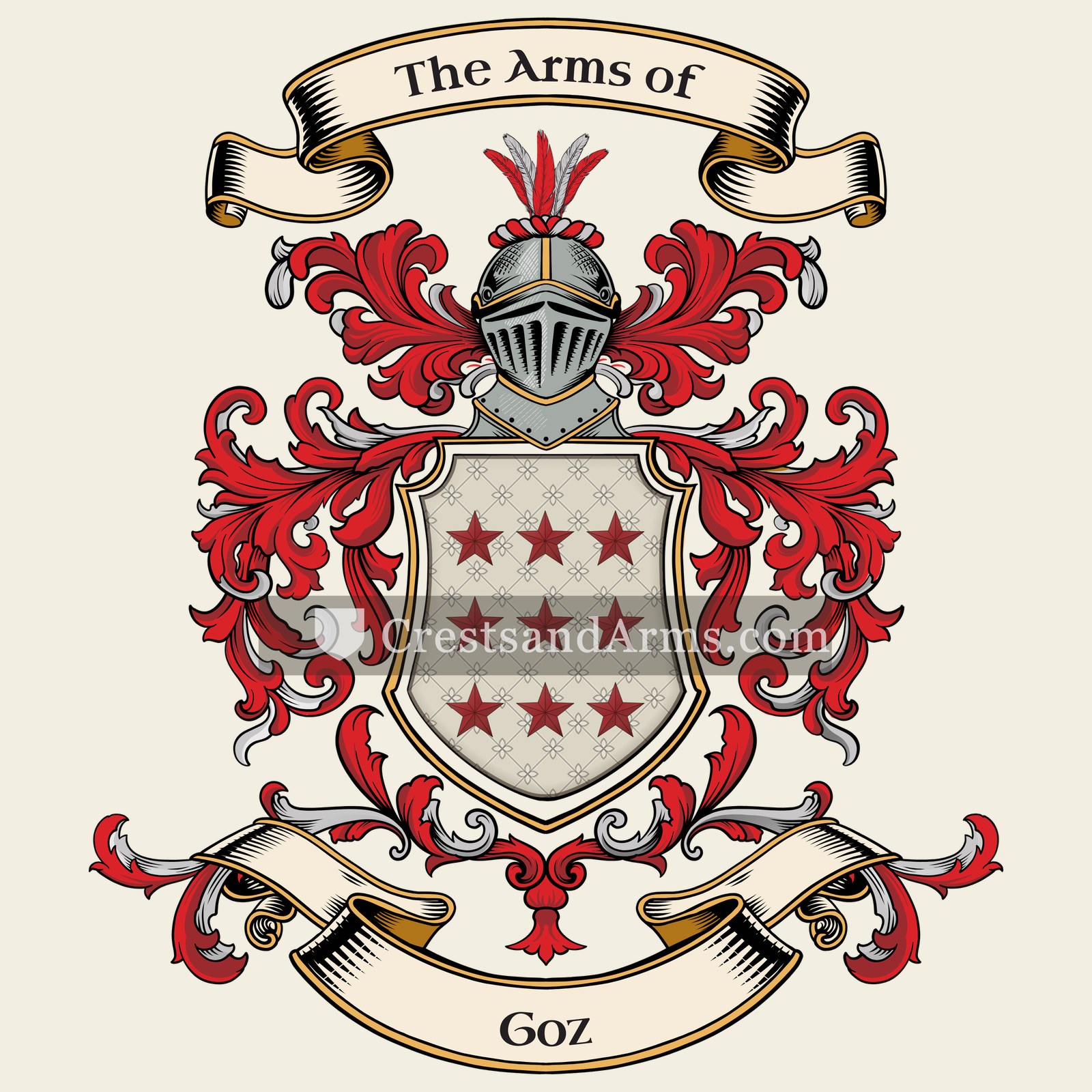
Coat of Arms & Family Crest Details
Symbols on this shield
mulletThe third son, and a divine quality from above
Colours
Silver (Argent)Means: Peace and sincerity
Red (Gules)Means: Military strength
Historical info
Source
Sir Bernard Burke, The General Armory of England, Scotland, Ireland and Wales, London: Harrison & Sons, 1884
Blazon (the actual original written record)
“Ar. nine mullets in saltire gu”
Englandc. 1620
Digital archive packCoat of arms PNG, gold border print PDF, vector SVG and the certificate of authenticity. Sent to your email in minutes.
Map of England showing where the Goz arms are recorded
The Goz arms were recorded in England, c. 1620.
Arms such as these were typically recorded in York.
Yorkshire is the largest of the English counties, and it held more gentry families than any other. Land there was split among a great many households rather than a few, so a great many of them carried arms.
This is where the arms were entered in the register. Families often moved to other parts of the country, so the same name can turn up in more than one region.
The body that granted and recorded arms in England in this period.
James VI and I
Sovereign of the period
James VI and I
1603–1625
Reigning in Germany when the Goz arms are first recorded.
How Arms Worked in England
English heraldry allowed arms to be shared by all legitimate descendants of the original owner. These symbols were treated as personal property that moved through the generations to all children. While the eldest son kept the original design, other family members could use the same shield without needing to change it or register their own unique versions.
Granting authority
The College of Arms in London has regulated the use of coats of arms throughout England and Wales since 1484.
How they got arms
Families typically obtained their coats of arms through a formal grant from the Crown or by proving their ancient right to them.
Where arms were recorded
All official coats of arms are recorded in the registers kept at the College of Arms, which date back to the fifteenth century.
The family's standing
Recorded among the armigerous families of England.
Origin & History of the Goz Family in England
The surname Goz carries a distinct history that likely traces back to the linguistic shifts occurring in Northern England during the early seventeenth century. By 1620, records confirm that members of the family were established in the city of York, a major center of trade and administration at the time. The name itself is often linked to ancient Germanic or Old Norse roots, which were common in the Yorkshire region due to the area’s long history of Viking influence and settlement. In the early 1600s, families like the Goz clan were often part of the growing urban middle class, working as tradespeople or merchants who helped York thrive as a regional hub. While the name remained relatively rare, its presence in the parish registers of York suggests that the family was well-integrated into the local community during a period of significant social and economic change in England.
Related Branches & Arms
Root word
Gode
Derived from the Germanic word for god or good.
This name
GozA short form of names beginning with the element god, signifying divine or good.
also spelled
Goes
Guez
Goz
Gez
Documented Sources
J. B. Rietstap, Armorial Général, Gouda: G. B. van Goor Zonen, 1884–87


 bendDefence, and the scarf of a commander
 lionCourage, strength and royalty
 eagleNobility, strength and a keen mind
 hunting horn stringedOne who delights in the chase
 pillowRest earned, and authority at ease
 treeLife, endurance and deep roots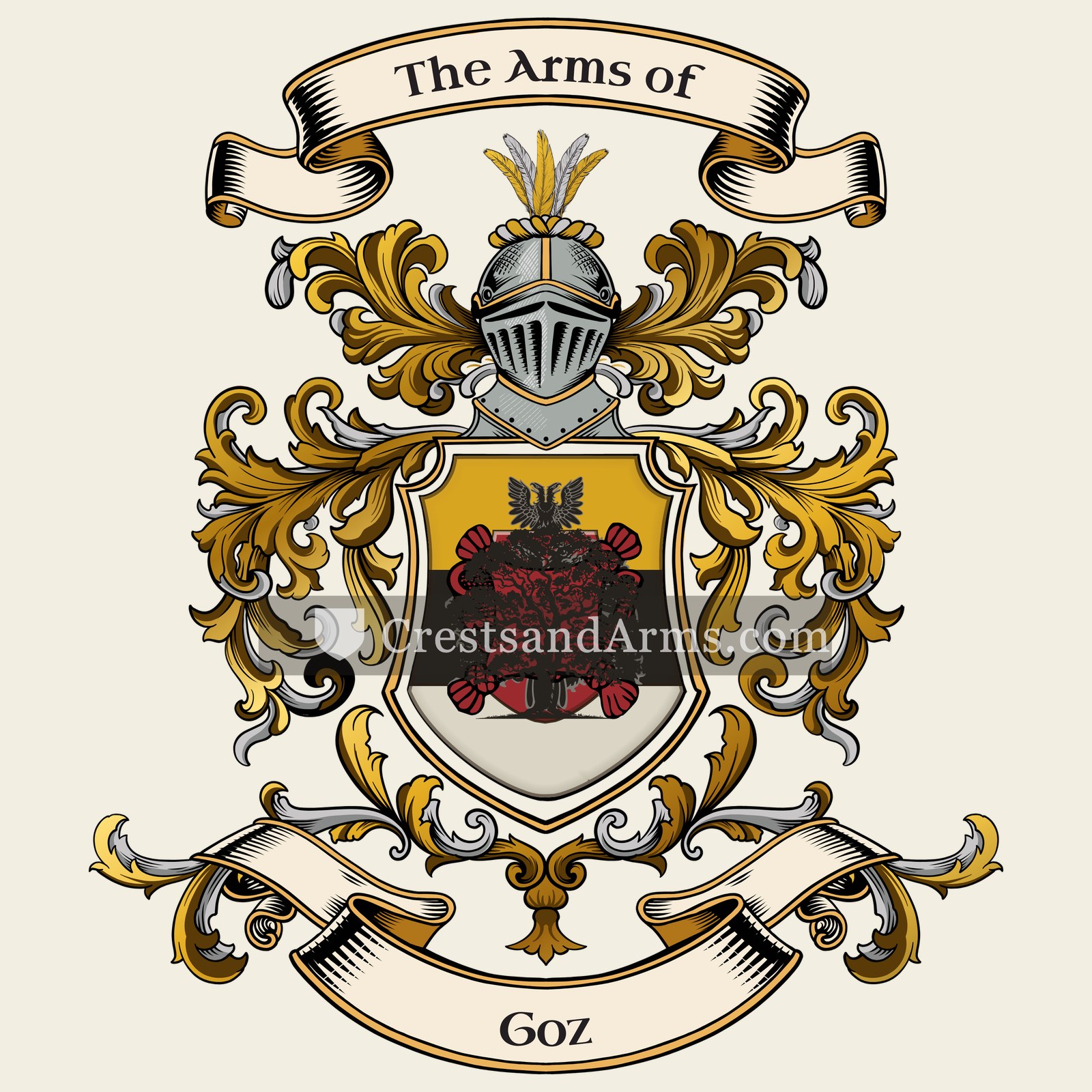


 mulletThe third son, and a divine quality from above