Map of France showing where the Graham arms are recorded
The Graham arms were recorded in France, c. 1725.
Arms such as these were typically recorded in Bretagne.
More families held coats of arms in Bretagne than anywhere else in France. The land was divided into many small estates rather than a few large ones, so far more households counted as gentry, and each needed a shield of its own to be told apart.
This is where the arms were entered in the register. Families often moved to other parts of the country, so the same name can turn up in more than one region.
The body that granted and recorded arms in France in this period.
Louis XV of France
Sovereign of the period
Louis XV of France
1715–1774
Reigning in France when the Graham arms are first recorded.
How Arms Worked in France
In France, a coat of arms was a mark of honor that passed down through the male line to all legitimate descendants. Families often used the same shield without changes to show their shared heritage. If a branch wanted to stand out, they could add a small mark to their shield to show their specific place in the family tree.
Granting authority
The Juge d'armes de France acted as the official authority that regulated and verified coats of arms across the country.
How they got arms
Families typically inherited their arms from ancestors, though they could also receive them through royal grants or by proving their noble status.
Where arms were recorded
Coats of arms were officially recorded in the Armorial Général de France, which began its main collection in the year 1696.
The family's standing
Recorded among the armigerous families of France.
Origin & History of the Graham Family in France
The history of the Graham family in France is deeply tied to the movement of people across the English Channel during the eighteenth century. While the name is famously associated with Scottish origins, members of the family established a notable presence in the Brittany region by 1725. During this period, France served as a destination for families seeking new opportunities or fleeing political instability in the British Isles. These early settlers often integrated into the local French society by adapting their surnames to fit the phonetic patterns of the Breton language. By settling in coastal towns, these individuals frequently engaged in trade and maritime commerce, which allowed them to build stable lives far from their ancestral homes. This transition from their roots to life in France highlights how families adapted to new cultures while maintaining their distinct identity through their name.
Coat of Arms & Family Crest Details
Symbols on this shield
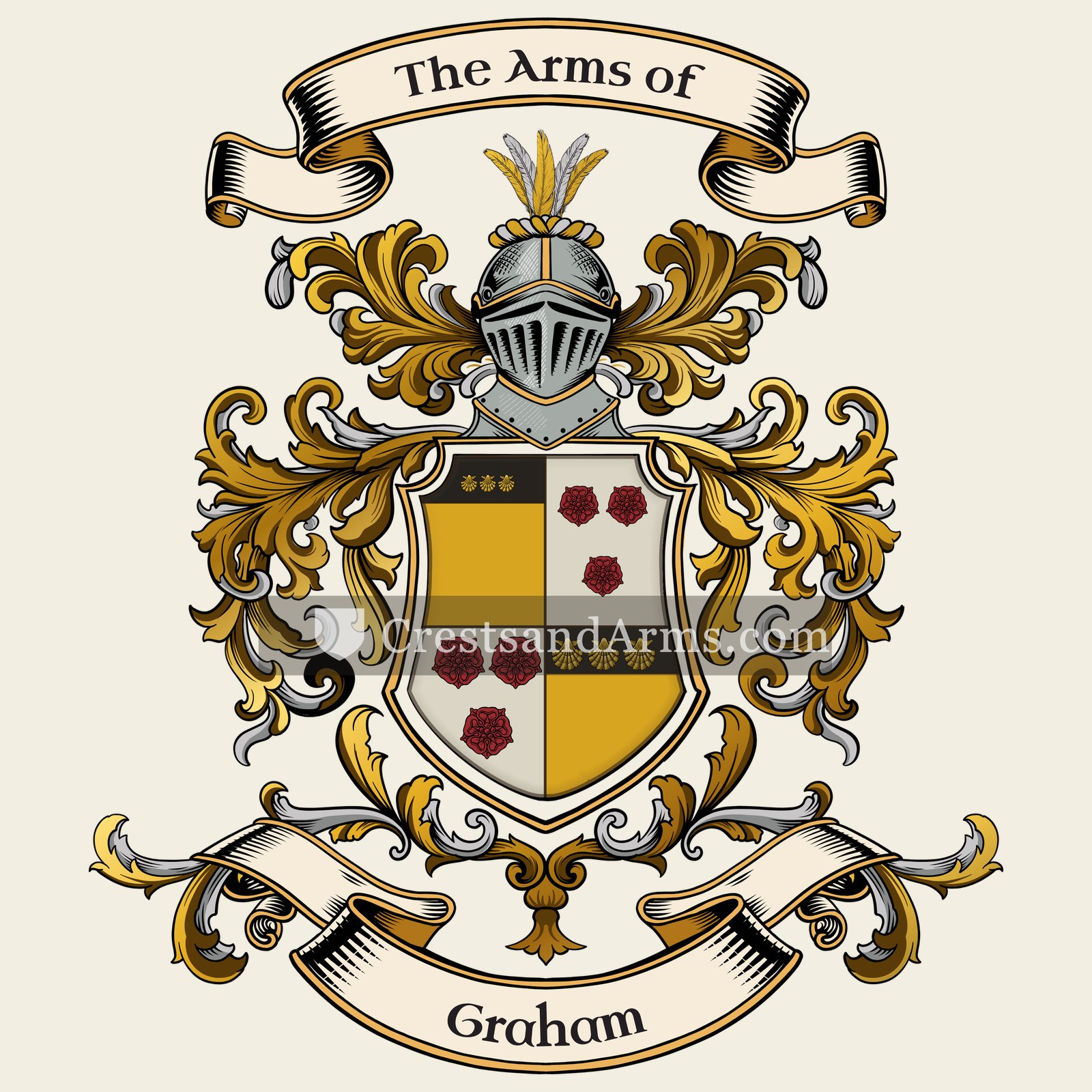
chiefAuthority, wisdom and dominion
escallopThe pilgrim's shell, and a long journey made
roseThe seventh son, and beauty with grace
Colours
Gold (Or)Means: Generosity
Silver (Argent)Means: Peace and sincerity
Black (Sable)Means: Constancy
Red (Gules)Means: Military strength
Historical info
Source
Sir Bernard Burke, The General Armory of England, Scotland, Ireland and Wales, London: Harrison & Sons, 1884
Blazon (the actual original written record)
“Quarterly, 1st and 4th, or, on a chief engr. sa. three escallops of the field; 2nd and 3rd, ar. three roses gu., for MONTROSE”
PerthBraco · Perth, c. 1625
Digital archive packCoat of arms PNG, gold border print PDF, vector SVG and the certificate of authenticity. Sent to your email in minutes.
Map of Scotland showing where the Graham arms are recorded
The Graham arms were recorded in Perth, c. 1625.
Perth sat where the Highlands meet the Lowlands, and its families held land on both sides of that line. Estates passed down whole for centuries, and unbroken tenure is what puts a name in the register.
This is where the arms were entered in the register. Families often moved to other parts of the country, so the same name can turn up in more than one region.
The body that granted and recorded arms in Scotland in this period.
James VI and I
Sovereign of the period
James VI and I
1587–1625
Reigning in France when the Graham arms are first recorded.
How Arms Worked in Scotland
Scottish heraldry is unique because it treats a coat of arms as a piece of personal property protected by law. Only one person can own a specific design at any given time. When a family grows, the head keeps the original shield while other relatives must apply for their own distinct version with slight changes to prove their specific identity.
Granting authority
The Court of the Lord Lyon acts as the official body that regulates and controls all heraldic matters throughout Scotland.
How they got arms
Individuals obtain a legal right to their arms through a formal petition process that confirms their identity and family connection.
Where arms were recorded
All valid coats of arms are officially entered into the Public Register of All Arms and Bearings starting from 1672.
The family's standing
Recorded among the armigerous families of Perth.
Origin & History of the Graham Family in Scotland
The Graham family name has deep roots in the history of Scotland, where it emerged as a prominent surname during the Middle Ages. The name is believed to have originated from the Old English words for a grey home, though it became firmly established within the Scottish Lowlands through land grants and political influence. By the early 17th century, the family had secured a notable presence in the city of Perth. Records from 1625 confirm that members of the Graham family were active participants in the civic and social life of this important Scottish burgh. During this era, families like the Grahams often served in local government or trade guilds, which helped them maintain their status and influence within the community. Over the centuries, the name spread from these urban centers into the wider Scottish countryside, becoming a well-recognized part of the nation's heritage.
Coat of Arms & Family Crest Details
Symbols on this shield
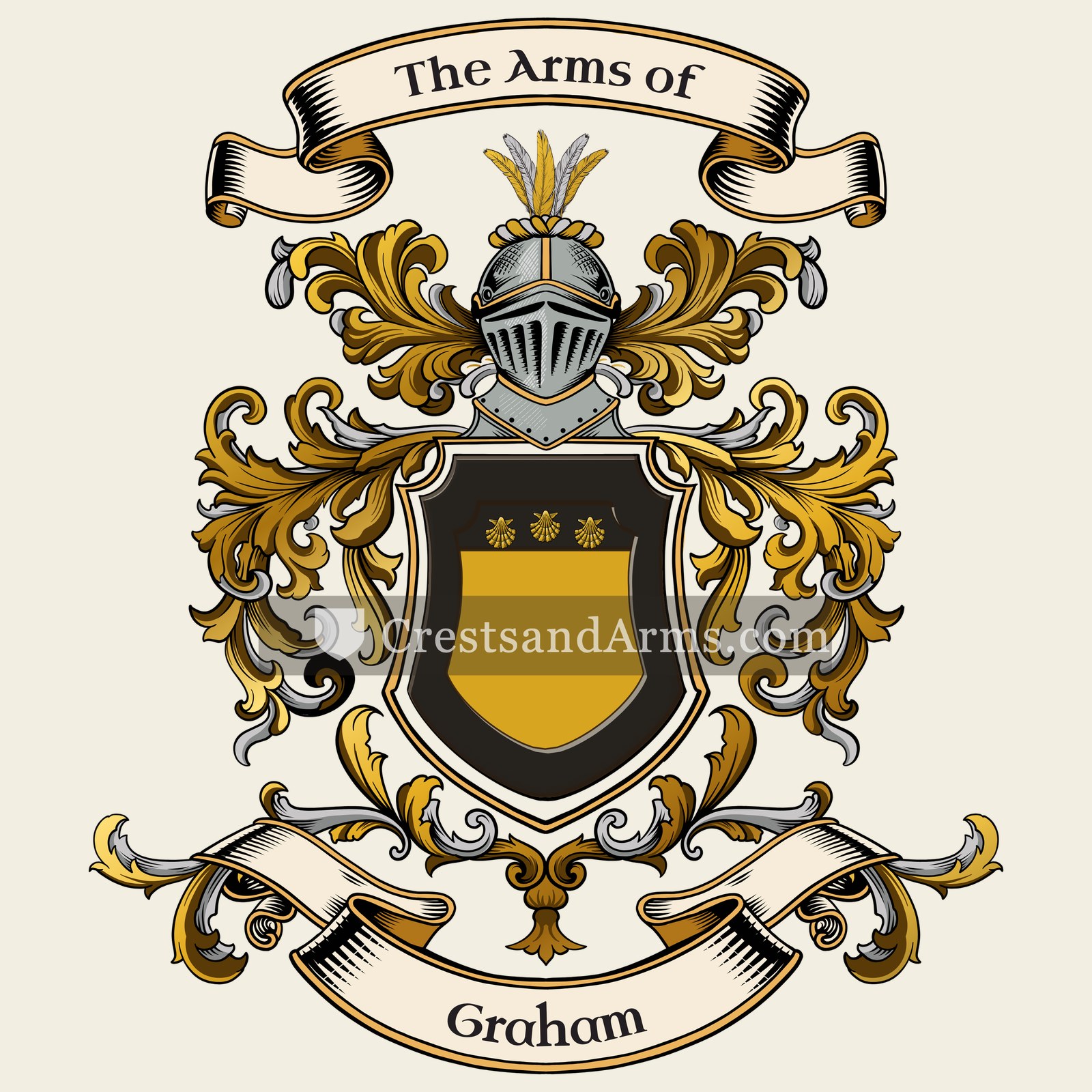
bordureA difference between branches of one family
chiefAuthority, wisdom and dominion
escallopThe pilgrim's shell, and a long journey made
Colours
Gold (Or)Means: Generosity
Black (Sable)Means: Constancy
Historical info
Source
Sir Bernard Burke, The General Armory of England, Scotland, Ireland and Wales, London: Harrison & Sons, 1884
Blazon (the actual original written record)
“Or, a bordure sa. on a chief of the second three escallop shells of the first”
ArmaghArmagh, c. 1645
Digital archive packCoat of arms PNG, gold border print PDF, vector SVG and the certificate of authenticity. Sent to your email in minutes.
Map of Ireland showing where the Graham arms are recorded
The Graham arms were recorded in Armagh, c. 1645.
Armagh was the church capital of Ireland with good farmland around it. Church office and landholding both brought standing, and standing was marked with arms.
This is where the arms were entered in the register. Families often moved to other parts of the country, so the same name can turn up in more than one region.
The body that granted and recorded arms in Ireland in this period.
Charles I of England
Sovereign of the period
Charles I of England
1625–1649
Reigning in France when the Graham arms are first recorded.
How Arms Worked in Ireland
The Ulster King of Arms granted coats of arms to individuals who proved their social standing and good character. These symbols were typically inherited by all legitimate descendants of the original holder. If a family branch wanted a unique look, they could apply for a specific change to their design through the office to ensure their identity remained distinct.
Granting authority
The Ulster King of Arms acted as the official body that regulated and issued all coats of arms throughout Ireland.
How they got arms
Families obtained their arms through formal grants issued by the office after proving their eligibility and paying the required fees.
Where arms were recorded
All official grants were recorded in the registers held by the Ulster King of Arms starting from the year 1552.
The family's standing
Recorded among the armigerous families of Armagh.
Origin & History of the Graham Family in Ireland
The Graham family name arrived in Ireland primarily as part of the seventeenth-century migrations from the Scottish Borders. By 1645, records confirm that members of the family had established a notable presence in County Armagh. These settlers were often part of the broader Plantation of Ulster, a government-led effort to encourage British migration to the region. Many Grahams in this area were descendants of the "Border Reivers," a group known for their rugged independence and history of living in the disputed territories between Scotland and England. Once they relocated to Ireland, these families integrated into the local community and transitioned from their traditional border lifestyle to agricultural and civic life. Their presence in Armagh during the mid-1600s highlights the complex movement of people across the Irish Sea during a period of significant political and social change.
Graham Meaning & Related Branches
Root word
Grand
Old French word meaning large, great, or tall.
This name
GrahamA locational surname derived from Grantham, meaning gravelly homestead or great settlement.
also spelled
Grahm
Gram
Graeme
Grame
Related arms
Greamevariant spelling
Brownerecorded with Graham, same area
Brucerecorded with Graham, same area
Campbellrecorded with Graham, same area
Documented Sources
J. B. Rietstap, Armorial Général, Gouda: G. B. van Goor Zonen, 1884–87
Archives départementales d'Ille-et-Vilaine, État civil et registres paroissiaux
Baudry, Patrick, Les migrations britanniques en Bretagne au XVIIIe siècle, 1998
Le Gall, Jean-Marie, Les étrangers en France sous l'Ancien Régime, 2005
Digital archive packCoat of arms PNG, gold border print PDF, vector SVG and the certificate of authenticity. Sent to your email in minutes.


 pileWell-doing, and a mark of distinction
 chiefAuthority, wisdom and dominion
 escallopThe pilgrim's shell, and a long journey made
 pileWell-doing, and a mark of distinction
 chiefAuthority, wisdom and dominion
 escallopThe pilgrim's shell, and a long journey made
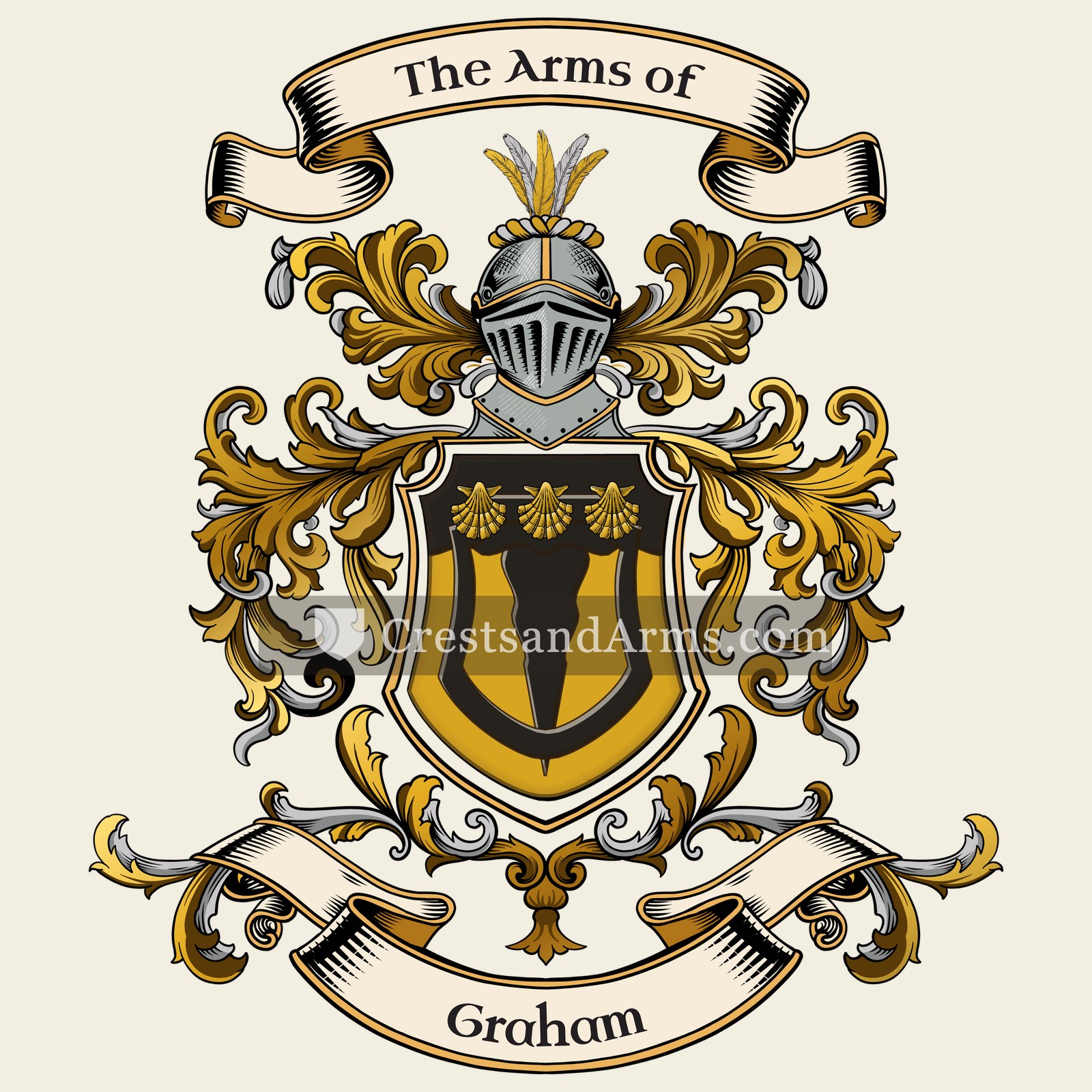


 roseThe seventh son, and beauty with grace


 bordureA difference between branches of one family