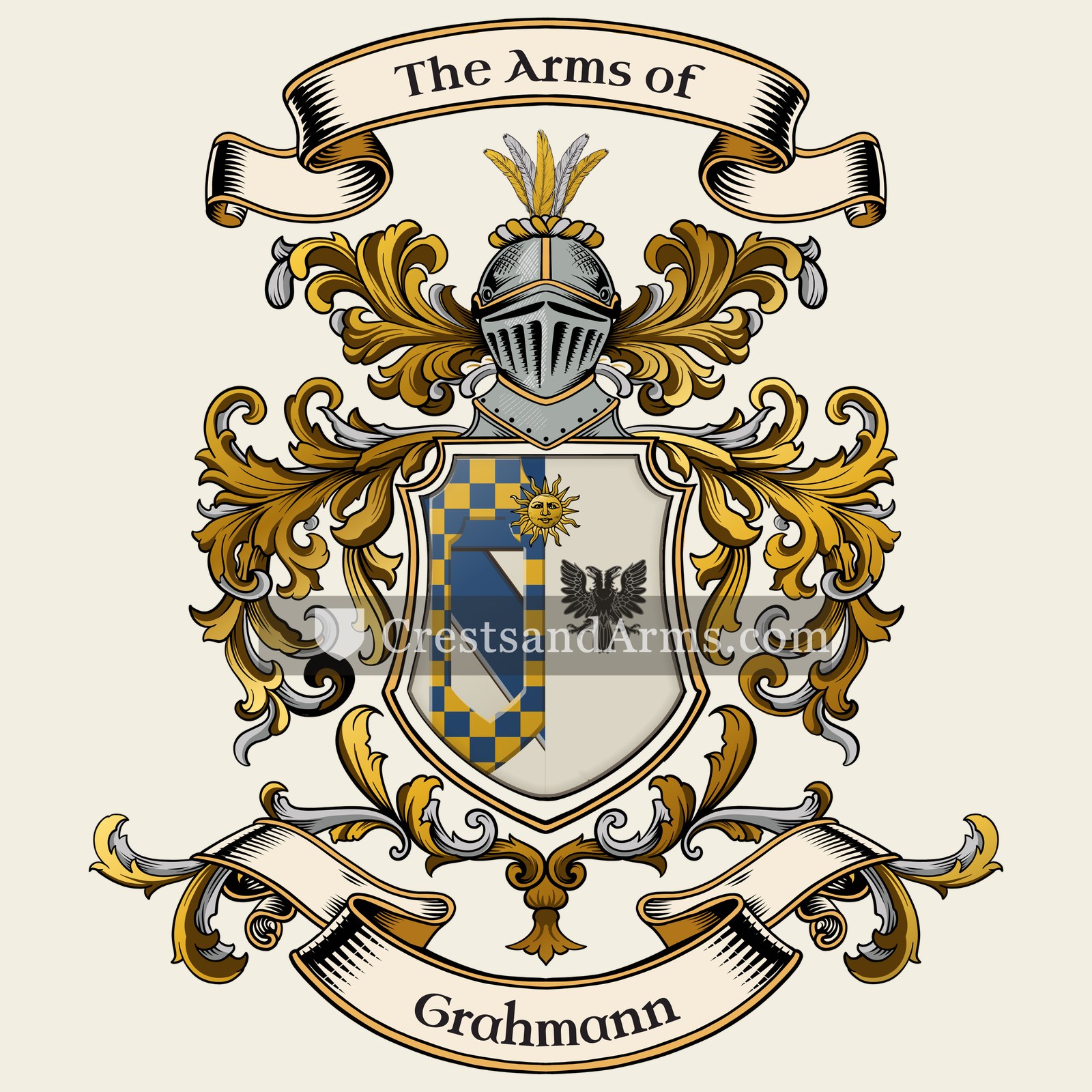
A record of documented arms, meaning and origin, researched for the Grahmann family of Russia.
Reg. 8313 · Russian, G–I
Coat of Arms & Family Crest Details
Symbols on this shield
bendDefence, and the scarf of a commander
chiefAuthority, wisdom and dominion
sunGlory, splendour and the source of life
fleur de lisPurity, light, and the sixth son
eagleNobility, strength and a keen mind
Colours
Silver (Argent)Means: Peace and sincerity
Blue (Azure)Means: Loyalty and truth
Gold (Or)Means: Generosity
Black (Sable)Means: Constancy
Historical info
Source
J. B. Rietstap, Armorial Général, Gouda: G. B. van Goor Zonen, 1884–87
Blazon (the actual original written record)
“Parti: au 1 d'arg. à deux bandes d'azur, ch. chacune de deux fleurs-de-lis d'or; chaque fleur-de-lis posée en pal; au 2 d'arg. à la demi-aigle de sa., mouv. du parti. Au chef de l'écu d'azur, br. sur le parti et ch. d'un soleil d'or, duquel sortent quatre foudres du même dans la direction d'un saut. Brl. d'or, d'azur, d'arg. et de sa. C.: le soleil. L.: à dextre d'arg. et de sa., à sen. d'or et d'azur.”
RussiaEsthonie, c. 1784
Digital archive packCoat of arms PNG, gold border print PDF, vector SVG and the certificate of authenticity. Sent to your email in minutes.
Map of Russia showing where the Grahmann arms are recorded
The Grahmann arms were recorded in Esthonie, c. 1784.
Arms such as these were typically recorded in Moscow.
Moscow held the Russian court, and rank there came from service rather than land. Families who served the Tsar were entered in the registers of nobility, and that entry is where their arms are recorded.
This is where the arms were entered in the register. Families often moved to other parts of the country, so the same name can turn up in more than one region.
The body that granted and recorded arms in Russia in this period.
Catherine II of Russia
Sovereign of the period
Catherine II of Russia
1762–1796
Reigning in Russia when the Grahmann arms are first recorded.
How Arms Worked in Russia
Russian heraldry was strictly tied to the nobility and the state service system. Families proved their ancient status or earned new rank to receive an official grant from the Tsar. These symbols were then inherited by all legitimate children of the noble line. If a family lacked proof of their status, they were often excluded from the official records entirely.
Granting authority
The Herald Master's Office acted as the central state body that strictly regulated and verified all noble heraldic symbols.
How they got arms
Families typically received their arms through a formal state grant or by proving their noble status to the government authorities.
Where arms were recorded
All approved coats of arms were officially recorded in the General Armorial of the Noble Families of the Russian Empire starting in 1797.
The family's standing
Recorded among the armigerous families of Russia.
Origin & History of the Grahmann Family in Russia
The family name Grahmann originates from the German-speaking regions of Central Europe, where it was likely used to identify individuals who lived near or worked on gray-colored land or soil. By the late 18th century, members of the family had moved eastward, establishing a documented presence in Moscow by 1784. This migration was part of a broader movement of skilled artisans, merchants, and professionals who traveled from German lands to the Russian Empire during the reign of Catherine the Great. These early Grahmanns in Moscow were part of a growing expatriate community that contributed to the city's commercial and cultural development. Over time, the family integrated into the local society while maintaining their distinct surname, which serves as a linguistic link to their ancestral roots in the German-speaking territories.
Grahmann Meaning & Related Branches
Root word
Gram
A German term referring to a person of somber or serious nature.
This name
GrahmannA surname indicating a descendant of someone characterized by a grave or serious demeanor.
also spelled
Grahman
Graman
Documented Sources
J. B. Rietstap, Armorial Général, Gouda: G. B. van Goor Zonen, 1884–87
Bahlow, Hans, Deutsches Namenlexikon: Familien- und Vornamen nach Ursprung und Sinn erklärt, 1967
Kappeler, Andreas, Rußland als Vielvölkerreich: Entstehung, Geschichte, Zerfall, 1992
Russian State Historical Archive (Rossiyskiy Gosudarstvennyy Istoricheskiy Arkhiv), Fond 1343: Records of the Department of Heraldry of the Governing Senate (containing genealogical files of foreign families in the Russian Empire)
Digital archive packCoat of arms PNG, gold border print PDF, vector SVG and the certificate of authenticity. Sent to your email in minutes.


 bendDefence, and the scarf of a commander
 chiefAuthority, wisdom and dominion
 sunGlory, splendour and the source of life
 fleur de lisPurity, light, and the sixth son
 eagleNobility, strength and a keen mind
 bendDefence, and the scarf of a commander
 chiefAuthority, wisdom and dominion
 sunGlory, splendour and the source of life
 fleur de lisPurity, light, and the sixth son
 eagleNobility, strength and a keen mind