Map of Switzerland showing where the Graley arms are recorded
The Graley arms were recorded in Fribourg, c. 1745.
This is where the arms were entered in the register. Families often moved to other parts of the country, so the same name can turn up in more than one region.
The body that granted and recorded arms in Switzerland in this period.
How Arms Worked in Switzerland
In Switzerland, coats of arms were not restricted to the nobility and were often adopted by common citizens and families. These symbols were passed down through generations to show family identity. When branches of a family grew, they often changed small details of the design to distinguish their own line from the original group.
Granting authority
Cantonal and civic authorities managed the use of coats of arms within their specific regions and local jurisdictions.
How they got arms
Families typically assumed their own coats of arms based on local custom rather than receiving them from a central monarch.
Where arms were recorded
Arms were recorded in various cantonal and civic registers starting from the fourteenth century throughout the Swiss region.
The family's standing
Recorded among the armigerous families of Switzerland.
Origin & History of the Graley Family in Switzerland
The Graley family name has deep roots tied to the region of Fribourg, Switzerland, where records confirm their presence by the year 1745. During this period, Fribourg was a center of agricultural and craft production, and families like the Graleys were often integrated into the local parish systems that managed daily life and record-keeping. The name likely evolved from regional dialects common in the Swiss plateau, where surnames were frequently adapted to reflect a family's trade, a specific geographic feature of their home, or a nickname used by neighbors. As the family established themselves in this alpine environment, they became part of the social fabric of the canton, contributing to the local economy and the steady growth of the community. Over time, the family name served as a marker of their identity and their long-standing connection to the traditions and history of the Fribourg area.
Related Branches & Arms
Root word
Graal
A medieval term for a cup, vessel, or chalice.
This name
GraleyLikely a topographic or occupational name referring to someone associated with a vessel or cup.
also spelled
Grolay
Documented Sources
J. B. Rietstap, Armorial Général, Gouda: G. B. van Goor Zonen, 1884–87
Archives de l'État de Fribourg, Registres paroissiaux de Fribourg, 1745
Boschung, Urs, Historisches Lexikon der Schweiz, 2006
Digital archive packCoat of arms PNG, gold border print PDF, vector SVG and the certificate of authenticity. Sent to your email in minutes.


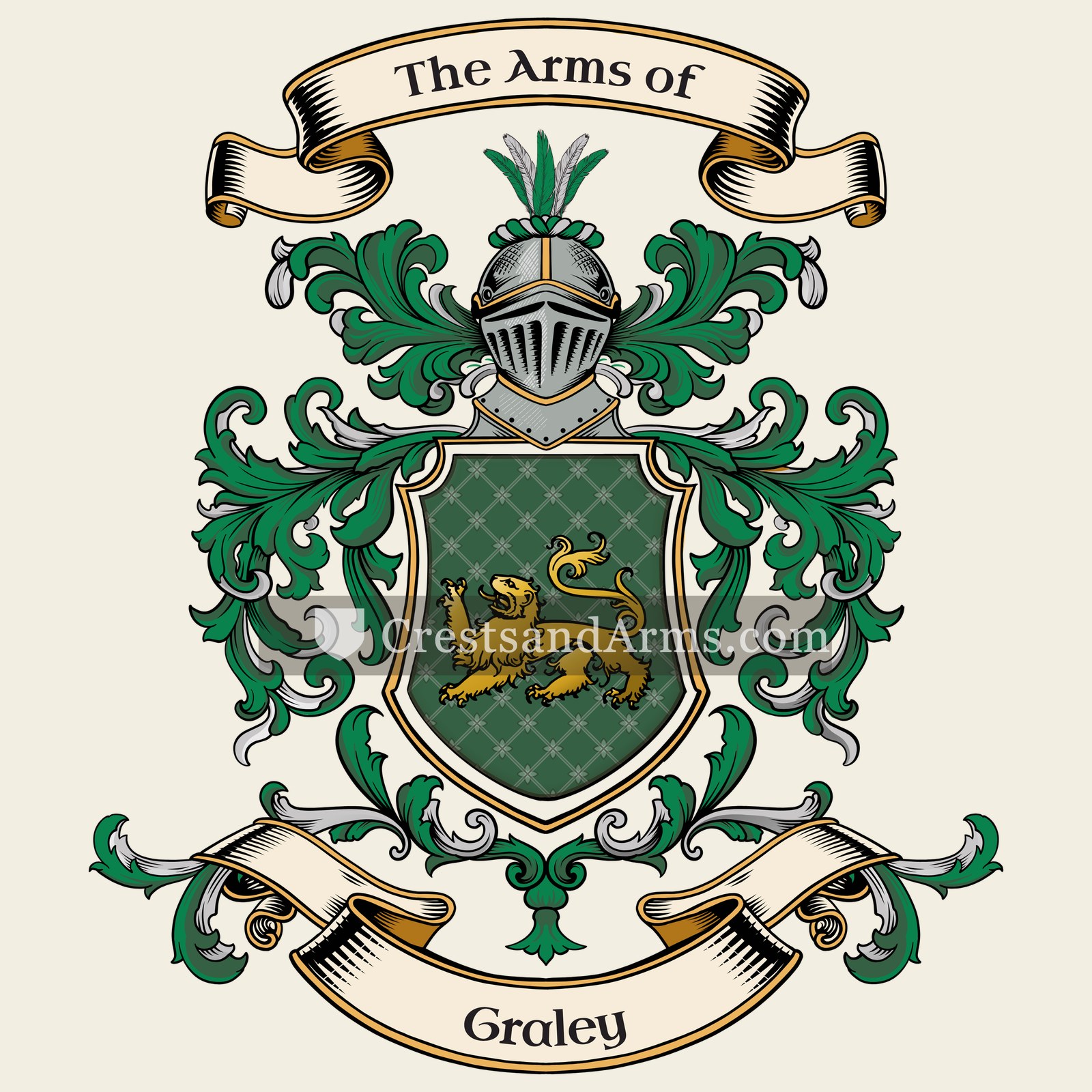
 lionCourage, strength and royalty
 lionCourage, strength and royalty