Map of Spain showing where the Gralla arms are recorded
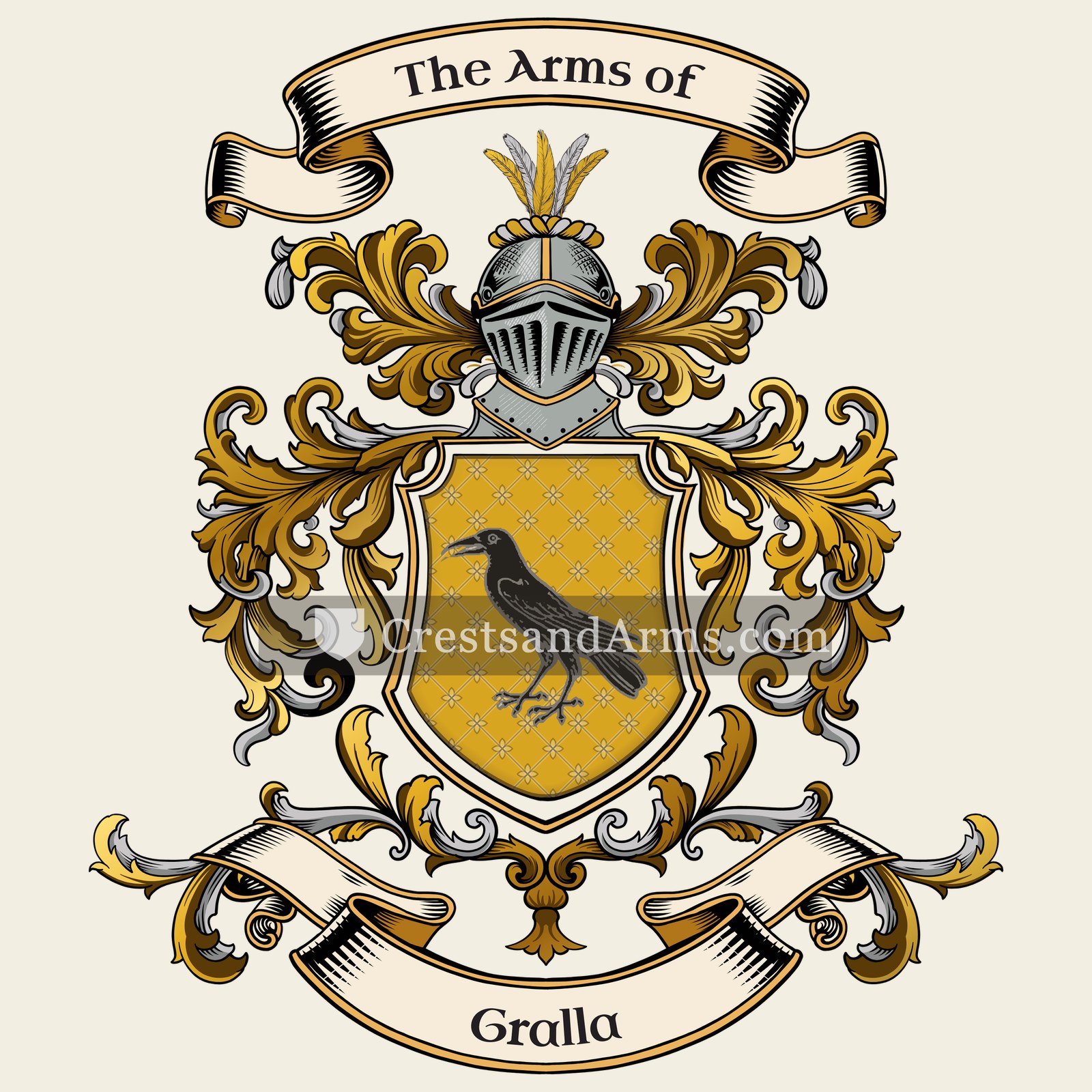
The Gralla arms were recorded in Catalonia, c. 1722.
Catalonia lived by sea trade, and its merchant houses were as powerful as its landowners. Both sorts of family took arms, and Barcelona kept records of the houses entitled to bear them.
This is where the arms were entered in the register. Families often moved to other parts of the country, so the same name can turn up in more than one region.
The body that granted and recorded arms in Spain in this period.
Philip V of Spain
Sovereign of the period
Philip V of Spain
1714–1724
Reigning in Spain when the Gralla arms are first recorded.
How Arms Worked in Spain
In Spain, a coat of arms was considered a form of property that belonged to the entire family line. These arms were passed down from a father to all his children equally. Younger branches of the family usually kept the original design without needing to add any special marks to distinguish their specific line.
Granting authority
The Cronista Rey de Armas was the official body that regulated and granted coats of arms throughout Spain.
How they got arms
Families often obtained their arms through royal grants or by proving their noble status to the official heraldic authority.
Where arms were recorded
Coats of arms were officially recorded in the registers of the Cronista Rey de Armas starting in 1496.
The family's standing
Recorded among the armigerous families of Catalonia.
Origin & History of the Gralla Family in Spain
The family name Gralla finds its historical roots in the northeastern region of Catalonia, where members of the lineage were firmly established by the early eighteenth century. The name itself is linked to the Catalan word for a traditional double-reed woodwind instrument, which suggests that the earliest ancestors may have been associated with music or local folk performances. During the 1700s, families bearing this name were often integrated into the social fabric of rural and urban Catalan communities, where they worked as landowners, artisans, or local officials. As the family grew, they became part of the regional history of Spain, reflecting the cultural shifts and economic developments that defined Catalonia during the Enlightenment. By maintaining a presence in this area for centuries, the Gralla family helped preserve the unique linguistic and social traditions of their homeland.
Gralla Meaning & Related Branches
Root word
Graculus
Latin term for a jackdaw or a type of crow.
This name
GrallaRefers to a person who played the shawm, a medieval woodwind instrument.
also spelled
Grala
Documented Sources
J. B. Rietstap, Armorial Général, Gouda: G. B. van Goor Zonen, 1884–87
Alcover, Antoni M. and Moll, Francesc de B., Diccionari català-valencià-balear, 1962
Arxiu de la Corona d'Aragó, Registres de la Reial Audiència de Catalunya, 1722
Moll, Francesc de B., Els llinatges catalans, 1959
Digital archive packCoat of arms PNG, gold border print PDF, vector SVG and the certificate of authenticity. Sent to your email in minutes.


 ravenConstancy and divine providence
 ravenConstancy and divine providence