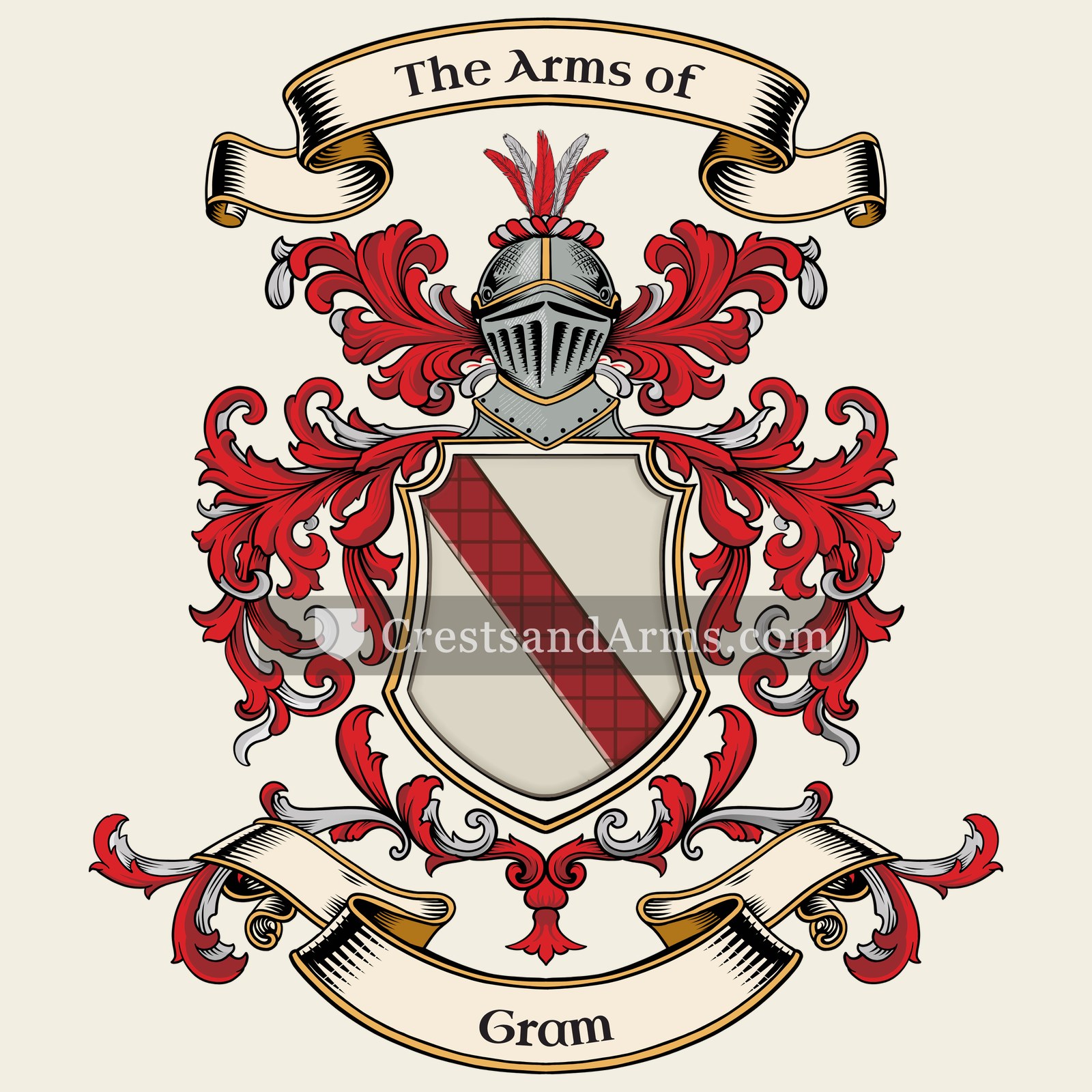
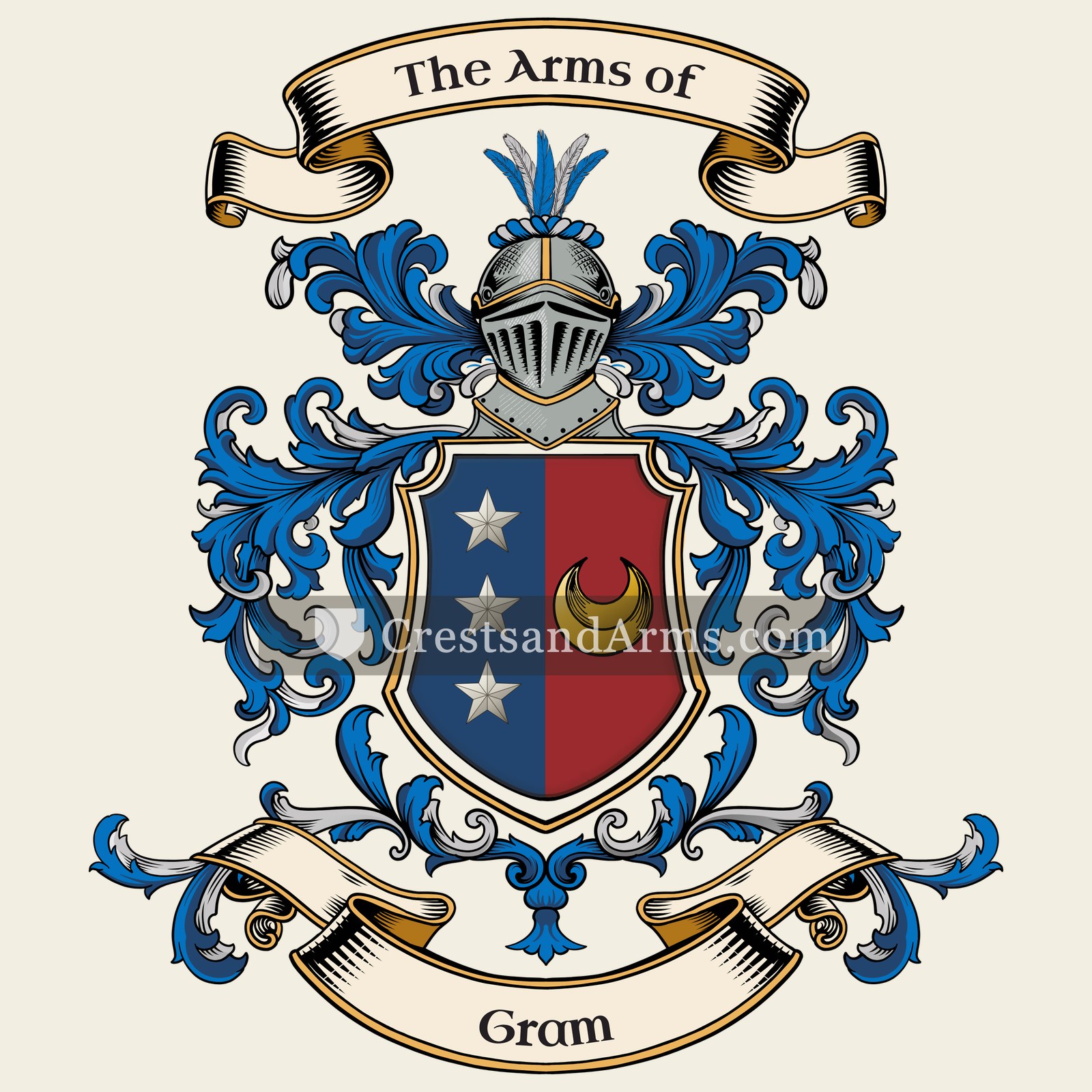
A record of documented arms, meaning and origin, researched for the Gram family lines. Documented in 2 countries.
Reg. 3437 · Dutch, G–I
Coat of Arms & Family Crest Details
Symbols on this shield
bendDefence, and the scarf of a commander
Colours
Silver (Argent)Means: Peace and sincerity
Red (Gules)Means: Military strength
Historical info
Source
J. B. Rietstap, Armorial Général, Gouda: G. B. van Goor Zonen, 1884–87
Blazon (the actual original written record)
“D'arg. à trois bandes de gu.”
Netherlandsc. 1815
Where the Gram Arms Were Recorded
Friesland
Map of Netherlands showing where the Gram arms are recorded
The Gram arms were recorded in Netherlands, c. 1815.
Arms such as these were typically recorded in Friesland.
Friesland was low, wet country on the northern coast of the Netherlands, farmed by families who had held the same land for centuries. Free landholders were unusually common there, and a free landholder could carry arms.
This is where the arms were entered in the register. Families often moved to other parts of the country, so the same name can turn up in more than one region.
Region
Friesland
First recorded
1815
Granting Authority for the Gram Arms
Hoge Raad van Adel
Photograph made by me · CC BY-SA 3.0
The body that granted and recorded arms in Netherlands in this period.
William I of the Netherlands
Sovereign of the period
William I of the Netherlands
1815–1840
Reigning in Netherlands when the Gram arms are first recorded.
How Arms Worked in Netherlands
In the Netherlands, coats of arms were often used by noble families and those who held specific public offices. These arms were passed down through the generations to legitimate descendants. Younger branches of a family usually kept the original design without needing to add special marks. This system ensured that the family identity remained clear and consistent over many years.
Granting authority
The Hoge Raad van Adel is the official body that regulates and manages noble titles and coats of arms in the Netherlands.
How they got arms
Families typically obtained their coats of arms through official royal grants or by proving their long-standing historical use of the symbols.
Where arms were recorded
Coats of arms are officially recorded in the registers held by the Hoge Raad van Adel, which began its work in 1814.
The family's standing
Recorded among the armigerous families of Netherlands.
Origin & History of the Gram Family in Netherlands
The surname Gram carries a distinct history rooted in the northern regions of the Netherlands, particularly within the province of Friesland. By the early 19th century, records confirm that families bearing this name were established members of Frisian society. The name itself is thought to be linked to old Germanic roots, where it often served as a descriptive term or a shortened form of personal names common in the coastal territories of Northern Europe. During the period around 1815, the Netherlands underwent significant administrative changes, including the formal registration of surnames under the Napoleonic civil code. This process helped solidify the use of the name Gram across local census records and civil registries. Families with this name were typically involved in the agricultural and maritime trades that defined the Frisian economy at the time. Their presence in these northern provinces reflects a long tradition of settlement in the low-lying lands near the Wadden Sea, where families often maintained deep local ties for many generations.
Coat of Arms & Family Crest Details
Symbols on this shield
mulletThe third son, and a divine quality from above
crescentHonour by the sovereign, and the second son
Colours
Blue (Azure)Means: Loyalty and truth
Red (Gules)Means: Military strength
Silver (Argent)Means: Peace and sincerity
Gold (Or)Means: Generosity
Historical info
Source
J. B. Rietstap, Armorial Général, Gouda: G. B. van Goor Zonen, 1884–87
Blazon (the actual original written record)
“Parti: au 1 d'azur à trois étoiles d'arg., rangées en pal; au 2 de gu. à un croiss. figuré tourné d'or. C.: une jeune fille iss., hab. de gu., cour. d'or, tenant de sa main dextre étendue une couronne de feuillage de sin.”
Denmarkc. 1722
Where the Gram Arms Were Recorded
Sjaælland
Map of Denmark showing where the Gram arms are recorded
The Gram arms were recorded in Denmark, c. 1722.
Arms such as these were typically recorded in Sjaælland.
Zealand held the Danish court, the crown's offices and Copenhagen itself. Families who served the king kept estates within reach of it, and royal service was the ordinary route to a coat of arms.
This is where the arms were entered in the register. Families often moved to other parts of the country, so the same name can turn up in more than one region.
The body that granted and recorded arms in Denmark in this period.
Frederik IV of Denmark
Sovereign of the period
Frederik IV of Denmark
1699–1730
Reigning in Netherlands when the Gram arms are first recorded.
How Arms Worked in Denmark
Danish heraldry during this period was closely tied to noble status and royal favor rather than being open to all citizens. Arms were typically granted by the monarch to individuals, and these symbols were then shared by all members of the noble house. If a family line died out, the right to use those specific arms ended with them.
Granting authority
The Danish royal chancery held the power to issue and regulate official coats of arms for the kingdom.
How they got arms
Families usually received their arms through a formal royal grant that confirmed their noble status and rights.
Where arms were recorded
These grants were officially recorded in the Danish Royal Chancery records starting in the sixteenth century.
The family's standing
Recorded among the armigerous families of Denmark.
Origin & History of the Gram Family in Denmark
The family name Gram has deep roots in the Danish landscape, with documented evidence placing family members on the island of Sjælland as early as 1722. In the context of Danish naming traditions, the name Gram likely originated as a descriptive nickname or a reference to a specific location, as many surnames during this period were tied to the geography or the personal traits of an ancestor. By the early 18th century, families in Sjælland were often deeply integrated into the local agrarian or administrative systems, and those bearing the name Gram were part of the social fabric that defined rural Danish life. As the family grew, they moved through the parishes of the region, leaving traces in church records and census documents that help historians track their movement across the island. This history reflects the broader transition of Danish society, where families began to solidify their identities through stable surnames that were passed down through generations.
Related Branches & Arms
Root word
Grimr
Old Norse term meaning masked, helmeted, or fierce.
This name
GramA topographic or occupational name referring to a person who is stern, fierce, or wears a mask.
also spelled
Gramm
Graam
Gramme
Related arms
de Langesimilar arms
Rausimilar arms
Salmena de' Salimbenisimilar arms
Documented Sources
J. B. Rietstap, Armorial Général, Gouda: G. B. van Goor Zonen, 1884–87
Tresoar (Fries Historisch en Letterkundig Centrum), Burgerlijke Stand van Friesland
Hofstee, E.W., Nederlandse bevolkingsstatistiek in het verleden, 1978
Meertens Instituut, Nederlandse Familienamenbank, 2023
Digital archive packCoat of arms PNG, gold border print PDF, vector SVG and the certificate of authenticity. Sent to your email in minutes.


 bendDefence, and the scarf of a commander
 bendDefence, and the scarf of a commander

 mulletThe third son, and a divine quality from above
 crescentHonour by the sovereign, and the second son