A record of documented arms, meaning and origin, researched for the Graner family lines. Documented in 2 countries.
Reg. 1163 · German, G–I
Coat of Arms & Family Crest Details
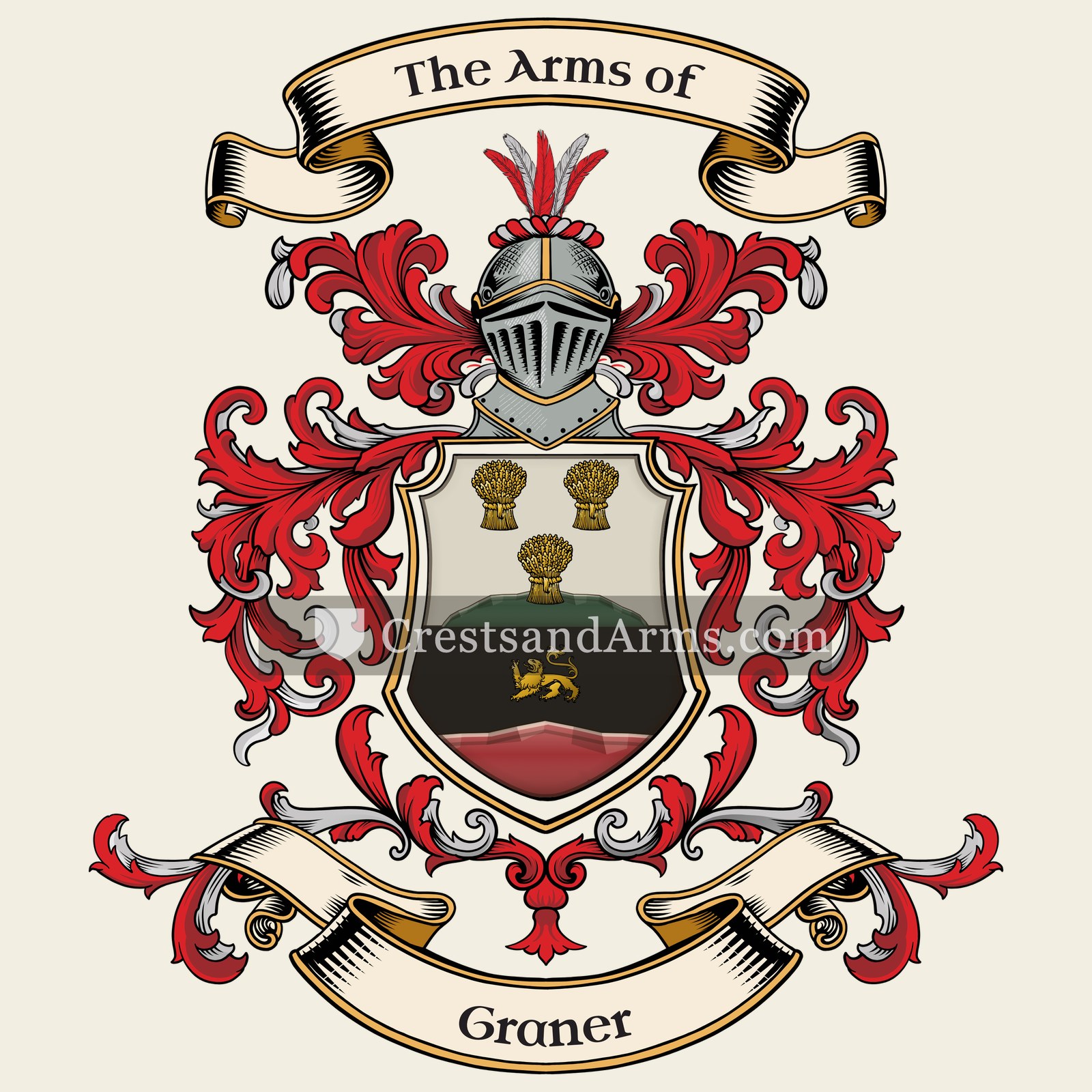
Symbols on this shield
mountThe ground held, and steadfastness upon it
wheatsheafPlenty, and the harvest of one's own labour
lionCourage, strength and royalty
Colours
Silver (Argent)Means: Peace and sincerity
Black (Sable)Means: Constancy
Red (Gules)Means: Military strength
Green (Vert)Means: Hope
Gold (Or)Means: Generosity
Historical info
Source
J. B. Rietstap, Armorial Général, Gouda: G. B. van Goor Zonen, 1884–87
Blazon (the actual original written record)
“Coupé: au 1 d'arg. à trois épis feuillés d'or, mouv. d'un tertre de gu.; au 2 de sa. au lion léopardé d'or. Cq. cour. C.: le lion léopardé, iss. L.: à dextre d'or et de sa., à sen. d'arg. et de gu.”
GermanyNuremberg, c. 1765
Where the Graner Arms Were Recorded
Nuremberg
Map of Germany showing where the Graner arms are recorded
The Graner arms were recorded in Nuremberg, c. 1765.
This is where the arms were entered in the register. Families often moved to other parts of the country, so the same name can turn up in more than one region.
The body that granted and recorded arms in Germany in this period.
Francis I, Holy Roman Emperor
Sovereign of the period
Francis I, Holy Roman Emperor
1745–1765
Reigning in Germany when the Graner arms are first recorded.
How Arms Worked in Germany
In the Holy Roman Empire, coats of arms were often granted to individuals by the Emperor or his representatives. These arms were then passed down through the generations to all legitimate descendants of the original holder. Younger branches of a family usually kept the same shield design without needing to change it, as the arms belonged to the entire lineage.
Granting authority
The Holy Roman Emperor held the sole power to grant new coats of arms throughout his vast imperial territories.
How they got arms
Families typically obtained their coats of arms through a formal imperial grant or by proving their noble status to the authorities.
Where arms were recorded
These grants were officially recorded in the Imperial Chancery registers, which began keeping formal records of such honors during the Middle Ages.
The family's standing
Recorded among the armigerous families of Germany.
Origin & History of the Graner Family in Germany
The surname Graner is deeply rooted in the historical landscape of southern Germany, where it functioned as a topographic or occupational descriptor. In the Middle Ages, names were often derived from a person’s surroundings or their specific trade, and the name Graner likely evolved from the Middle High German word *gran*, which referred to a grain or a specific type of bearded wheat. This suggests that the earliest ancestors of the family were likely involved in the agricultural trade or lived near a prominent granary. By the time the family was firmly established in the imperial city of Nuremberg in 1765, the name had become a stable identifier for citizens participating in the city’s vibrant urban economy. During this period, Nuremberg was a major center for craftsmanship and trade, and families like the Graners were part of the growing middle class that helped sustain the city’s reputation for industry. The transition from a simple descriptive nickname to a formal family name reflects the broader shift in German society toward organized record-keeping and established lineage.
Coat of Arms & Family Crest Details
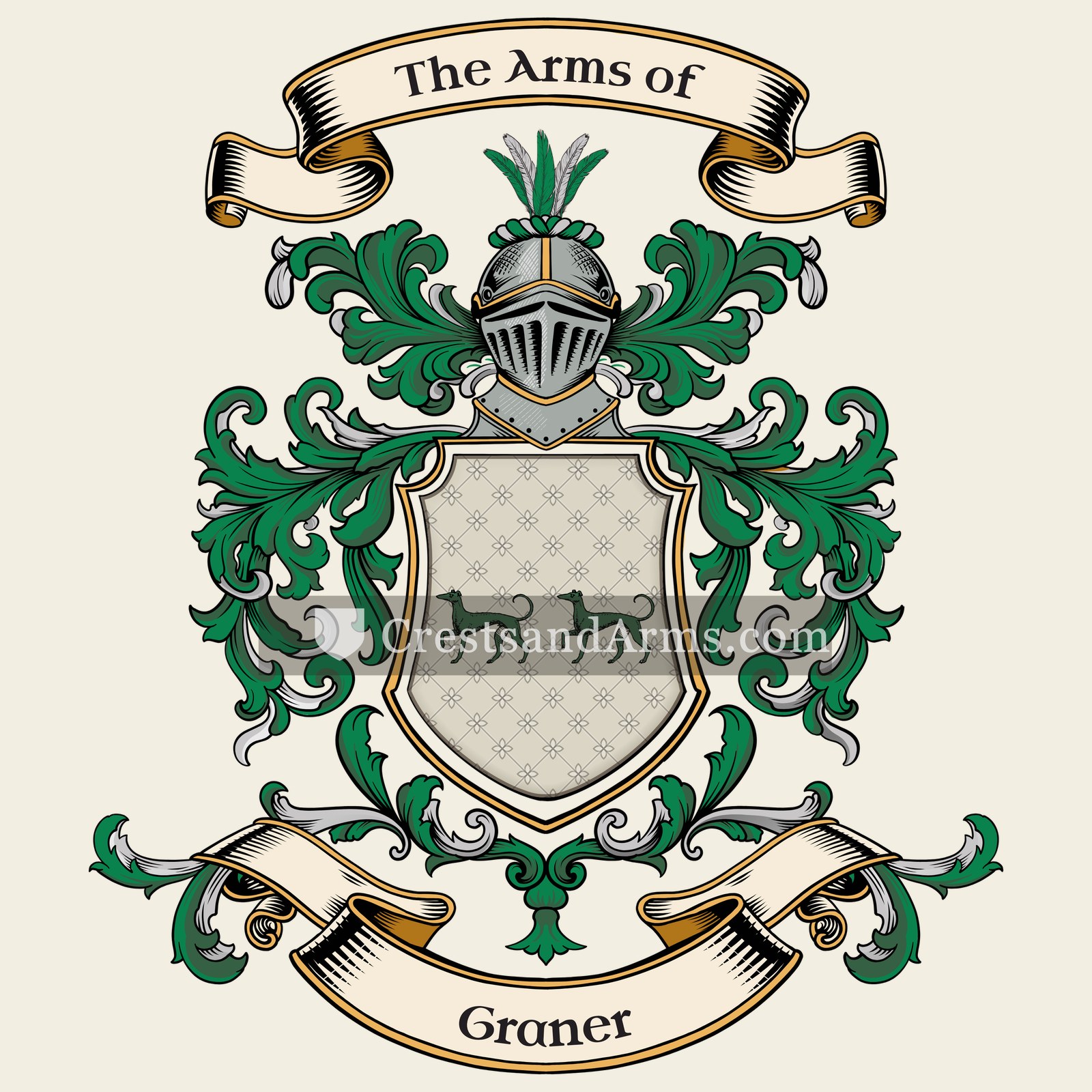
Symbols on this shield
greyhoundCourage, vigilance and loyalty
Colours
Silver (Argent)Means: Peace and sincerity
Green (Vert)Means: Hope
Historical info
Source
J. B. Rietstap, Armorial Général, Gouda: G. B. van Goor Zonen, 1884–87
Blazon (the actual original written record)
“D'arg. à un gabion d'azur, supporté par deux lévriers de sin.”
CataloniaCatalonia, c. 1722
Where the Graner Arms Were Recorded
Catalonia
Map of Spain showing where the Graner arms are recorded
The Graner arms were recorded in Catalonia, c. 1722.
Catalonia lived by sea trade, and its merchant houses were as powerful as its landowners. Both sorts of family took arms, and Barcelona kept records of the houses entitled to bear them.
This is where the arms were entered in the register. Families often moved to other parts of the country, so the same name can turn up in more than one region.
The body that granted and recorded arms in Spain in this period.
Philip V of Spain
Sovereign of the period
Philip V of Spain
1714–1724
Reigning in Germany when the Graner arms are first recorded.
How Arms Worked in Spain
In Spain, a coat of arms was considered a form of property that belonged to the entire family line. These arms were passed down from a father to all his children equally. Younger branches of the family usually kept the original design without needing to add any special marks to distinguish their specific line.
Granting authority
The Cronista Rey de Armas was the official body that regulated and granted coats of arms throughout Spain.
How they got arms
Families often obtained their arms through royal grants or by proving their noble status to the official heraldic authority.
Where arms were recorded
Coats of arms were officially recorded in the registers of the Cronista Rey de Armas starting in 1496.
The family's standing
Recorded among the armigerous families of Catalonia.
Origin & History of the Graner Family in Spain
The surname Graner has deep roots in the Catalonia region of Spain, where records confirm the family was established by at least 1722. The name is likely derived from the Catalan word for a granary or a person who worked with grain, suggesting that the earliest ancestors were involved in the vital agricultural trade of the Mediterranean landscape. During the early 18th century, Catalonia was a hub of economic transition following the War of the Spanish Succession, and families like the Graners were often tied to the land and the local parish communities that defined social life. By settling in this region, the family became part of a distinct cultural identity that valued local traditions and the development of rural estates. These early generations helped shape the local economy by managing harvests and maintaining the infrastructure necessary to store and distribute food for their growing communities.
Related Branches & Arms
Root word
Gran
A Middle High German term referring to grain or corn.
This name
GranerAn occupational surname for a person who worked as a grain merchant or farmer.
also spelled
Granier
Granner
Related arms
Graniervariant spelling
Grannervariant spelling
Documented Sources
J. B. Rietstap, Armorial Général, Gouda: G. B. van Goor Zonen, 1884–87
Bahlow, Hans, Deutsches Namenlexikon: Familien- und Vornamen nach Ursprung und Sinn erklärt, 1967
Heintze, Albert, Die deutschen Familiennamen: geschichtlich, geographisch, sprachlich, 1903
Stadtarchiv Nürnberg, Bürgerbücher der Reichsstadt Nürnberg
Digital archive packCoat of arms PNG, gold border print PDF, vector SVG and the certificate of authenticity. Sent to your email in minutes.


 mountThe ground held, and steadfastness upon it
 wheatsheafPlenty, and the harvest of one's own labour
 lionCourage, strength and royalty
 mountThe ground held, and steadfastness upon it
 wheatsheafPlenty, and the harvest of one's own labour
 lionCourage, strength and royalty

 greyhoundCourage, vigilance and loyalty